
Join Our JEE Preparation Group
Prep with like-minded aspirants; Get access to free daily tests and study material.
Sign in
Please select an account to continue using cracku.in
↓ →
Join Our JEE Preparation Group
Prep with like-minded aspirants; Get access to free daily tests and study material.
A pair of fair dice is thrown independently three times. The probability of getting a score of exactly 9 twice is
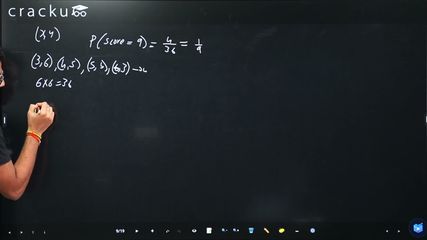
The outcome for a pair of fair dice can be represented as the ordered pair $$(x,y)$$ with $$x,y \in \{1,2,\dots,6\}$$, giving $$6 \times 6 = 36$$ equally likely results.
Step 1: Favourable cases for a score of 9.
A sum of $$9$$ occurs for the pairs $$(3,6), (4,5), (5,4), (6,3)$$—exactly $$4$$ outcomes.
Hence, for a single throw of the two dice,
$$P(\text{score } 9) = \frac{4}{36} = \frac{1}{9}, \qquad P(\text{score }\neq 9) = 1 - \frac{1}{9} = \frac{8}{9}.$$
Step 2: Model the three independent throws.
Let “success’’ mean “score is 9’’. We need exactly two successes in three trials, which follows the binomial distribution:
$$P(\text{exactly } 2 \text{ scores of } 9) = \binom{3}{2}\left(\frac{1}{9}\right)^{2}\left(\frac{8}{9}\right).$$
Calculate:
$$\binom{3}{2} = 3,\quad \left(\frac{1}{9}\right)^{2} = \frac{1}{81},\quad 3 \times \frac{1}{81} \times \frac{8}{9} = 3 \times \frac{8}{729} = \frac{24}{729}.$$
Simplify $$\frac{24}{729}$$ by dividing numerator and denominator by $$3$$:
$$\frac{24}{729} = \frac{8}{243}.$$
Therefore, the required probability is $$\frac{8}{243}$$.
Option D which is: $$\dfrac{8}{243}$$
Was this solution helpful?
Click on the Email ☝️ to Watch the Video Solution
Create a FREE account and get:
_1.webp)

Educational materials for JEE preparation

Ask our AI anything

AI can make mistakes. Please verify important information.
AI can make mistakes. Please verify important information.
