
Join Our JEE Preparation Group
Prep with like-minded aspirants; Get access to free daily tests and study material.
Sign in
Please select an account to continue using cracku.in
↓ →
Join Our JEE Preparation Group
Prep with like-minded aspirants; Get access to free daily tests and study material.
Let $$a_1, a_2, a_3, \ldots$$ be terms of an A.P. If $$\dfrac{a_1 + a_2 + \cdots + a_p}{a_1 + a_2 + \cdots + a_q} = \dfrac{p^2}{q^2}, p \ne q$$, then $$\dfrac{a_6}{a_{21}}$$ equals
Let the A.P. have first term $$a$$ and common difference $$d$$.
Then the sum of its first $$n$$ terms is
$$S_n=\frac{n}{2}\left[\,2a+(n-1)d\,\right]$$
Using the given condition,
$$\frac{S_p}{S_q}=\frac{p^2}{q^2}\;,\qquad p\neq q$$
substitute the expression for $$S_n$$:
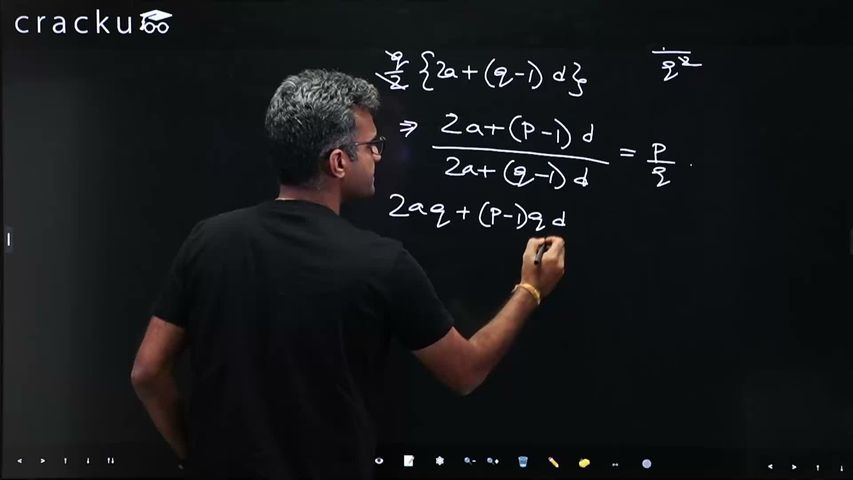
$$\frac{\dfrac{p}{2}\left[\,2a+(p-1)d\,\right]}{\dfrac{q}{2}\left[\,2a+(q-1)d\,\right]}=\frac{p^2}{q^2}$$
Simplify the left-hand side:
$$\frac{p}{q}\;\frac{2a+(p-1)d}{2a+(q-1)d}=\frac{p^2}{q^2}$$
Cancel a factor $$\tfrac{p}{q}$$ from both sides:
$$\frac{2a+(p-1)d}{2a+(q-1)d}=\frac{p}{q}$$
Cross-multiply:
$$q\,[2a+(p-1)d]=p\,[2a+(q-1)d]$$
Expand both sides:
$$2aq+q(p-1)d=2ap+p(q-1)d$$
Bring all terms to one side and collect:
$$2a(q-p)+\bigl[q(p-1)-p(q-1)\bigr]d=0$$
Compute the coefficient of $$d$$:
$$q(p-1)-p(q-1)=qp-q-pq+p=p-q=-(q-p)$$
Hence
$$(q-p)\,[\,2a-d\,]=0$$
Because $$p\neq q$$, we must have
$$2a-d=0\;\;\Longrightarrow\;\;d=2a$$
Now find the sixth and twenty-first terms. The $$n^{\text{th}}$$ term of an A.P. is
$$a_n=a+(n-1)d=a+(n-1)(2a)=a[\,1+2(n-1)\,]=a\,(2n-1)$$
Therefore
$$a_6=a(2\cdot6-1)=a(11)=11a$$
$$a_{21}=a(2\cdot21-1)=a(41)=41a$$
Hence
$$\frac{a_6}{a_{21}}=\frac{11a}{41a}=\frac{11}{41}$$
Option D which is: $$\dfrac{11}{41}$$
Was this solution helpful?
Click on the Email ☝️ to Watch the Video Solution
Create a FREE account and get:
_1.webp)

Educational materials for JEE preparation

Ask our AI anything

AI can make mistakes. Please verify important information.
AI can make mistakes. Please verify important information.
