Join Our JEE Preparation Group
Prep with like-minded aspirants; Get access to free daily tests and study material.
Sign in
Please select an account to continue using cracku.in
↓ →
Join Our JEE Preparation Group
Prep with like-minded aspirants; Get access to free daily tests and study material.
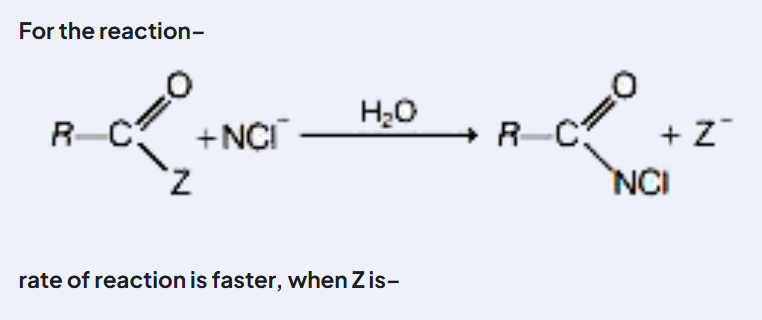
For all reactions that proceed through nucleophilic acyl substitution, the overall rate is governed by how easily the group $$Z$$ bonded to the acyl carbon can depart as the leaving group $$Z^-$$.
The better the leaving group, the lower its basicity (i.e. the more stable it is after departure). Hence, reactivity order of common carboxylic-acid derivatives is:
$$\text{Acyl chloride }(Z = Cl) \;\gt\; \text{Acid anhydride }(Z = OCOR)\;\gt\; \text{Ester }(Z = OC_2H_5)\;\gt\; \text{Amide }(Z = NH_2)$$
Reasons:
1. $$Cl^-$$ is a very weak base (conjugate base of a strong acid $$HCl$$). It is therefore the most stable and the best leaving group.
2. $$RCOO^-$$ (from anhydrides) is stabilised by resonance but is still a stronger base than $$Cl^-$$.
3. $$RO^-$$ (from esters) is a still stronger base than $$RCOO^-$$.
4. $$NH_2^-$$ (from amides) is the strongest base in this list and hence the poorest leaving group.
Because the derivative with the best leaving group reacts fastest, the reaction will be fastest when $$Z = Cl$$, i.e. when the substrate is an acyl chloride.
Option A which is: Cl
Was this solution helpful?
Create a FREE account and get:
_1.webp)

Educational materials for JEE preparation

Ask our AI anything

AI can make mistakes. Please verify important information.
AI can make mistakes. Please verify important information.