
Join Our JEE Preparation Group
Prep with like-minded aspirants; Get access to free daily tests and study material.
Sign in
Please select an account to continue using cracku.in
↓ →
Join Our JEE Preparation Group
Prep with like-minded aspirants; Get access to free daily tests and study material.
Consider the nucleophiles:
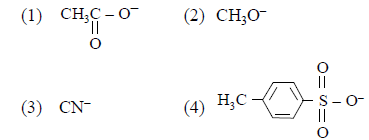
The decreasing order of nucleophilicity among the nucleophiles is
We need to determine the correct decreasing order of nucleophilicity for the following four nucleophiles:
Nucleophilicity refers to a species' ability to donate an electron pair to an electrophilic carbon atom. Generally, for a series of nucleophiles, a weaker conjugate base makes a better leaving group and a poorer nucleophile. Conversely, a stronger, less resonance-stabilized base is a more powerful nucleophile.
1. Cyanide Ion ($$\text{CN}^-$$):
The negative charge resides on a highly accessible carbon atom with a lone pair. Carbon is less electronegative than oxygen, making it much more willing to donate its electron density to an electrophilic center. Thus, $$\text{CN}^-$$ is the strongest nucleophile in this set.
2. Methoxide Ion ($$\text{CH}_3\text{O}^-$$):
The negative charge resides on a localized oxygen atom. While oxygen is electronegative, there is no resonance stabilization to delocalize or "lock away" this charge. The inductive electron-donating effect ($$+I$$) of the methyl group further enhances its electron density, making it a very strong nucleophile (though slightly less than carbon-centered $$\text{CN}^-$$).
3. Acetate Ion ($$\text{CH}_3\text{COO}^-$$):
The negative charge on the oxygen atom is delocalized over two equivalent oxygen atoms via resonance. Because the electron density is spread out, it is less available for attacking an electrophile, significantly reducing its nucleophilicity compared to methoxide.
4. Tosylate Ion ($$\text{CH}_3\text{C}_6\text{H}_4\text{SO}_3^-$$):
The negative charge is highly delocalized over three highly electronegative oxygen atoms in the sulfonate group, further stabilized by the aromatic ring. Because its conjugate acid (p-toluenesulfonic acid) is an extremely strong acid, the tosylate anion is an exceptionally weak base and a classic excellent leaving group, meaning it is the poorest nucleophile in the group.
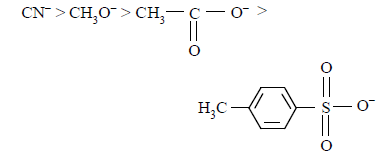
Combining these factors from strongest to weakest gives the decreasing order of nucleophilicity:
$$\text{CN}^- > \text{CH}_3\text{O}^- > \text{CH}_3\text{COO}^- > \text{CH}_3\text{C}_6\text{H}_4\text{SO}_3^-$$
Matching this to the structural labels gives the sequence: (d) > (a) > (b) > (c).
Answer: Option D — 3, 2, 1, 4 (corresponding to the textbook ordering assignment of $$\text{CN}^- > \text{CH}_3\text{O}^- > \text{CH}_3\text{COO}^- > \text{TsO}^-$$)
Was this solution helpful?
Create a FREE account and get:
_1.webp)

Educational materials for JEE preparation

Ask our AI anything

AI can make mistakes. Please verify important information.
AI can make mistakes. Please verify important information.
