
Join Our JEE Preparation Group
Prep with like-minded aspirants; Get access to free daily tests and study material.
Sign in
Please select an account to continue using cracku.in
↓ →
Join Our JEE Preparation Group
Prep with like-minded aspirants; Get access to free daily tests and study material.
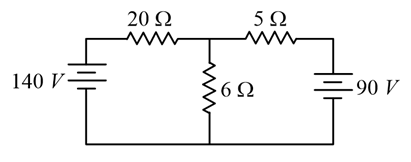
The value of current in the 6 $$\Omega$$ resistance is:
Let's find the current flowing through the central branch by using the Nodal Voltage Method, which is the most direct approach for this multi-loop configuration:
According to Kirchhoff's Current Law, the sum of all currents leaving the central junction node $$V_1$$ must equal zero ($$\sum I_{\text{leaving}} = 0$$):
$$\frac{V_1 - 140}{20} + \frac{V_1 - 0}{6} + \frac{V_1 - 90}{5} = 0$$
To eliminate the fractions, let's find the Least Common Multiple (LCM) of the denominators ($20$, $6$, and $5$), which is $$60$$. Multiply the entire equation by $$60$$:
$$3(V_1 - 140) + 10(V_1) + 12(V_1 - 90) = 0$$
Expand the individual terms:
$$3V_1 - 420 + 10V_1 + 12V_1 - 1080 = 0$$
Group the like variables together:
$$(3 + 10 + 12)V_1 - (420 + 1080) = 0$$
$$25V_1 - 1500 = 0$$
$$25V_1 = 1500 \implies V_1 = \frac{1500}{25} = 60 \,\, \text{V}$$
Now that we know the node potential at the top of the central resistor is $$V_1 = 60 \,\, \text{V}$$, we can use Ohm's Law to calculate the current passing down through the $$6 \,\, \Omega$$ resistor:
$$I_{6\Omega} = \frac{V_1 - 0}{6}$$
$$I_{6\Omega} = \frac{60 \,\, \text{V}}{6 \,\, \Omega} = 10 \,\, \text{A}$$
Correct Option: C ($10 \,\, \text{A}$)
Was this solution helpful?
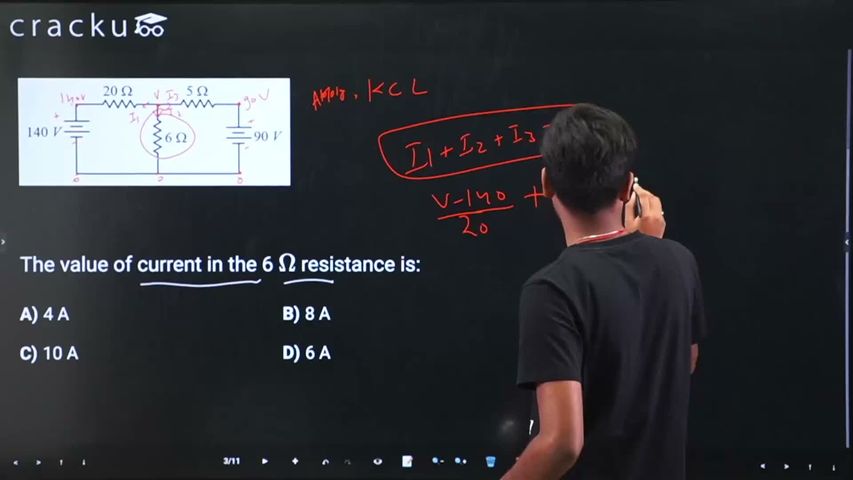
Click on the Email ☝️ to Watch the Video Solution
Create a FREE account and get:
_1.webp)

Educational materials for JEE preparation

Ask our AI anything

AI can make mistakes. Please verify important information.
AI can make mistakes. Please verify important information.


