
Join Our JEE Preparation Group
Prep with like-minded aspirants; Get access to free daily tests and study material.
Sign in
Please select an account to continue using cracku.in
↓ →
Join Our JEE Preparation Group
Prep with like-minded aspirants; Get access to free daily tests and study material.
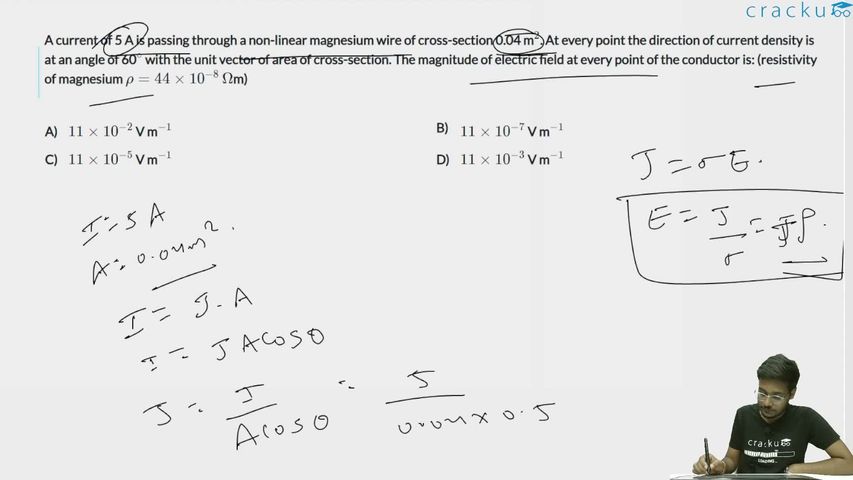
A current of 5 A is passing through a non-linear magnesium wire of cross-section 0.04 m$$^2$$. At every point the direction of current density is at an angle of 60$$^\circ$$ with the unit vector of area of cross-section. The magnitude of electric field at every point of the conductor is: (resistivity of magnesium $$\rho = 44 \times 10^{-8}$$ $$\Omega$$m)
The current $$I$$ through the cross-section is related to the current density $$\vec{J}$$ by $$I = \vec{J} \cdot \vec{A} = JA\cos\theta$$, where $$\theta = 60°$$ is the angle between the current density direction and the area vector.
Solving for $$J$$: $$J = \frac{I}{A\cos\theta} = \frac{5}{0.04 \times \cos 60°} = \frac{5}{0.04 \times 0.5} = \frac{5}{0.02} = 250$$ A m$$^{-2}$$.
The magnitude of the electric field is related to the current density by $$E = \rho J$$, where $$\rho = 44 \times 10^{-8}$$ $$\Omega$$m:
$$E = 44 \times 10^{-8} \times 250 = 11000 \times 10^{-8} = 11 \times 10^{-5}$$ V m$$^{-1}$$.
Was this solution helpful?
Click on the Email ☝️ to Watch the Video Solution
Create a FREE account and get:
_1.webp)

Educational materials for JEE preparation

Ask our AI anything

AI can make mistakes. Please verify important information.
AI can make mistakes. Please verify important information.


