
Join Our JEE Preparation Group
Prep with like-minded aspirants; Get access to free daily tests and study material.
Sign in
Please select an account to continue using cracku.in
↓ →
Join Our JEE Preparation Group
Prep with like-minded aspirants; Get access to free daily tests and study material.
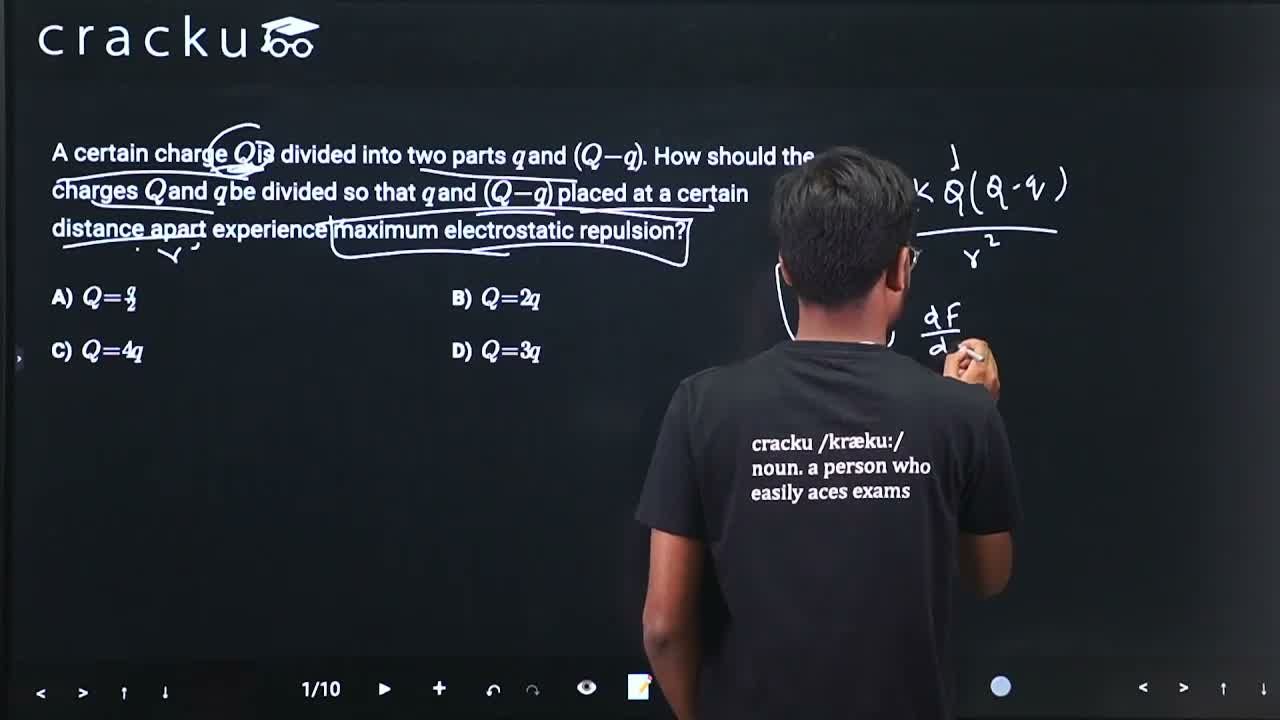
A certain charge $$Q$$ is divided into two parts $$q$$ and $$(Q - q)$$. How should the charges $$Q$$ and $$q$$ be divided so that $$q$$ and $$(Q - q)$$ placed at a certain distance apart experience maximum electrostatic repulsion?
The electrostatic force between the two charges $$q$$ and $$(Q - q)$$ separated by distance $$r$$ is $$F = k\frac{q(Q-q)}{r^2}$$.
To maximize $$F$$, we treat $$r$$ and $$Q$$ as constants and differentiate with respect to $$q$$: $$\frac{dF}{dq} = \frac{k}{r^2}(Q - 2q) = 0$$, giving $$q = \frac{Q}{2}$$, i.e., $$Q = 2q$$.
This can also be verified by the second derivative: $$\frac{d^2F}{dq^2} = -\frac{2k}{r^2} < 0$$, confirming a maximum. The repulsion is maximised when the charge $$Q$$ is divided into two equal halves, so $$Q = 2q$$.
Was this solution helpful?
Click on the Email ☝️ to Watch the Video Solution
Create a FREE account and get:
_1.webp)

Educational materials for JEE preparation

Ask our AI anything

AI can make mistakes. Please verify important information.
AI can make mistakes. Please verify important information.


