
Join Our JEE Preparation Group
Prep with like-minded aspirants; Get access to free daily tests and study material.
Sign in
Please select an account to continue using cracku.in
↓ →
Join Our JEE Preparation Group
Prep with like-minded aspirants; Get access to free daily tests and study material.
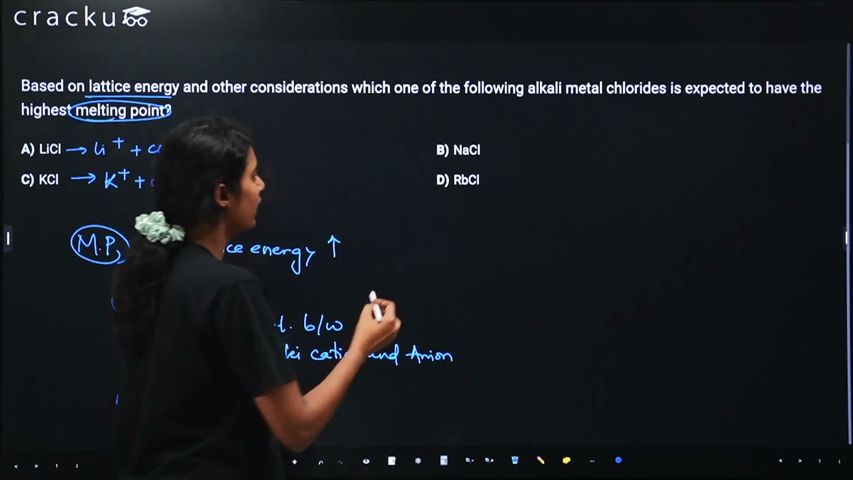
Based on lattice energy and other considerations which one of the following alkali metal chlorides is expected to have the highest melting point?
The melting point of an ionic compound depends on two main competing factors:
$$U \propto \frac{1}{r_+ + r_-}$$
As you move down Group 1 from $$\text{Li}^+$$ to $$\text{Rb}^+$$, the size of the alkali metal cation increases. Consequently, the lattice energy steadily decreases in the order:$$\text{LiCl} > \text{NaCl} > \text{KCl} > \text{RbCl}$$
Based strictly on ideal lattice energy, one would initially expect $$\text{LiCl}$$ to have the highest melting point.Once we pass lithium, the remaining alkali metal chlorides ($$\text{NaCl}$$, $$\text{KCl}$$, $$\text{RbCl}$$) behave like highly ideal ionic compounds with negligible polarization effects. For these three, the melting point trend follows the standard decrease in lattice energy as the cation grows larger:
$$\text{NaCl } (801^\circ\text{C}) > \text{KCl } (770^\circ\text{C}) > \text{RbCl } (718^\circ\text{C})$$
Combining all observations, the overall trend for the melting points of alkali metal chlorides is:
$$\text{NaCl} > \text{KCl} > \text{RbCl} > \text{LiCl}$$
While $$\text{LiCl}$$ suffers a melting point depression due to its covalent character, $$\text{NaCl}$$ achieves the optimal balance of a powerful ionic lattice energy with negligible polarization, giving it the highest melting point in the series.
Correct Option: B — NaCl
Was this solution helpful?
Click on the Email ☝️ to Watch the Video Solution
Create a FREE account and get:
_1.webp)

Educational materials for JEE preparation

Ask our AI anything

AI can make mistakes. Please verify important information.
AI can make mistakes. Please verify important information.
