
Join Our JEE Preparation Group
Prep with like-minded aspirants; Get access to free daily tests and study material.
Sign in
Please select an account to continue using cracku.in
↓ →
Join Our JEE Preparation Group
Prep with like-minded aspirants; Get access to free daily tests and study material.
Calomel is mercurous chloride with formula $$Hg_2Cl_2$$. In the mercurous ion, two Hg atoms are bonded together as $$Hg_2^{2+}$$, i.e. each Hg is in the $$+1$$ oxidation state.
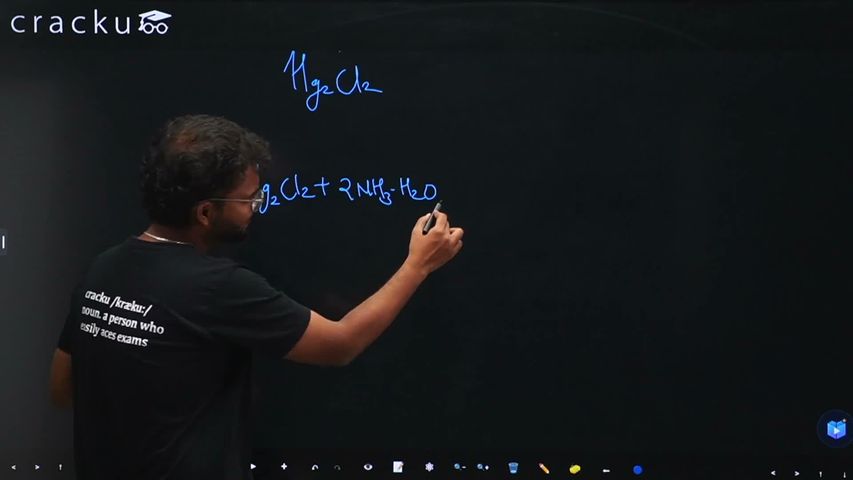
When ammonium hydroxide (which furnishes ammonia in the solution) is added, ammonia behaves as a ligand and simultaneously a mild reducing agent. A part of the $$Hg_2^{2+}$$ is converted to metallic mercury, while the other part forms an amido-complex. The overall reaction is written as
$$Hg_2Cl_2 + 2\,NH_3 \cdot H_2O \;\longrightarrow\; HgNH_2Cl \;+\; Hg \;+\; NH_4Cl \;+\; H_2O$$
(i) $$HgNH_2Cl$$ is mercuric amido chloride, a white solid.
(ii) Elemental Hg produced side-by-side appears black in the finely divided form, so the precipitate obtained in the laboratory test looks grey-black.
Among the options offered, only Option A corresponds to the principal chemical product $$HgNH_2Cl$$.
Hence, the correct choice is:
Option A which is: $$HgNH_2Cl$$
Was this solution helpful?
Click on the Email ☝️ to Watch the Video Solution
Create a FREE account and get:
_1.webp)

Educational materials for JEE preparation

Ask our AI anything

AI can make mistakes. Please verify important information.
AI can make mistakes. Please verify important information.
