
Join Our JEE Preparation Group
Prep with like-minded aspirants; Get access to free daily tests and study material.
Sign in
Please select an account to continue using cracku.in
↓ →
Join Our JEE Preparation Group
Prep with like-minded aspirants; Get access to free daily tests and study material.
The velocity of a particle is $$v = v_0 + gt + ft^2$$. If its position is $$x = 0$$ at $$t = 0$$, then its displacement after unit time ($$t = 1$$) is
Velocity ($$v$$) is defined as the instantaneous rate of change of displacement ($$x$$) with respect to time ($$t$$):
$$v = \frac{dx}{dt}$$
We substitute the given velocity expression into this definition to form our differential equation:
$$\frac{dx}{dt} = v_0 + g \cdot t + f \cdot t^2$$
Separating the variables to prepare for integration gives:
$$dx = (v_0 + g \cdot t + f \cdot t^2) \cdot dt$$
We now integrate both sides using the boundary conditions specified in the problem statement:
Setting up the integration limits:
$$\int_{0}^{x} dx = \int_{0}^{1} (v_0 + g \cdot t + f \cdot t^2) \cdot dt$$
Applying the standard power rule for calculus integration ($$\int t^n \cdot dt = \frac{t^{n+1}}{n+1}$$):
$$[x]_{0}^{x} = \left[ v_0 \cdot t + \frac{g \cdot t^2}{2} + \frac{f \cdot t^3}{3} \right]_{0}^{1}$$
Evaluating the limits by substituting the upper value ($$1$$) and subtracting the lower value ($$0$$):
$$x - 0 = \left( v_0 \cdot (1) + \frac{g \cdot (1)^2}{2} + \frac{f \cdot (1)^3}{3} \right) - (0)$$
$$x = v_0 + \frac{g}{2} + \frac{f}{3}$$
Concept Check: Because acceleration is not constant (due to the time-dependent terms $$g \cdot t$$ and $$f \cdot t^2$$), standard algebraic equations of motion cannot be used. Continuous calculus integration over the entire time interval correctly accounts for the changing acceleration components.
Correct Option Key: Option B ($$v_0 + \frac{g}{2} + \frac{f}{3}$$)
Was this solution helpful?
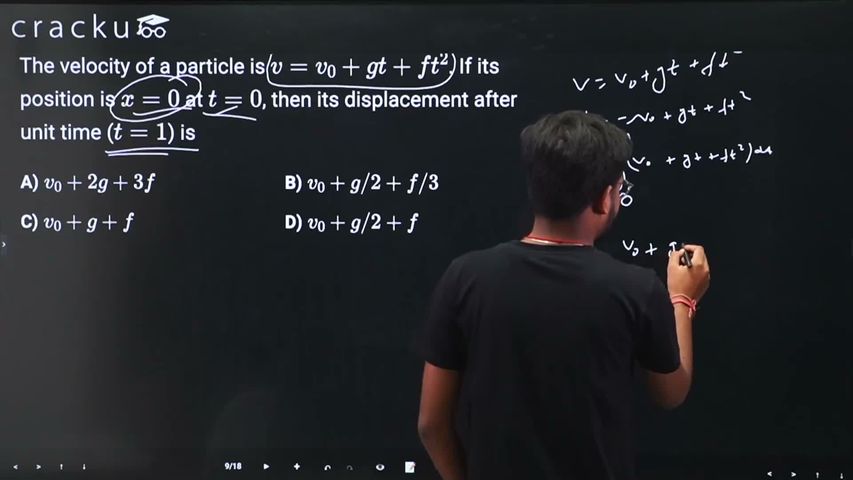
Click on the Email ☝️ to Watch the Video Solution
Create a FREE account and get:
_1.webp)

Educational materials for JEE preparation

Ask our AI anything

AI can make mistakes. Please verify important information.
AI can make mistakes. Please verify important information.
