
Join Our JEE Preparation Group
Prep with like-minded aspirants; Get access to free daily tests and study material.
Sign in
Please select an account to continue using cracku.in
↓ →
Join Our JEE Preparation Group
Prep with like-minded aspirants; Get access to free daily tests and study material.
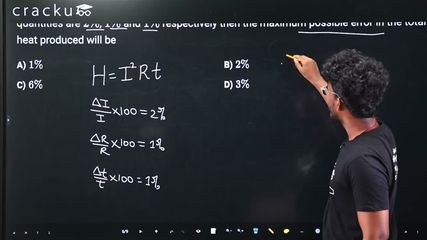
The amount of heat produced in an electric circuit depends upon the current ($$I$$), resistance ($$R$$) and time ($$t$$). If the error made in the measurements of the above quantities are $$2\%$$, $$1\%$$ and $$1\%$$ respectively then the maximum possible error in the total heat produced will be
Heat generated in a conductor (Joule’s law) is given by
$$H = I^{2}\,R\,t \qquad -(1)$$
To find the maximum (worst-case) percentage error, use the rule: for a quantity $$Q = A^{m}B^{n}C^{p}\ldots$$, the maximum percentage (relative) error in $$Q$$ is
$$\frac{\Delta Q}{Q}\times 100\% = \bigl(m\,\frac{\Delta A}{A} + n\,\frac{\Delta B}{B} + p\,\frac{\Delta C}{C} + \ldots\bigr)\times 100\%$$
Comparing $$H = I^{2}R t$$ with the general form, the exponents are:
• for $$I$$ → $$m = 2$$
• for $$R$$ → $$n = 1$$
• for $$t$$ → $$p = 1$$
The given measurement errors are:
$$\frac{\Delta I}{I}\times 100\% = 2\%,$$
$$\frac{\Delta R}{R}\times 100\% = 1\%,$$
$$\frac{\Delta t}{t}\times 100\% = 1\%$$
Hence the maximum percentage error in $$H$$ is
$$\frac{\Delta H}{H}\times 100\% = 2\,(2\%) + 1\,(1\%) + 1\,(1\%)$$
$$ = 4\% + 1\% + 1\% = 6\%$$
Therefore, the largest possible error in the calculated heat is 6 %.
Option C which is: $$6\%$$
Was this solution helpful?
Click on the Email ☝️ to Watch the Video Solution
Create a FREE account and get:
_1.webp)

Educational materials for JEE preparation

Ask our AI anything

AI can make mistakes. Please verify important information.
AI can make mistakes. Please verify important information.
