Group
Group
 Group
Group


 Preferred Source

 Google Discover
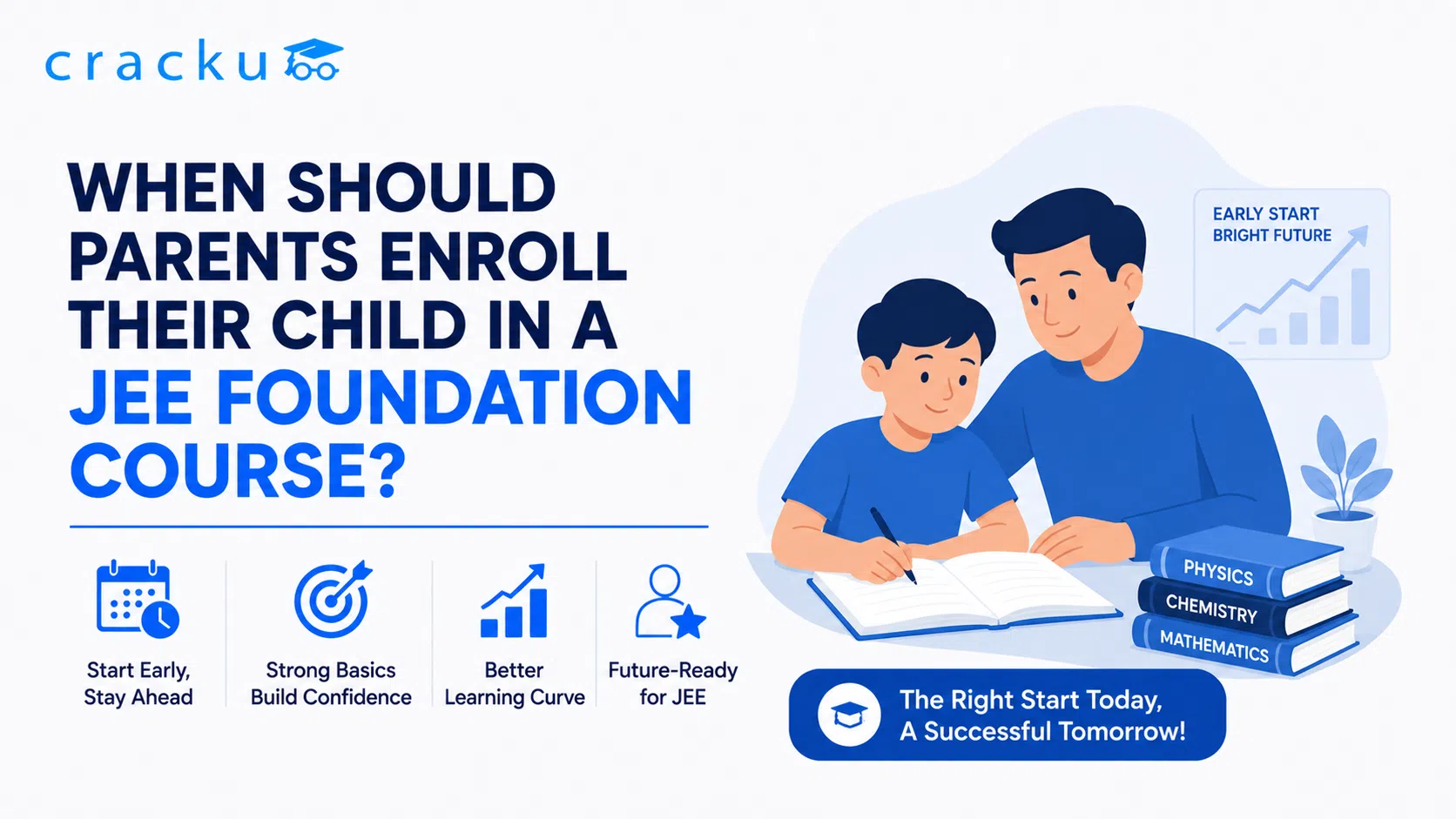
Little by little, one travels far. Your child's learning is also the same. No one becomes a scientist in a day. Curiosity about maths, physics, and chemistry builds slowly. To build that interest with strong basics, this JEE foundation course is the best way. We all know JEE is the exam that sets the next career options in engineering in motion. As a parent, you must also know that Class 11 or 12 is not the right time to put your child under too much pressure. Begin your child's learning today and support them towards their dream.
Which Class Is the Best Time to Join a JEE Foundation Course?
You might be thinking, "Should I enrol my child in JEE preparation in 10th class, 9th class, or 11th?" Which class is perfect? But once look at your child and ask this question: "Is the child ready to learn beyond textbooks?"
If not, why? Is he/she interested in other subjects? First understand that and then enrol them in a JEE foundation course.
The earlier the better, but as the main concepts start from class 8th its the best time.
What Students Gain at Each Stage
Class | Focus Area | Long-Term Advantage |
Class 8 | Develop logical thinking and strengthen school Mathematics and Science | Builds learning habits before academic pressure increases |
Class 9 | Improve concept clarity and numerical skills | Creates a smooth bridge towards higher-level topics |
Class 10 | Strengthen application-based learning and revision habits | Makes the transition to Class 11 more comfortable |
However, once your child adapts to consistent learning, everything will fall into place at the time of real JEE preparation.
Factors Parents Should Consider Before Enrolling in a Course
Before enrolling, spend a little time observing your child's learning style. Some children understand concepts quickly but hesitate while solving numerical questions. Others enjoy practising but lose confidence during tests. The learning plan should address those gaps instead of following the same approach for everyone.
Another factor is consistency. Children learn better when classes become part of their weekly routine. Like four classes per week, not every day. They don’t like it if the learning feels like school. This learning should be colourful and useful.
Parents should also check who will be teaching the classes.
Question | Why It Matters |
For whom is this JEE foundation program? | Students learn according to their academic level. |
Who teaches the subjects? | Experienced IIT faculty bring practical classroom knowledge. |
Is there enough practice after each chapter? | Regular practice improves confidence naturally. |
How often are tests conducted? | Frequent assessments help identify weak chapters early. |
Can parents monitor progress? | Performance becomes easier to track throughout the year. |
The quality of JEE study material also deserves attention. Solving random worksheets rarely helps if questions are not arranged chapter-wise. A better approach is to complete one topic first and then practise different question types before moving to the next lesson.
A good JEE foundation program should also offer:
Learning Support | Details |
Live Classes | 120+ interactive sessions across 30 weeks |
Weekly Schedule | 4 live classes every week |
Subject Split | 2 Mathematics, 1 Physics, 1 Chemistry |
Recorded Lessons | 250+ videos for revision |
Practice | 5,000+ chapter-wise questions |
Concept Tests | 200+ assessments |
Test Frequency | One test every 15 days |
Parent Login | Track attendance, tests, and progress anytime |
These resources work together. JEE live classes introduce concepts. Practice questions strengthen them. Tests measure progress. Recorded lessons fill learning gaps whenever required.
One more point is often overlooked. Children should feel comfortable asking doubts. A classroom where students hesitate to speak usually slows down learning. Ensure that the batch size is limited to a small number of students.
Also Read: Why Choose Cracku's JEE Foundation Course? Check Now
How to Balance School Studies and a JEE Foundation Course
One concern almost every parent shares is whether coaching will affect school performance.
It doesn't have to.
In fact, if the learning plan follows the school syllabus closely, both can support each other.
Imagine a child studying linear equations at school during the week. The same topic is discussed again in the evening class with additional practice and detailed explanations. Instead of learning two different things, the child understands one concept from two different perspectives.
That naturally reduces revision time before CBSE/any board exams.
A Simple Weekly Learning Pattern
Day | Learning Activity |
Tuesday | Live Mathematics and Physics classes |
Wednesday | Practice chapter-wise questions |
Thursday | School revision and homework |
Friday | Live Mathematics and Chemistry classes |
Weekend | Revision, doubt-solving and concept practice |
This type of routine leaves enough space for school assignments, family time, and proper rest.
- Encourage your child’s regular attendance instead of last-minute studying.
- Give children time to revise after each chapter.
- Avoid comparing scores with classmates.
- Review test reports together and discuss improvements.
- Celebrate your child’s steady progress instead of expecting perfect marks.
The parent dashboard also makes this easier. Attendance records, assessment scores, and learning progress remain available in one place, reducing the need for constant follow-ups.
Online vs Offline JEE Foundation Course: Which Should Parents Choose?
Offline classes offer face-to-face interaction, but they also involve travelling, fixed schedules, and limited flexibility. If a child misses a class due to school events or illness, catching up may become difficult.
JEE online foundation course offers a different advantage. Students can attend live sessions from home and revise recorded lessons whenever needed. Parents also save travel time, which leaves more room for schoolwork and revision.
The best option is an online program that combines live teaching with self-paced learning. Children attend regular classes, ask doubts during sessions, and revisit recorded videos before school exams or concept tests.
Online vs Offline Learning
Feature | Online Learning | Offline Learning |
Live interaction | Yes | Yes |
Recorded classes | Available for revision | Usually not available |
Travel time | Not required | Required |
Learning flexibility | High | Limited |
Revision before exams | Watch recorded lessons anytime | Depends on classroom notes |
Parent monitoring | Easy through dashboard | Limited updates |
If your child learns better by revisiting topics, online learning may be the better choice. If classroom interaction keeps them motivated, offline classes can also work well. The final decision should always depend on your child's learning style rather than current trends.
Why Choose Cracku's JEE Foundation Course?
Students continue practising through NCERT and JEE chapter-wise exercises, concept tests, and recorded lessons. If a topic feels difficult after a few weeks, they can revisit the recorded session instead of waiting for another classroom explanation.
Particular | Details |
Course Fee | ₹9,999 |
Suitable For | Classes 8, 9 & 10 |
Course Duration | 30 Weeks |
Learning Mode | Live Online + Recorded Lessons |
Class Schedule | Tuesday & Friday (6:00 PM – 8:30 PM) |
Mathematics Faculty | Radha Krishna Bandaru, Aniket (IIT BHU), Payal (IIT Guwahati) |
Physics Faculty | Krishnanu (IIT Dhanbad), Manoj (IIT Kanpur) |
Chemistry Faculty | Harshita (IIT Kharagpur), Bhabesh (IIT Guwahati) |
Parent Dashboard | Included |
As students become comfortable with concepts, they may gradually solve JEE Mains previous papers to understand how classroom learning connects with competitive exams. Once important chapters are completed, attempting a JEE Mains Mock Test helps them improve time management and question selection before moving to advanced preparation.
Conclusion
After all these details, as a parent, you might have gained insights on selecting the best JEE foundation course. Better hold the reins early and provide good guidance to your child for his/her future. Check their consistency and support them through the practice sessions. Play puzzles with them and understand which stream they wish to go into. JEE is not just for engineering; there are several other UG courses. Check them out and tell your child too.