For the following questions answer them individually
A physical quantity $$z$$ depends on four observables $$a$$, $$b$$, $$c$$ and $$d$$, as $$z = \frac{a^2 b^{2/3}}{\sqrt{cd^3}}$$. The percentage of error in the measurement of $$a$$, $$b$$, $$c$$ and $$d$$ are $$2\%$$, $$1.5\%$$, $$4\%$$ and $$2.5\%$$ respectively. The percentage of error in $$z$$ is:
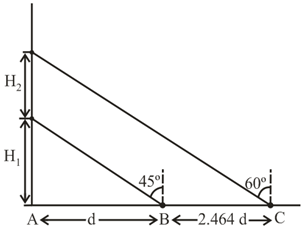
A balloon is moving up in air vertically above a point $$A$$ on the ground. When it is at a height $$h_1$$, a girl standing at a distance $$d$$ (point B) from $$A$$ (see figure) sees it at an angle $$45^\circ$$ with respect to the vertical. When the balloon climbs up a further height $$h_2$$, it is seen at an angle $$60^\circ$$ with respect to the vertical if the girl moves further by a distance $$2.464\,d$$ (point C). Then the height $$h_2$$ is (given $$\tan 30^\circ = 0.5774$$):
A helicopter rises from rest on the ground vertically upwards with a constant acceleration $$g$$. A food packet is dropped from the helicopter when it is at a height $$h$$. The time taken by the packet to reach the ground is close to [$$g$$ is the acceleration due to gravity]:
A wheel is rotating freely with an angular speed $$\omega$$ on a shaft. The moment of inertia of the wheel is $$I$$ and the moment of inertia of the shaft is negligible. Another wheel of moment of inertia $$3I$$ initially at rest is suddenly coupled to the same shaft. The resultant fractional loss in the kinetic energy of the system is:
The value of the acceleration due to gravity is $$g_1$$ at a height $$h = \frac{R}{2}$$ ($$R$$ = radius of the earth) from the surface of the earth. It is again equal to $$g_1$$ at a depth $$d$$ below the surface the earth. The ratio $$\left(\frac{d}{R}\right)$$ equals:
A hollow spherical shell at outer radius $$R$$ floats just submerged under the water surface. The inner radius of the shell is $$r$$. If the specific gravity of the shell material is $$\frac{27}{8}$$ with respect to water, the value of $$r$$ is:
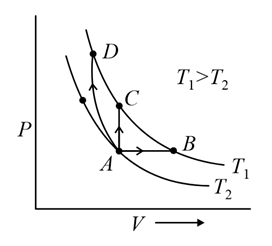
Three different processes that can occur in an ideal monoatomic gas are shown in the $$P$$ vs $$V$$ diagram. The paths are labelled as $$A \to B$$, $$A \to C$$ and $$A \to D$$. The change in internal energies during these processes are taken as $$E_{AB}$$, $$E_{AC}$$ and $$E_{AD}$$ and the work done as $$W_{AB}$$, $$W_{AC}$$ and $$W_{AD}$$. The correct relation between these parameters are:
Number of molecules in a volume of $$4\,\text{cm}^3$$ of a perfect monoatomic gas at some temperature T and at a pressure of $$2\,\text{cm}$$ of mercury is close to? (Given, mean kinetic energy of a molecule (at T) is $$4 \times 10^{-14}\,\text{erg}$$, $$g = 980\,\text{cm s}^{-2}$$, density of mercury $$= 13.6\,\text{g cm}^{-3}$$)
A bullet of mass $$5\,\text{gram}$$, travelling with a speed of $$210\,\text{m s}^{-1}$$, strikes a fixed wooden target. One half of its kinetic energy is converted into heat in the wood. The rise of temperature of the bullet if the specific heat of its material is $$0.030\,(\text{gram}\,^\circ\text{C})^{-1}$$ ($$1\,\text{calorie} = 4.2 \times 10^7\,\text{ergs}$$) close to:
Assume that the displacement (s) of air is proportional to the pressure difference $$(\Delta p)$$ created by a sound wave. Displacement (s) further depends on the speed of sound (v), density of air ($$\rho$$) and the frequency (f). If $$\Delta p \sim 10\,\text{Pa}$$, $$v \sim 300\,\text{m/s}$$, $$\rho \sim 1\,\text{kg/m}^3$$, $$f \sim 1000\,\text{Hz}$$, then $$s$$ will be of the order of (take the multiplicative constant to be 1):
In a resonance tube experiment when the tube is filled with water up to a height of $$17.0\,\text{cm}$$, from bottom, it resonates with a given tuning fork. When the water level is raised the next resonance with the same tuning fork occurs at a height of $$24.5\,\text{cm}$$. If the velocity of sound in air is $$330\,\text{m s}^{-1}$$, the tuning fork frequency is:
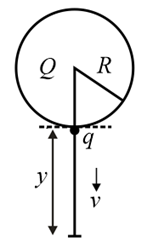
A solid sphere of radius $$R$$ carries a charge $$Q + q$$ distributed uniformly over its volume. A very small point like piece of it of mass $$m$$ gets detached from the bottom of the sphere and falls down vertically under gravity. This piece carries charge $$q$$. If it acquires a speed $$v$$ when it has fallen through a vertical height $$y$$ (see figure), then (assume the remaining portion to be spherical)
Two capacitors of capacitances $$C$$ and $$2C$$ are charged to potential differences $$V$$ and $$2V$$, respectively. These are then connected in parallel in such a manner that the positive terminal of one is connected to the negative terminal of the other. The final energy of this configuration is:
A galvanometer of resistance $$G$$ is converted into a voltmeter of range $$0 - 1\,\text{V}$$ by connecting a resistance $$R$$ in series with it. The additional resistance that should be connected in series with $$R_1$$ to increase the range of the voltmeter to $$0 - 2\,\text{V}$$ will be:
An electrical power line, having a total resistance of $$2\,\Omega$$, delivers $$1\,\text{kW}$$ at $$220\,\text{V}$$. The efficiency of the transmission line is approximately:
An electron is constrained to move along the $$y$$-axis with a speed of $$0.1\,c$$ ($$c$$ is the speed of light) in the presence of electromagnetic wave, whose electric field is $$\vec{E} = 30\hat{j}\sin(1.5 \times 10^7 t - 5 \times 10^{-2}x)\,\text{V m}^{-1}$$, where $$t$$ in in seconds and $$x$$ is in meters. The maximum magnetic force experienced by the electron will be: (given $$c = 3 \times 10^8\,\text{m s}^{-1}$$ and electron charge $$= 1.6 \times 10^{-19}\,\text{Coulombs}$$)
A square loop of side $$2a$$, and carrying current $$I$$, is kept in $$XZ$$ plane with its centre at origin. A long wire carrying the same current $$I$$ is placed parallel to the $$z$$-axis and passing through the point $$(0, b, 0)$$, $$(b >> a)$$. The magnitude of the torque on the loop about $$z$$-axis is given by:
For a concave lens of focal length $$f$$, the relation between object and image distance $$u$$ and $$v$$, respectively, from its pole can best be represented by ($$u = v$$ is the reference line):
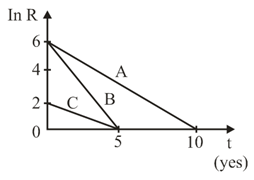
Activities of three radioactive substances $$A$$, $$B$$ and $$C$$ are represented by the curves $$A$$, $$B$$ and $$C$$, in the figure. Then their half-lives $$T_{1/2}(A) : T_{1/2}(B) : T_{1/2}(C)$$ are in the ratio:
With increasing biasing voltage of a photo diode, the photocurrent magnitude:
A particle of mass $$200\,\text{MeV c}^{-2}$$ collides with a hydrogen atom at rest. Soon after the collision, the particle comes to rest, and the atom recoils and goes to its first excited state. The initial kinetic energy of the particle (in eV) is $$\frac{N}{4}$$. The value of $$N$$ is: (Given the mass of the hydrogen atom to be $$1\,\text{GeV c}^{-2}$$)........
A force $$\vec{F} = \left(\hat{i} + 2\hat{j} + 3\hat{k}\right)\,\text{N}$$ acts at a point $$\left(4\hat{i} + 3\hat{j} - \hat{k}\right)\,\text{m}$$. Then the magnitude of torque about the point $$\left(\hat{i} + 2\hat{j} + \hat{k}\right)\,\text{m}$$ will be $$\sqrt{x}\,\text{N-m}$$. The value of $$x$$ is..........
Two concentric circular coils, $$C_1$$ and $$C_2$$, are placed in the $$XY$$ plane. $$C_1$$ has 500 turns, and a radius of $$1\,\text{cm}$$. $$C_2$$ has 200 turns and radius of $$20\,\text{cm}$$. $$C_2$$ carries a time dependent current $$I(t) = (5t^2 - 2t + 3)\,\text{A}$$ where $$t$$ is in s. The emf induced in $$C_1$$ (in mV) at the instant $$t = 1\,\text{s}$$ is $$\frac{4}{x}$$. The value of $$x$$ is..........
A compound microscope consists of an objective lens of focal length $$1\,\text{cm}$$ and an eye piece of focal length $$5\,\text{cm}$$ with a separation of $$10\,\text{cm}$$. The distance between an object and the objective lens, at which the strain on the eye is minimum is $$\frac{n}{40}\,\text{cm}$$. The value of $$n$$ is.......
A beam of electrons of energy $$E$$ scatters from a target having atomic spacing of $$1\,\text{\AA}$$. The first maximum intensity occurs at $$\theta = 60^\circ$$. Then $$E$$ (in eV) is......... (Planck's constant $$h = 6.64 \times 10^{-34}\,\text{Js}$$, $$1\,\text{eV} = 1.6 \times 10^{-19}\,\text{J}$$, electron mass $$m = 9.1 \times 10^{-31}\,\text{kg}$$)