
Join Our JEE Preparation Group
Prep with like-minded aspirants; Get access to free daily tests and study material.
Sign in
Please select an account to continue using cracku.in
↓ →
Join Our JEE Preparation Group
Prep with like-minded aspirants; Get access to free daily tests and study material.
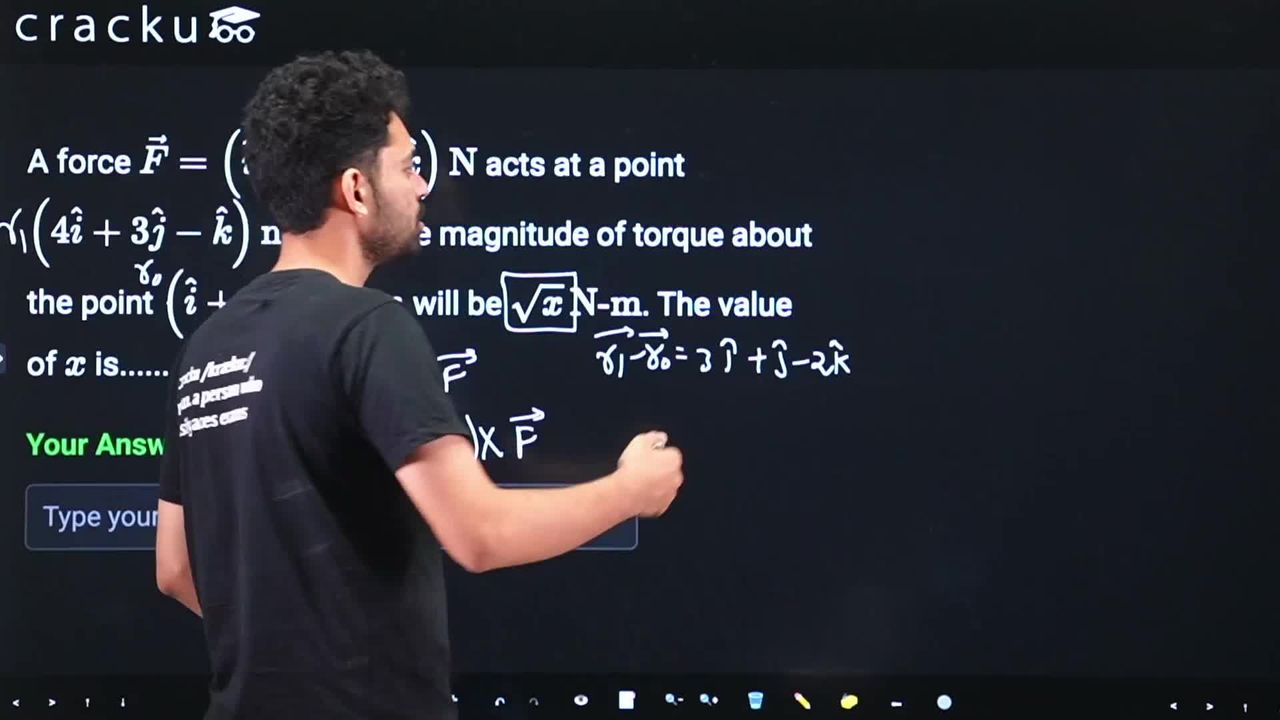
A force $$\vec{F} = \left(\hat{i} + 2\hat{j} + 3\hat{k}\right)\,\text{N}$$ acts at a point $$\left(4\hat{i} + 3\hat{j} - \hat{k}\right)\,\text{m}$$. Then the magnitude of torque about the point $$\left(\hat{i} + 2\hat{j} + \hat{k}\right)\,\text{m}$$ will be $$\sqrt{x}\,\text{N-m}$$. The value of $$x$$ is..........
Correct Answer: 195
We have a force vector given by $$\vec F = \hat i + 2\hat j + 3\hat k\;{\rm N}$$ and the point of application of this force is at the position vector $$\vec r_1 = 4\hat i + 3\hat j - \hat k\;{\rm m}.$$
The torque (or moment of force) about some reference point with position vector $$\vec r_0$$ is defined by the vector formula
$$\vec\tau = (\vec r_1 - \vec r_0)\times\vec F.$$
Here the reference point is $$\vec r_0 = \hat i + 2\hat j + \hat k\;{\rm m}.$$ Subtracting, we obtain the position vector of the line of action of the force with respect to the reference point:
$$\vec r = \vec r_1 - \vec r_0 = \bigl(4\hat i + 3\hat j - \hat k\bigr) - \bigl(\hat i + 2\hat j + \hat k\bigr) = (4-1)\hat i + (3-2)\hat j + (-1-1)\hat k = 3\hat i + 1\hat j - 2\hat k\;{\rm m}.$$
Now we calculate the cross product $$\vec\tau = \vec r \times \vec F.$$ Writing the two vectors component-wise,
$$\vec r = 3\hat i + 1\hat j - 2\hat k, \qquad \vec F = 1\hat i + 2\hat j + 3\hat k.$$ Using the determinant form for the cross product,
$$\vec\tau = \begin{vmatrix} \hat i & \hat j & \hat k\\ 3 & 1 & -2\\ 1 & 2 & 3 \end{vmatrix}.$$
Expanding this determinant step by step,
$$\vec\tau = \hat i\,(1\cdot 3 - (-2)\cdot 2) - \hat j\,(3\cdot 3 - (-2)\cdot 1) + \hat k\,(3\cdot 2 - 1\cdot 1).$$
Simplifying each term inside the parentheses,
$$1\cdot 3 - (-2)\cdot 2 = 3 + 4 = 7,$$ $$3\cdot 3 - (-2)\cdot 1 = 9 + 2 = 11,$$ $$3\cdot 2 - 1\cdot 1 = 6 - 1 = 5.$$
Substituting these values back, we get
$$\vec\tau = 7\hat i - 11\hat j + 5\hat k\;{\rm N\!-\!m}.$$
The magnitude of the torque vector is obtained through the relation
$$|\vec\tau| = \sqrt{(7)^2 + (-11)^2 + (5)^2}.$$
Carrying out the squaring and addition,
$$(7)^2 = 49,\quad (-11)^2 = 121,\quad (5)^2 = 25,$$ $$49 + 121 + 25 = 195.$$
Thus,
$$|\vec\tau| = \sqrt{195}\,{\rm N\!-\!m}.$$
Comparing with the given form $$\sqrt{x}\,{\rm N\!-\!m},$$ we see that $$x = 195.$$
Hence, the correct answer is Option C.
Was this solution helpful?
Click on the Email ☝️ to Watch the Video Solution
Create a FREE account and get:
_1.webp)

Educational materials for JEE preparation

Ask our AI anything

AI can make mistakes. Please verify important information.
AI can make mistakes. Please verify important information.


