
Join Our JEE Preparation Group
Prep with like-minded aspirants; Get access to free daily tests and study material.
Sign in
Please select an account to continue using cracku.in
↓ →
Join Our JEE Preparation Group
Prep with like-minded aspirants; Get access to free daily tests and study material.
A photodiode is a p-n junction that is operated under reverse bias. When light falls on the junction, photons with energy greater than the band gap create electron-hole pairs in the depletion region and nearby.
These photo-generated carriers are swept across the junction by the electric field in the depletion region, producing a current called the photocurrent.
Now let us understand how the photocurrent changes as the reverse bias voltage is increased.
At low reverse bias: The depletion region is relatively narrow. Not all the photo-generated carriers are collected efficiently because some of them recombine before reaching the depletion region. As the reverse bias increases, the depletion region widens, and the electric field across it becomes stronger. This means:
(i) A larger volume is available for generating electron-hole pairs.
(ii) The stronger field sweeps carriers more quickly, reducing recombination losses.
So the photocurrent increases with increasing reverse bias voltage.
At sufficiently high reverse bias: The depletion region has become wide enough that essentially all incident photons that can create electron-hole pairs are being absorbed within (or near) the depletion region, and virtually all photo-generated carriers are being collected. At this point, increasing the bias further does not produce significantly more carriers — the photocurrent reaches a saturation value determined by the incident light intensity.
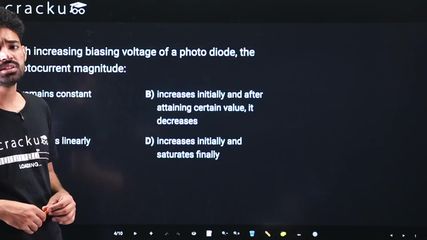
Therefore, as the biasing voltage of a photodiode is increased, the photocurrent magnitude increases initially and after reaching a certain value, it saturates (becomes nearly constant).
This matches Option D: increases initially and saturates finally.
The correct answer is Option D.
Was this solution helpful?
Click on the Email ☝️ to Watch the Video Solution
Create a FREE account and get:
_1.webp)

Educational materials for JEE preparation

Ask our AI anything

AI can make mistakes. Please verify important information.
AI can make mistakes. Please verify important information.


