
Join Our JEE Preparation Group
Prep with like-minded aspirants; Get access to free daily tests and study material.
Sign in
Please select an account to continue using cracku.in
↓ →
Join Our JEE Preparation Group
Prep with like-minded aspirants; Get access to free daily tests and study material.
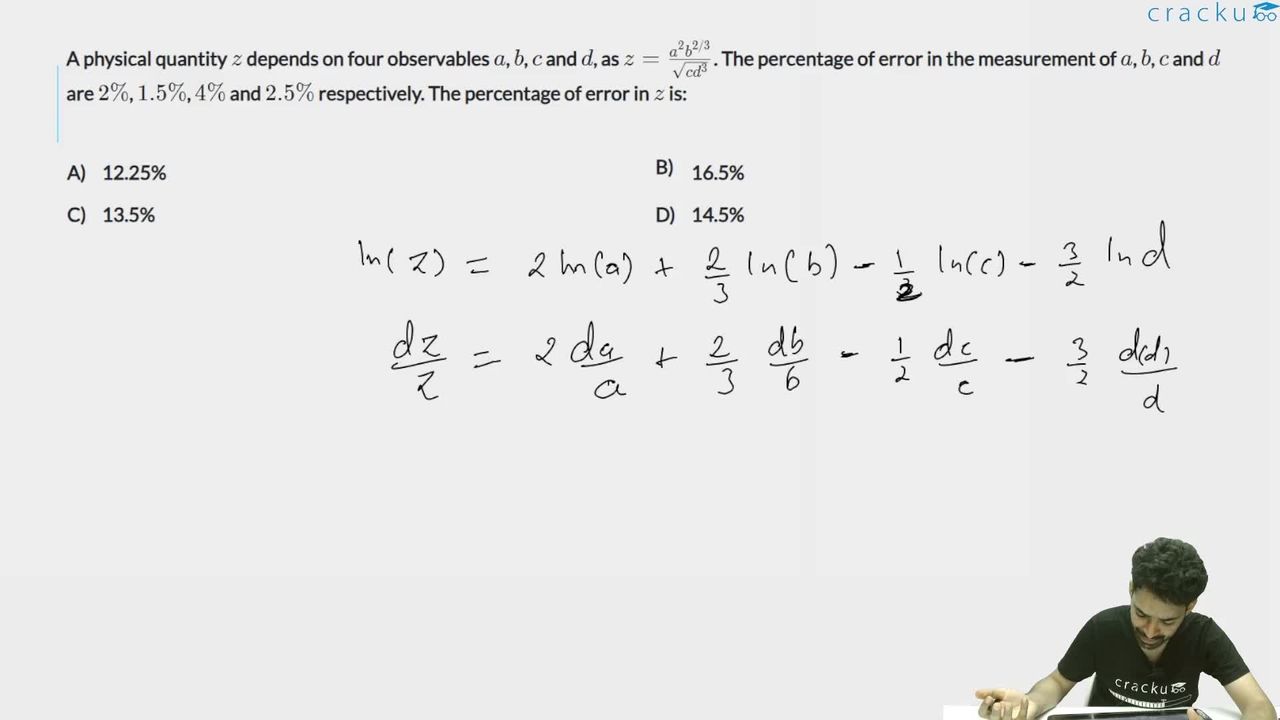
A physical quantity $$z$$ depends on four observables $$a$$, $$b$$, $$c$$ and $$d$$, as $$z = \frac{a^2 b^{2/3}}{\sqrt{cd^3}}$$. The percentage of error in the measurement of $$a$$, $$b$$, $$c$$ and $$d$$ are $$2\%$$, $$1.5\%$$, $$4\%$$ and $$2.5\%$$ respectively. The percentage of error in $$z$$ is:
We have the physical quantity $$z$$ expressed as
$$z \;=\; \frac{a^{2}\,b^{\,2/3}}{\sqrt{c}\,d^{3}}$$
(the square-root sign acts only on $$c$$, while $$d^{3}$$ is outside the root).
In error analysis we use the general rule: if a quantity can be written in the form
$$z \;=\; a^{\,m}\,b^{\,n}\,c^{\,p}\,d^{\,q},$$
then the fractional (relative) error in $$z$$ is obtained from
$$\frac{\Delta z}{z} =\; |m|\,\frac{\Delta a}{a} +\; |n|\,\frac{\Delta b}{b} +\; |p|\,\frac{\Delta c}{c} +\; |q|\,\frac{\Delta d}{d}.$$
This formula is nothing but the differential form of the logarithmic derivative $$\ln z = m\ln a + n\ln b + p\ln c + q\ln d$$ with all magnitudes taken positive because every separate error contributes additively to the maximum possible error.
Comparing the given expression with the standard form we read off the exponents directly:
$$m = 2,\qquad n = \frac23,\qquad p = -\frac12,\qquad q = -3.$$
Only the absolute values of these exponents matter for the percentage error, so we write
$$|m| = 2,\qquad |n| = \frac23,\qquad |p| = \frac12,\qquad |q| = 3.$$
The stated percentage errors in the measured quantities are
$$\frac{\Delta a}{a}\times100 = 2\%,\; \frac{\Delta b}{b}\times100 = 1.5\%,\; \frac{\Delta c}{c}\times100 = 4\%,\; \frac{\Delta d}{d}\times100 = 2.5\%.$$
Substituting these numbers into the error-propagation formula gives the percentage error in $$z$$:
$$ \frac{\Delta z}{z}\times100 = 2\,(2\%) + \left(\frac23\right)(1.5\%) + \left(\frac12\right)(4\%) + 3\,(2.5\%). $$
Now we carry out every multiplication one by one:
$$ 2\,(2\%) = 4\%, \\ \left(\frac23\right)(1.5\%) = 1\%, \\ \left(\frac12\right)(4\%) = 2\%, \\ 3\,(2.5\%) = 7.5\%. $$
Adding all these individual contributions we obtain
$$ \frac{\Delta z}{z}\times100 = 4\% + 1\% + 2\% + 7.5\% = 14.5\%. $$
So the percentage error in the calculated value of $$z$$ is $$14.5\%$$.
Hence, the correct answer is Option D.
Was this solution helpful?
Click on the Email ☝️ to Watch the Video Solution
Create a FREE account and get:
_1.webp)

Educational materials for JEE preparation

Ask our AI anything

AI can make mistakes. Please verify important information.
AI can make mistakes. Please verify important information.


