If $$Z = \frac{A^2 B^3}{C^4}$$, then the relative error in $$Z$$ will be

Join Our JEE Preparation Group
Prep with like-minded aspirants; Get access to free daily tests and study material.
Sign in
Please select an account to continue using cracku.in
↓ →
Join Our JEE Preparation Group
Prep with like-minded aspirants; Get access to free daily tests and study material.
If $$Z = \frac{A^2 B^3}{C^4}$$, then the relative error in $$Z$$ will be
Login to view the detailed solution.
$$\vec{A}$$ is a vector quantity such that $$|\vec{A}|$$ = non-zero constant. Which of the following expression is true for $$\vec{A}$$?
Login to view the detailed solution.
Which of the following relations is true for two unit vectors $$\hat{A}$$ and $$\hat{B}$$ making an angle $$\theta$$ to each other?
Login to view the detailed solution.
.webp)
If force $$\vec{F} = 3\hat{i} + 4\hat{j} - 2\hat{k}$$ acts on a particle having position vector $$2\hat{i} + \hat{j} + 2\hat{k}$$ then, the torque about the origin will be:
Login to view the detailed solution.
The height of any point $$P$$ above the surface of earth is equal to diameter of earth. The value of acceleration due to gravity at point $$P$$ will be : (Given $$g$$ = acceleration due to gravity at the surface of earth).
Login to view the detailed solution.
The terminal velocity $$v_t$$ of the spherical rain drop depends on the radius $$r$$ of the spherical rain drop as
Login to view the detailed solution.
.webp)
The relation between root mean square speed $$v_{rms}$$ and most probable speed $$v_p$$ for the molar mass $$M$$ of oxygen gas molecule at the temperature of $$300$$ K will be
Login to view the detailed solution.
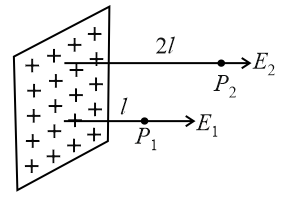
In the figure, a very large plane sheet of positive charge is shown. $$P_1$$ and $$P_2$$ are two points at distance $$l$$ and $$2l$$ from the charge distribution. If $$\sigma$$ is the surface charge density, then the magnitude of electric fields $$E_1$$ and $$E_2$$ at $$P_1$$ and $$P_2$$ respectively are
Login to view the detailed solution.
A teacher in his physics laboratory allotted an experiment to determine the resistance $$G$$ a galvanometer. Students took the observations for $$\frac{1}{3}$$ deflection in the galvanometer. Which of the below is true for measuring value of $$G$$?
Login to view the detailed solution.
.webp)
A long straight wire with a circular cross-section having radius $$R$$, is carrying a steady current $$I$$. The current $$I$$ is uniformly distributed across this cross-section. Then the variation of magnetic field due to current $$I$$ with distance $$r$$ ($$r < R$$) from its centre will be
Login to view the detailed solution.
Match List - I with List - II.
| List-I | List-II |
|---|---|
| (A) AC generator | (I) Detects the presence of current in the circuit |
| (B) Galvanometer | (II) Converts mechanical energy into electrical energy |
| (C) Transformer | (III) Works on the principle of resonance in AC circuit |
| (D) Metal detector | (IV) Changes an alternating voltage for smaller or greater value |
Login to view the detailed solution.
If wattless current flows in the AC circuit, then the circuit is :
Login to view the detailed solution.
.webp)
The electric field in an electromagnetic wave is given by $$E = 56.5 \sin\omega\left(\frac{t - x}{c}\right)$$ NC$$^{-1}$$. Find the intensity of the wave if it is propagating along $$x$$-axis in the free space. (Given $$\varepsilon_0 = 8.85 \times 10^{-12}$$ C$$^2$$ N$$^{-1}$$ m$$^{-2}$$)
Login to view the detailed solution.
A light wave travelling linearly in a medium of dielectric constant $$4$$, incidents on the horizontal interface separating medium with air. The angle of incidence for which the total intensity of incident wave will be reflected back into the same medium will be :
(Given : relative permeability of medium $$\mu_r = 1$$)
Login to view the detailed solution.
The difference of speed of light in the two media $$A$$ and $$B$$ ($$v_A - v_B$$) is $$2.6 \times 10^7$$ m s$$^{-1}$$. If the refractive index of medium $$B$$ is $$1.47$$, then the ratio of refractive index of medium $$B$$ to medium $$A$$ is: (Given : speed of light in vacuum $$c = 3 \times 10^8$$ m s$$^{-1}$$)
Login to view the detailed solution.

The two light beams having intensities $$I$$ and $$9I$$ interfere to produce a fringe pattern on a screen. The phase difference between the beams is $$\frac{\pi}{2}$$ at point $$P$$ and $$\pi$$ at point $$Q$$. Then the difference between the resultant intensities at $$P$$ and $$Q$$ will be :
Login to view the detailed solution.
Given below are two statements :
Statement I : Davisson-Germer experiment establishes the wave nature of electrons.
Statement II : If electrons have wave nature, they can interfere and show diffraction.
In the light of the above statements choose the correct answer from the option given below :
Login to view the detailed solution.
The ratio for the speed of the electron in the $$3^{rd}$$ orbit of $$He^+$$ to the speed of the electron in the $$3^{rd}$$ orbit of hydrogen atom will be :
Login to view the detailed solution.
_1.webp)
The photodiode is used to detect the optical signals. These diodes are preferably operated in reverse biased mode because
Login to view the detailed solution.
A signal of $$100$$ THz frequency can be transmitted with maximum efficiency by
Login to view the detailed solution.
A uniform chain of $$6$$ m length is placed on a table such that a part of its length is hanging over the edge of the table. The system is at rest. The co-efficient of static friction between the chain and the surface of the table is $$0.5$$, the maximum length of the chain hanging from the table is ______ m.
Login to view the detailed solution.
A force on an object of mass $$100$$ g is $$(10\hat{i} + 5\hat{j})$$ N. The position of that object at $$t = 2$$ s is $$a\hat{i} + b\hat{j}$$ m after starting from rest. The value of $$\frac{a}{b}$$ will be ______.
Login to view the detailed solution.
A $$0.5$$ kg block moving at a speed of $$12$$ ms$$^{-1}$$ compresses a spring through a distance $$30$$ cm when its speed is halved. The spring constant of the spring will be ______ Nm$$^{-1}$$
Login to view the detailed solution.
The velocity of upper layer of water in a river is $$36$$ km h$$^{-1}$$. Shearing stress between horizontal layers of water is $$10^{-3}$$ N m$$^{-2}$$. Depth of the river is ______ m. (Co-efficient of viscosity of water is $$10^{-2}$$ Pa s)
Login to view the detailed solution.
A steam engine intakes $$50$$ g of steam at $$100°$$C per minute and cools it down to $$20°$$C. If latent heat of vaporization of steam is $$540$$ cal g$$^{-1}$$, then the heat rejected by the steam engine per minute is ______ $$\times 10^3$$ cal
(Given : specific heat capacity of water : $$1$$ cal g$$^{-1}$$ °C$$^{-1}$$)
Login to view the detailed solution.
The first overtone frequency of an open organ pipe is equal to the fundamental frequency of a closed organ pipe. If the length of the closed organ pipe is $$20$$ cm. The length of the open organ pipe is ______ cm
Login to view the detailed solution.
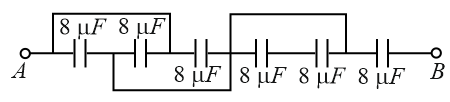
The equivalent capacitance between points $$A$$ and $$B$$ in below shown figure will be ______ $$\mu$$F.
Login to view the detailed solution.
A resistor develops $$300$$ J of thermal energy in $$15$$ s, when a current of $$2$$ A is passed through it. If the current increases to $$3$$ A, the energy developed in $$10$$ s is ______ J.
Login to view the detailed solution.
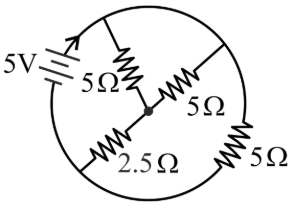
The total current supplied to the circuit as shown in the figure by the $$5$$ V battery is ______ A.
Login to view the detailed solution.
The current in a coil of self inductance $$L = 2.0$$ H is increasing according to the law $$i = 2\sin t^2$$. Find the amount of energy spent (in J) during the period when the current changes from $$0$$ to $$2$$ A.
Login to view the detailed solution.
Educational materials for JEE preparation
 Share
Share