
Join Our JEE Preparation Group
Prep with like-minded aspirants; Get access to free daily tests and study material.
Sign in
Please select an account to continue using cracku.in
↓ →
Join Our JEE Preparation Group
Prep with like-minded aspirants; Get access to free daily tests and study material.
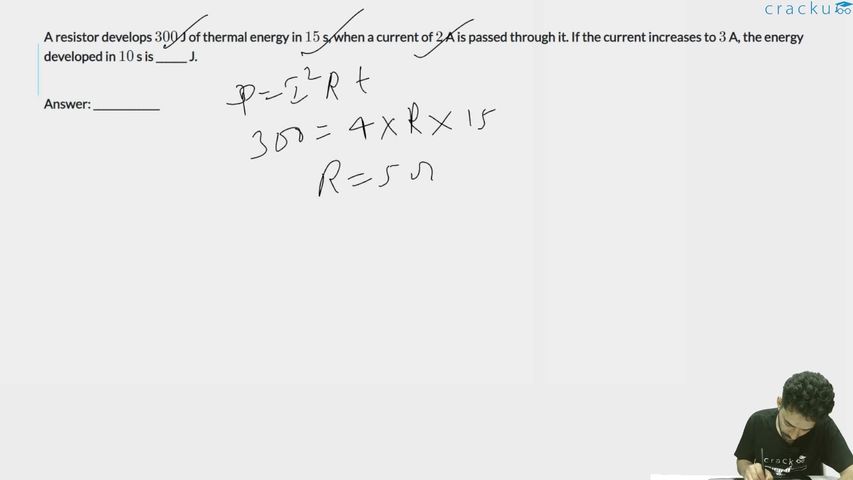
A resistor develops $$300$$ J of thermal energy in $$15$$ s, when a current of $$2$$ A is passed through it. If the current increases to $$3$$ A, the energy developed in $$10$$ s is ______ J.
Correct Answer: 450
Thermal energy $$E_1 = 300$$ J is developed in time $$t_1 = 15$$ s with a current of $$I_1 = 2$$ A. Using Joule’s law of heating, $$E = I^2 R t$$, the resistance of the resistor is determined by $$R = \frac{E_1}{I_1^2 t_1} = \frac{300}{(2)^2 \times 15} = \frac{300}{60} = 5\ \Omega$$.
When the current is increased to $$I_2 = 3$$ A for $$t_2 = 10$$ s, the energy developed is $$E_2 = I_2^2 R t_2 = (3)^2 \times 5 \times 10 = 9 \times 50 = 450\ \text{J}$$. Thus, the energy developed in 10 s is 450 J.
Was this solution helpful?
Click on the Email ☝️ to Watch the Video Solution
Create a FREE account and get:
_1.webp)

Educational materials for JEE preparation

Ask our AI anything

AI can make mistakes. Please verify important information.
AI can make mistakes. Please verify important information.
