
Join Our JEE Preparation Group
Prep with like-minded aspirants; Get access to free daily tests and study material.
Sign in
Please select an account to continue using cracku.in
↓ →
Join Our JEE Preparation Group
Prep with like-minded aspirants; Get access to free daily tests and study material.
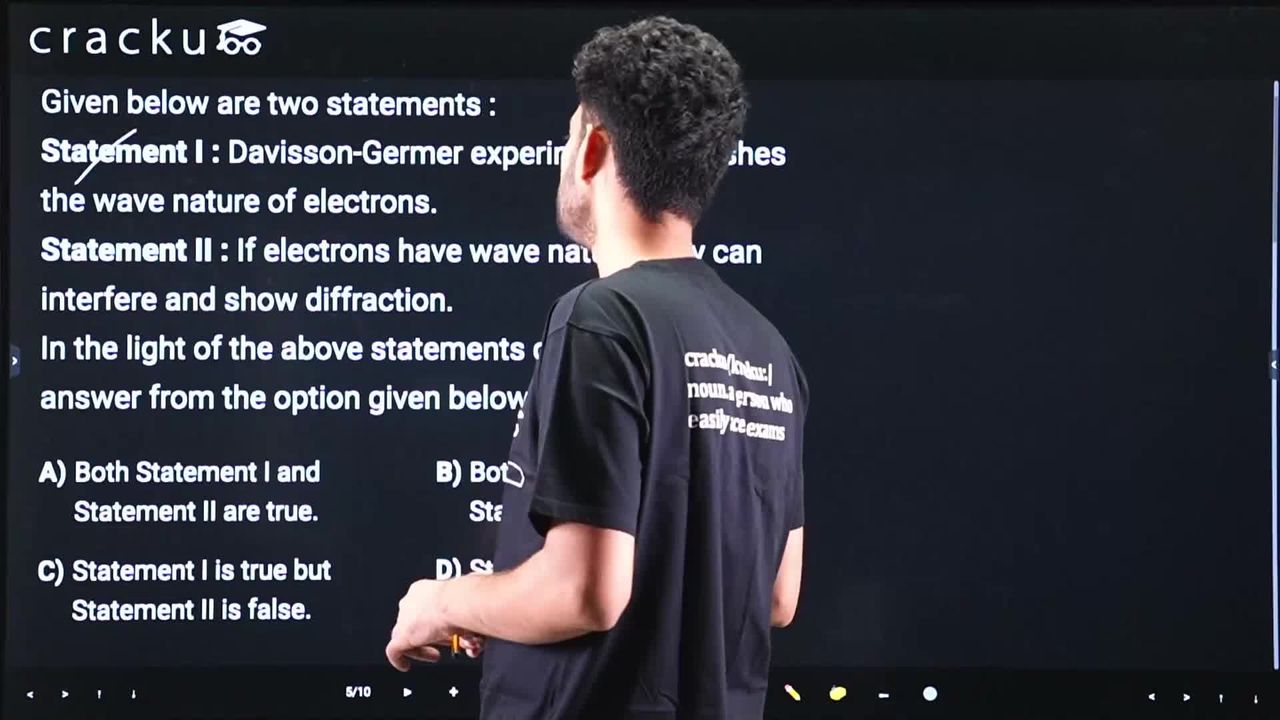
Given below are two statements :
Statement I : Davisson-Germer experiment establishes the wave nature of electrons.
Statement II : If electrons have wave nature, they can interfere and show diffraction.
In the light of the above statements choose the correct answer from the option given below :
We need to evaluate two statements about the wave nature of electrons.
Statement I: Davisson-Germer experiment establishes the wave nature of electrons.
This is TRUE. The Davisson-Germer experiment (1927) demonstrated electron diffraction by firing electrons at a nickel crystal and observing a diffraction pattern. The measured electron wavelengths matched the de Broglie prediction $$\lambda = \frac{h}{p}$$, thereby experimentally confirming the wave nature of electrons.
Statement II: If electrons have wave nature, they can interfere and show diffraction.
This is TRUE. Interference and diffraction are fundamental wave phenomena. Any entity that has wave nature must exhibit these properties. Since electrons possess wave nature (as established by Statement I and de Broglie's hypothesis), they can indeed show interference and diffraction patterns — which is exactly what is observed experimentally.
Both statements are true, and Statement II is a logical consequence of the wave nature of electrons.
The correct answer is Option A: Both Statement I and Statement II are true.
Was this solution helpful?
Click on the Email ☝️ to Watch the Video Solution
Create a FREE account and get:
_1.webp)

Educational materials for JEE preparation

Ask our AI anything

AI can make mistakes. Please verify important information.
AI can make mistakes. Please verify important information.
