
Join Our JEE Preparation Group
Prep with like-minded aspirants; Get access to free daily tests and study material.
Sign in
Please select an account to continue using cracku.in
↓ →
Join Our JEE Preparation Group
Prep with like-minded aspirants; Get access to free daily tests and study material.
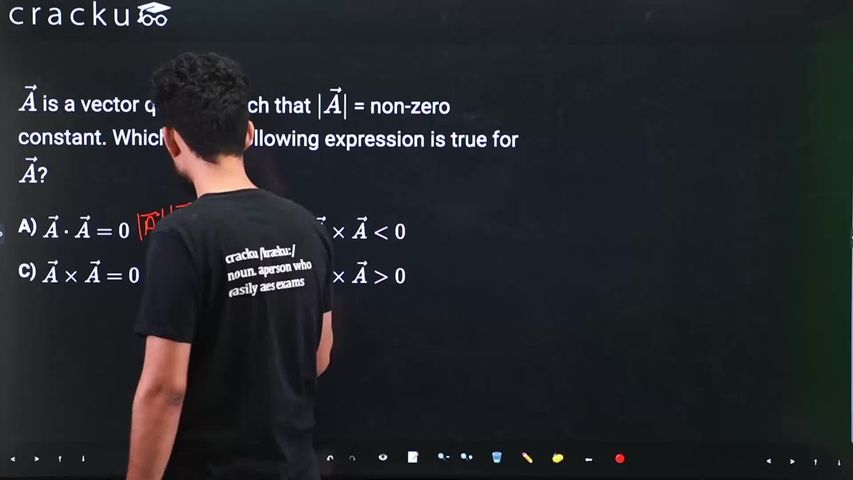
$$\vec{A}$$ is a vector quantity such that $$|\vec{A}|$$ = non-zero constant. Which of the following expression is true for $$\vec{A}$$?
We are given that $$\vec{A}$$ is a vector with $$|\vec{A}|$$ a non-zero constant, and we need to determine which of the provided expressions is true.
Consider Option A, which asserts $$\vec{A} \cdot \vec{A} = 0$$. In fact, $$\vec{A} \cdot \vec{A} = |\vec{A}|^2$$. Since $$|\vec{A}|$$ is non-zero, it follows that $$\vec{A} \cdot \vec{A} \neq 0$$, so Option A is false.
Options B and D claim $$\vec{A} \times \vec{A} < 0$$ or $$\vec{A} \times \vec{A} > 0$$, respectively. However, the cross product $$\vec{A} \times \vec{A}$$ is the zero vector, and vectors cannot be compared to scalars as "less than" or "greater than" in the usual sense. Thus these statements are invalid.
Option C states $$\vec{A} \times \vec{A} = 0$$. Indeed, since the angle between $$\vec{A}$$ and itself is $$0°$$ and $$\sin(0°)=0$$, one has
$$\vec{A} \times \vec{A} = |\vec{A}||\vec{A}|\sin(0°)\hat{n} = 0\,. $$
Therefore, the cross product of any vector with itself vanishes, and the correct answer is Option C: $$\vec{A} \times \vec{A} = 0$$.
Was this solution helpful?
Click on the Email ☝️ to Watch the Video Solution
Create a FREE account and get:
_1.webp)

Educational materials for JEE preparation

Ask our AI anything

AI can make mistakes. Please verify important information.
AI can make mistakes. Please verify important information.
