Join WhatsApp Icon JEE WhatsApp Group
JEE Laws of Thermodynamics Questions

Laws of Thermodynamics is one of the most important and high-weightage chapters in the Thermal Physics unit of JEE Physics. It governs how heat, work, and internal energy interact, and it underpins engines, refrigerators, and the behaviour of gases under various processes. Because it blends conceptual understanding with reliable numerical application, JEE Laws of Thermodynamics questions appear consistently in both JEE Main and JEE Advanced. This chapter covers the first law of thermodynamics, thermodynamic processes (isothermal, adiabatic, isobaric, isochoric), work done by gases, heat capacities, and the second law with engine and refrigerator efficiency. JEE Main tests process-based numericals, while JEE Advanced often combines thermodynamics with kinetic theory and PV-diagram reasoning. Practising topic-wise Cracku JEE Questions helps you interpret PV diagrams quickly and apply the first law without confusion over sign conventions.  A strong command of thermodynamics ties together kinetic theory and heat transfer, completing your mastery of the thermal physics unit.

Laws of Thermodynamics Topic Overview

Parameter

Details

Topic Name

Laws of Thermodynamics

Subject

Physics

JEE Main Weightage

~4–6% (2 questions on average)

JEE Advanced Weightage

~5–7% (often combined)

Difficulty Level

Moderate to High

Important Concepts

First Law, Thermodynamic Processes, Work by Gas, Heat Capacities, Second Law & Efficiency

Recommended Practice Level

High – attempt 70+ mixed problems

Why Practice JEE Laws of Thermodynamics Questions?

  • High weightage: Thermodynamics contributes around two questions in JEE Main most years.
  • PV-diagram skills: Interpreting and using PV diagrams is a recurring, transferable skill.
  • Strong in Advanced: Combined thermodynamics-kinetic-theory problems are JEE Advanced favourites.
  • Conceptual depth: The first and second laws build deep physical understanding.
  • Reliable numericals: Process-based questions reward systematic application.
  • Engine and efficiency focus: Carnot and real-engine problems are commonly tested.
  • Connects thermal topics: Thermodynamics links heat transfer and kinetic theory.

Important Concepts and Subtopics

Concept

Importance

Difficulty Level

Frequently Asked In

First Law of Thermodynamics

Very High

Moderate

JEE Main & Advanced

Thermodynamic Processes & PV Diagrams

Very High

Moderate–High

JEE Main & Advanced

Work Done by a Gas

Very High

Moderate

JEE Main & Advanced

Heat Capacities (Cp, Cv)

High

Moderate

JEE Main

Adiabatic & Isothermal Relations

High

Moderate–High

JEE Advanced

Second Law, Carnot Engine & Efficiency

Very High

Moderate–High

JEE Main & Advanced

Preparation Strategy for JEE Laws of Thermodynamics

Concept learning: Master the first law as energy conservation linking heat, work, and internal energy, and fix a consistent sign convention. Understand how each process appears on a PV diagram and what stays constant in each.

Formula revision: Keep work-done expressions for each process, adiabatic and isothermal relations, heat-capacity links, and efficiency formulas handy. Organised JEE Study Material helps you keep these process relations in one place for efficient revision.

Problem-solving techniques: Identify the process first, then choose the matching work and heat relations. Use the area under the PV curve for work done, and apply the first law to find the missing quantity.

Common mistakes: Sign errors in heat added versus work done, confusing isothermal and adiabatic relations, forgetting that internal energy depends only on temperature for an ideal gas, and misreading PV diagrams.

Exam strategy: Attempt single-process numericals first, then tackle cyclic-process and efficiency questions that require multiple steps.

JEE Main & Advanced Weightage Analysis

Exam

Average Questions

Expected Marks

JEE Main

2

8

JEE Advanced

2–3 (often combined)

8–14

Laws of Thermodynamics is a consistently heavy chapter in JEE Main and a frequent source of combined problems in JEE Advanced, especially those linking processes with kinetic theory.

Tips to Solve Thermodynamics Questions Faster

  • Identify the process (isothermal, adiabatic, isobaric, isochoric) before choosing any formula.
  • Use the area under the PV curve to find work done directly.
  • Remember that internal energy change depends only on temperature change for an ideal gas.
  • Fix a sign convention for heat and work at the start and apply it consistently.
  • For cyclic processes, net internal energy change is zero, so net heat equals net work.
  • Use Carnot efficiency as the maximum benchmark for engine problems.

Reinforcing these methods with a timed JEE Mock Test helps you interpret PV diagrams and apply the first law quickly under pressure.

JEE Laws of Thermodynamics Questions

Question 1

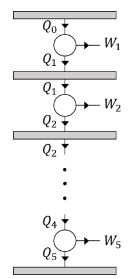
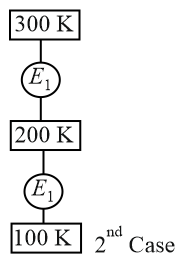
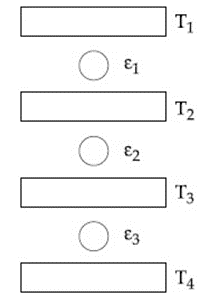
As shown in the figure, five Carnot engines, each with efficiency $$\eta$$ and same number of cycles per unit time, are operating between six heat reservoirs. The amount of heat released per cycle by one engine is completely absorbed by the next engine. Consider $$Q_0$$ to be the amount of heat absorbed per cycle by the first engine and $$W$$ as the amount of total work done by all the engines per cycle, then the net efficiency of the system is found to be $$\eta_{\text{net}}=\dfrac{W}{Q_0}=\dfrac{211}{243}$$. The value of $$\eta$$ is:

image
Question 2

One mole of an ideal diatomic gas expands from volume $$V$$ to $$2 V$$ isothermally at a temperature $$27^{o}C$$ and does W joule of work. lf the gas undergoes same magnitude of expansion adiabatically from $$27^{o}C$$ doing the same amount of work $$W$$, then its final temperature will be (close to) ____ $$^{\circ}C.$$
$$(\log_{e}2 = 0.693)$$

Question 3

The volume of an ideal gas increases 8 times and temperature becomes $$(1/4)^{th}$$ of initial temperature during a reversible change. If there is no exchange of heat in this process $$(\triangle Q = 0)$$ then identify the gas from the following options (Assuming the gases given in the options are ideal gases):

Question 4

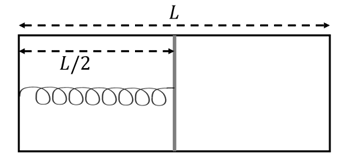
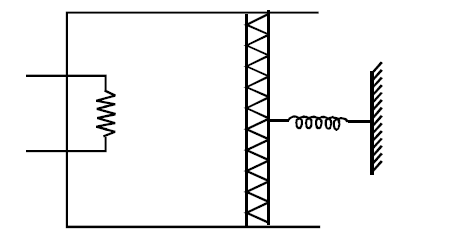
A cylinder with adiabatic walls is closed at both ends and is divided into two compartments by a frictionless adiabatic piston. Ideal gas is filled in both (left and right) the compartments at same P, V, T. Heating is started from left side until pressure changes to $$27 P/8$$. If initial volume of each compartment was 9 litres then the final volume in right-hand side compartment is __________ litres. (for this ideal gas $$C_P/C_V = 1.5$$)

Question 5

Given below are two statements: one is labelled as Assertion A and the other is labelled as Reason R.
Statement I: Change in internal energy of a system containing $$n$$ mole of ideal gas can be written as $$\Delta U = n C_v (T_f - T_i) = \frac{nR}{\gamma - 1}(T_f - T_i)$$, where $$\gamma = \frac{C_p}{C_v}$$, $$T_i$$ = initial temperature, $$T_f$$ = final temperature.
Statement II: Relation between degree of freedom $$f$$ and $$ \gamma$$ (= $$C_p/C_v$$) is $$\left(\gamma = 1 + \frac{2}{f}\right)$$.
Choose the correct answer from the options given below

Question 6

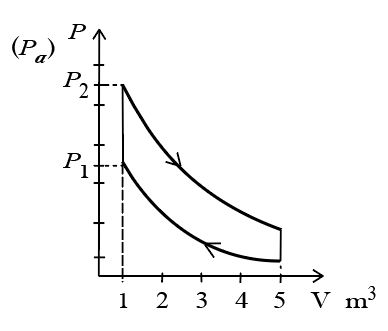
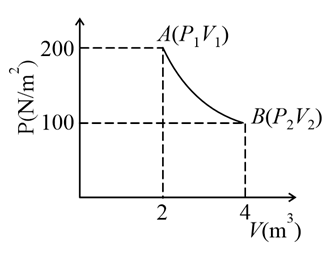
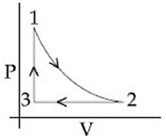
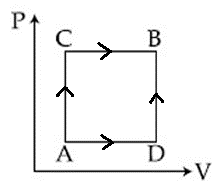
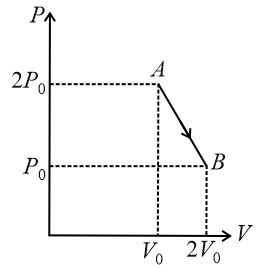
10 mole of an ideal gas is undergoing the process showu in the figure. The heat involved in the process from $$P_{1}$$ to $$P_{2}$$ is $$\alpha$$ Joule(P_{1}= 21.7Pa and $$P_{2} = 30$$ Pa, $$C_{v}=21J/K.mol, R=8.3 J/mol.K.$$) The value of $$\alpha$$ is _________.

image
Question 7

Consider the following statements:
A. Zeroth law of thermodynamics gives concept of temperature
B. First law of thermodynamics gives concept of internal energy
C. In isothermal expansion of ideal gas, $$\Delta Q \neq \Delta W$$
D. Product of intensive and extensive variables is extensive
E. The ratio of any extensive variable to mass will be an extensive variable
Choose the correct combination of statements from the options given below:

Question 8

Heat is supplied to a diatomic gas at constant pressure. Then the ratio of $$\Delta Q : \Delta U : \Delta W$$ is __________.

Question 9

One mole of diatomic gas having rotational modes only is kept in a cylinder with a piston system. The cross-section area of the cylinder is 4 cm$$^2$$. The gas is heated slowly to raise the temperature by 1.2 $$^\circ$$C during which the piston moves by 25 mm. The amount of heat supplied to the gas is __________ J. (Atmospheric pressure = 100 kPa, $$R = 8.3$$ J/mol. K) (Neglect mass of the piston)

Question 10

10 mole of oxygen is heated at constant volume from $$30^{\circ}C  \text{to}  40^{\circ}C$$. The change in the internal energy of the gas is ____ cal (the molecular specific heat of oxygen at constant pressure, $$C_{p}= 7 \text{cal}/\text{mol}.^{\circ}C \text{and} R = 2 \text{cal}./\text{mol}.^{\circ}C).$$

Question 11

A diatomic gas ( y= 1.4) does 100 J of work when it is expanded isobarically. Then the heat given to the gas ____ J.

Question 12

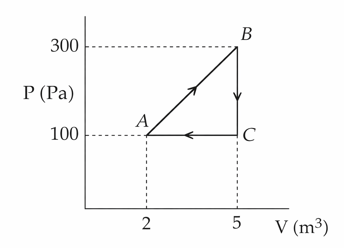
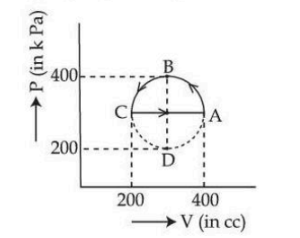
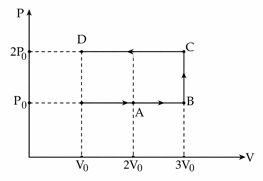
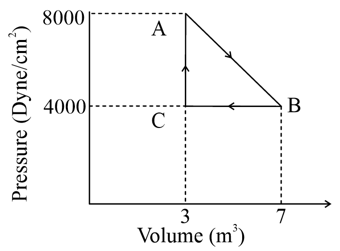
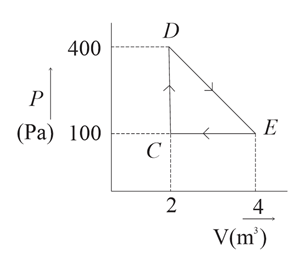
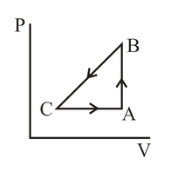
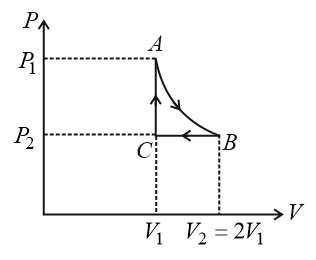
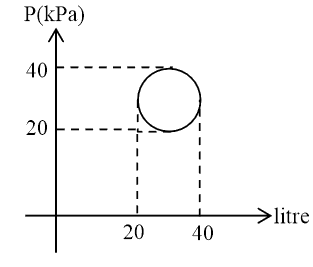
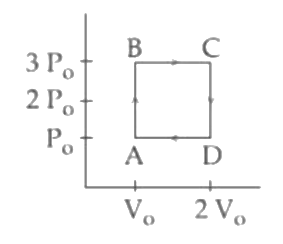
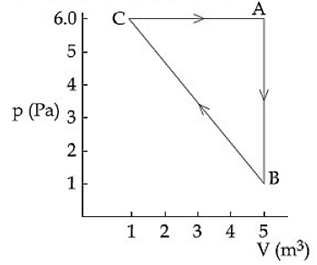
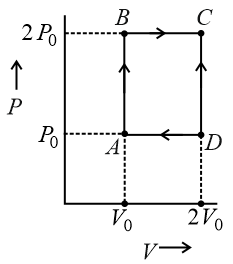
A thermodynamic system is taken through the cyclic process $$ABC$$ as shown in the figure. The total work done by the system during the cycle $$ABC$$ is ______ J.

image
Question 13

A vessel contains 0.15 m$$^3$$ of a gas at pressure 8 bar and temperature 140 °C with $$c_p = 3R$$ and $$c_v = 2R$$. It is expanded adiabatically till pressure falls to 1 bar. The work done during this process is __________ kJ. (R is gas constant)

Question 14

5 moles of unknown gas is heated at constant volume from 10 °C to 20 °C. The molar specific heat of this gas at constant pressure $$c_p = 8$$ cal/mol.°C and $$R = 8.36$$ J/mol.°C. The change in internal energy of the gas is _________ calorie.

Question 15

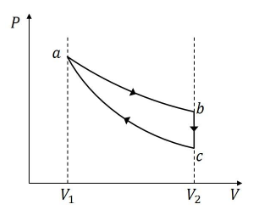
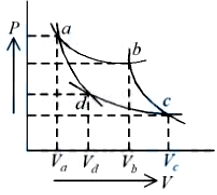
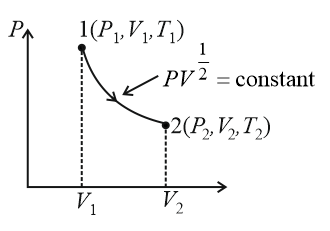
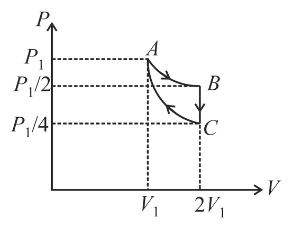
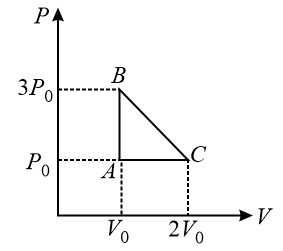
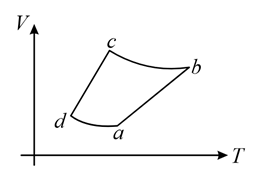
A quasi-static cycle of a monoatomic ideal gas contains an isothermal process ($$\boldsymbol{ab}$$), followed by an isochoric process ($$\boldsymbol{bc}$$) and an adiabatic process ($$\boldsymbol{ca}$$) as shown in the figure. The volumes of the gas are $$V_1$$ and $$V_2$$ at $$\boldsymbol{a}$$ and $$\boldsymbol{b}$$, respectively. If the cycle has heat input $$Q_{\text{in}}$$ and output $$Q_{\text{out}}$$, then the efficiency of the cycle is defined as $$\eta=\dfrac{Q_{\text{in}}-Q_{\text{out}}}{Q_{\text{in}}}$$. The correct statement(s) is(are):

[Given: $$\ln 2\approx 0.7$$]

image
Question 16

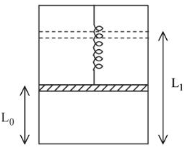
Ten moles of an ideal monatomic gas, initially in state $$\boldsymbol{a}$$ at atmospheric pressure and temperature $$T_a=27^\circ\mathrm{C}$$, is enclosed in a metal cylinder of volume $$V_0$$ fitted with a frictionless piston. The gas is suddenly compressed to state $$\boldsymbol{b}$$ with volume $$V_0/3$$. Now, keeping the piston stationary, the cylinder is submerged in a water bath of temperature $$11^\circ\mathrm{C}$$ until the gas reaches the temperature of the water bath, which is denoted as state $$\boldsymbol{c}$$. Finally, while still in the water bath, the piston is brought slowly to its initial position, which is denoted as state $$\boldsymbol{f}$$. If $$R$$ is universal gas constant, then the correct option(s) is/are:

[Given: $$9^{1/3}=2.08$$]

Frequently Asked Questions