Join WhatsApp Icon JEE WhatsApp Group

JEE Laws of Motion Questions

Laws of Motion is the heart of Mechanics and one of the most frequently tested chapters in JEE Physics. Built on Newton's three laws, it governs how forces produce motion and is the foundation for dynamics, circular motion, and rotational mechanics. Because nearly every mechanics problem reduces to a free-body analysis, JEE Laws of Motion questions are essential practice for both JEE Main and JEE Advanced.

This chapter covers force analysis, friction, tension, pseudo forces, and the dynamics of connected systems. JEE Main tests direct applications of Newton's laws and friction, while JEE Advanced layers in pulleys, inclined planes, and non-inertial frames for higher-order reasoning. Practising topic-wise JEE Questions trains you to draw accurate free-body diagrams, the single most important skill in this chapter.

A strong command of Laws of Motion makes the rest of Mechanics far more manageable, since the same force-analysis approach reappears everywhere from circular motion to rotational dynamics.

Laws of Motion Topic Overview

Parameter

Details

Topic Name

Laws of Motion

Subject

Physics

JEE Main Weightage

~4–6% (2–3 questions on average)

JEE Advanced Weightage

~6–8% (often in multi-body problems)

Difficulty Level

Moderate to High

Important Concepts

Newton's Laws, Free-Body Diagrams, Friction, Tension, Pseudo Forces

Recommended Practice Level

High – attempt 70+ mixed problems

Why Practice JEE Laws of Motion Questions?

  • High weightage: Laws of Motion contributes 2–3 questions in JEE Main most years.
  • Core of mechanics: Free-body analysis here is reused across circular and rotational motion.
  • Strong in Advanced: Connected systems and pseudo-force problems are JEE Advanced favourites.
  • Builds analytical discipline: Drawing correct free-body diagrams trains systematic problem-solving.
  • Friction is universal: Friction concepts appear in many other mechanics chapters.
  • Improves accuracy: Practice reduces the sign and force-direction errors common here.
  • Rewards method over memory: A consistent approach beats formula memorisation in this chapter.

Important Concepts and Subtopics

Concept

Importance

Difficulty Level

Frequently Asked In

Newton's Three Laws

Very High

Easy–Moderate

JEE Main & Advanced

Free-Body Diagrams

Very High

Moderate

JEE Main & Advanced

Friction (Static & Kinetic)

Very High

Moderate

JEE Main & Advanced

Tension & Connected Bodies

High

Moderate–High

JEE Main & Advanced

Pulley Systems

High

High

JEE Advanced

Pseudo Forces & Non-Inertial Frames

Moderate

High

JEE Advanced

Circular Motion Dynamics

High

Moderate–High

JEE Main & Advanced

Preparation Strategy for JEE Laws of Motion

Concept learning: Master Newton's three laws and the concept of net force. The key skill is drawing a correct free-body diagram for each object, marking every real force acting on it.

Formula revision: Keep friction relations, tension-balance conditions, and circular-motion force equations ready. Pairing practice with structured JEE Online Coaching helps you internalise the systematic free-body approach and clear doubts on tricky pulley and pseudo-force problems.
Problem-solving techniques: For connected systems, isolate each body, write its equation, and use the constraint relations to link accelerations. For non-inertial frames, add the pseudo force before analysing.

Common mistakes: Adding forces that don't act on the chosen body, ignoring friction direction, confusing static and kinetic friction limits, and forgetting constraint relations in pulley problems.

Exam strategy: Start with single-body and friction questions, then move to connected systems and pseudo-force problems that require more setup.

JEE Main & Advanced Weightage Analysis

Exam

Average Questions

Expected Marks

JEE Main

2–3

8–12

JEE Advanced

2–3 (often multi-body)

8–14

Laws of Motion is a consistently heavy chapter in JEE Main and a recurring source of multi-body problems in JEE Advanced. Mastery here directly improves performance across the entire Mechanics unit.

Tips to Solve Laws of Motion Questions Faster

  • Draw a clean free-body diagram for every object before writing any equation.
  • Mark only real forces, never include "ma" as a force in an inertial frame.
  • For connected bodies, write the constraint relation early to link their accelerations.
  • Check whether friction is static or kinetic before applying its formula.
  • In non-inertial frames, add the pseudo force opposite to the frame's acceleration.
  • Resolve forces along and perpendicular to the direction of motion for cleaner equations.

Practising these under timed conditions with a JEE Mock Test helps convert the free-body method into fast, reliable instinct.

JEE Laws of Motion Questions

Question 1

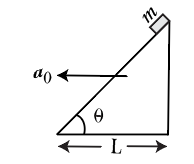
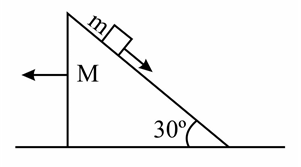
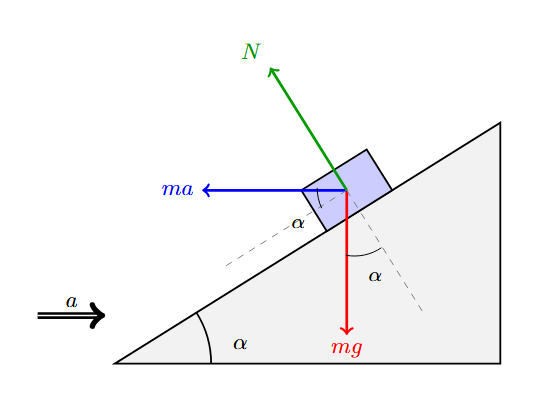
A small block of mass m slides down from the top of a frictionless inclined surface, while the inclined plane is moving towards left with constant acceleration $$a_{0}$$. The angle between the inclined plane and ground is θ and its base length is L. Assuming that initially the small block is at the top of the inclined plane, the time it takes to reach the lowest point of the inclined plane is ___ .

image
Video Solution
Question 2

A car moving with a speed of 54 km/h takes a turn of radius 20 m. A simple pendulum is suspended from the ceiling of the car. Determine the angle made by the string of the pendulum with the vertical during the turning. (Take $$g = 10$$ m/s$$^2$$)

Video Solution
Question 3

At $$t = 0$$, a body of mass $$100$$ g starts moving under the influence of a force $$(5\hat{i} + 10\hat{j})$$ N. After $$2$$ s, its  position is $$(2x\hat{i} + 5y\hat{j})$$ m. The ratio $$x : y$$ is ______.

Video Solution
Question 4

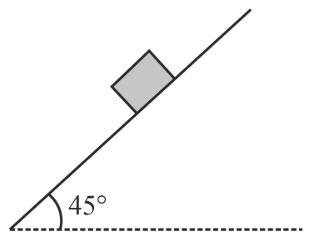
The time taken by a block of mass $$m$$ to slide down from the highest point to the lowest point on a rough inclined plane is 50% more compared to the time taken by the same block on identical inclined smooth plane. Both inclined planes are at $$45°$$ with the horizontal. The coefficient of kinetic friction between the rough inclined surface and block is :

Video Solution
Question 5

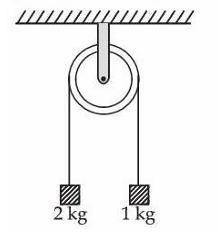
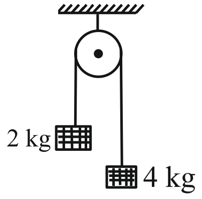
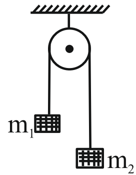
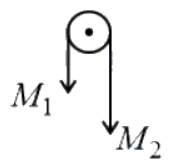
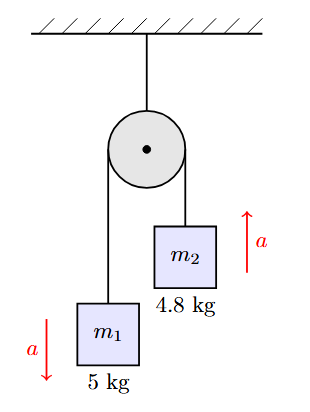
Two blocks of masses 2 kg and 1 kg respectively, are tied to the ends of a string which passes over a light frictionless pulley as shown in the figure. The masses are held at rest at the same horizontal level and then released. The distance traversed by the centre of mass in 2 s is _________ m. (Take $$g = 10$$ m/s$$^2$$)

image
Video Solution
Question 6

A body of mass 14 kg initially at rest explodes and breaks into three fragments of masses in the ratio 2 : 2 : 3. The two pieces of equal masses fly off perpendicular to each other with a speed of 18 m/s each. The velocity of the heavier fragment is ______m/s.

Question 7

The position of an object having mass 0.1 kg as a function of time t is given as $$\vec{r} = \left(10t^2 \hat{i} + 5t^3 \hat{j}\right)$$ m. At $$t = 1$$ s, which of the following statements are correct? A. The linear momentum $$\vec{p} = \left(2\hat{i} + 1.5\hat{j}\right)$$ kg·m/s. B. The force acting on the object $$\vec{F} = \left(2\hat{i} + 3\hat{j}\right)$$ N. C. The angular momentum of the object about its origin $$\vec{L} = 15 \hat{k}$$ J·s. D. The torque acting on the object about its origin $$\vec{\tau} = 20 \hat{k}$$ N·m. Choose the correct answer from the options given below :

Question 8

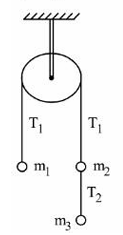
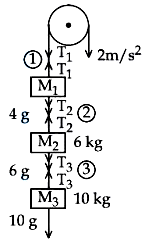
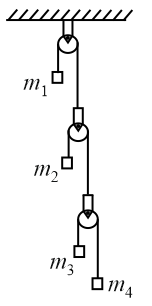
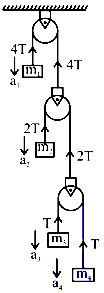
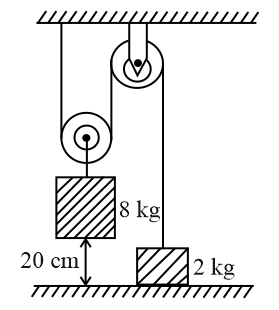
Three masses $$m_1 = 4$$ kg, $$m_2 = 4$$ kg and $$m_3 = 6$$ kg are suspended from a fixed smooth frictionless pully as shown in the figure below. The value of $$T_1/T_2$$ is _______. (take $$g = 10$$ m/s$$^2$$)

image
Question 9

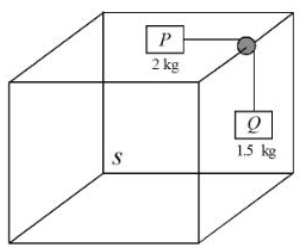
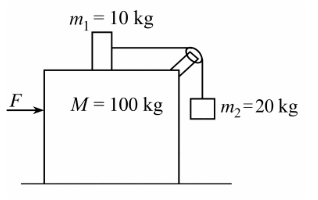
Two blocks (P and Q) with respectively masses 2 kg and 1.5 kg are joined by a massless thread. These blocks are mounted on a frictionless pully which is fixed on the edge of a cube (S), as shown in the figure below. Block P is positioned on the top surface which has no friction and block Q is in contact with side-surface, having coefficient friction $$\mu$$. The cube (S) moves towards the right with acceleration of $$\frac{g}{2}$$, where g is gravitational acceleration. During this movement the block P and Q remain stationary. The value of $$\mu$$ is _______.
(take g = 10 m/s$$^2$$)

image
Question 10

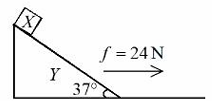
A wedge Y with mass of 10 kg and all frictionless surfaces and the inclined surface making 37° with horizontal. A block X with mass 2 kg is placed at the highest point of the wedge as shown in figure is at rest. At $$t = 0$$ wedge (Y) is pulled toward right with constant force ($$f$$) of 24 N. Taking the block X at rest at $$t = 0$$, the time taken by it to slide down 8.8 m on the slope, while Y is on the move, is _______ s. (take $$\tan(37°) = 3/4$$ and $$g = 10$$ m/s$$^2$$)

image
Question 11

A particle of mass m falls from rest through a resistive medium having resistive force, F = -kv, where v is the velocity of the particle and k is a constant. Which of the following graphs represents velocity (v) versus time (t)?

Question 12

A 4 kg mass moves under the influence of a force $$\overrightarrow{F}=\left(4t^{3}\widehat{i}-3t\widehat{j}\right)N$$ where t is the time in second. If mass starts from origin at t= 0, the velocity and position after t= 2 s will be:

Question 13

A flexible chain of mass m hangs between two fixed points at the same level. The inclination of the chain with the horizontal at the two points of support is $$30^{\circ}$$. Considering the equilibrium of each half of the chain, the tension of the chain at the lowest point is __________.

Question 14

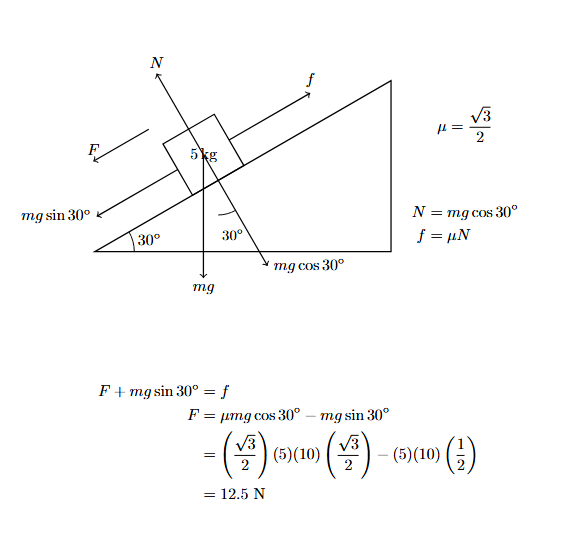
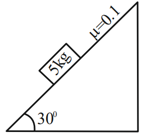
A block of mass 5 kg is moving on an inclined plane which makes an angle of 30° with the horizontal. Friction coefficient between the block and inclined plane surface is $$\frac{\sqrt{3}}{2}$$. The force to be applied on the block so that the block will move down without acceleration is _______N
$$(g=10m/s^{2})$$

Question 15

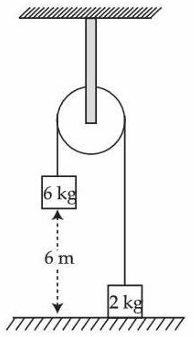
The velocity at which 6 kg mass (shown in figure) strikes the ground when it is released from a height of 6 m above the ground is __________ m/s. Assume pulley is massless and string is light and inextensible. (Take $$g = 10$$ m/s$$^2$$)

image
Question 16

A block takes $$t$$ time to slide down a plane inclined at 45° to the horizontal. If the surface is made smooth (frictionless), the block takes time $$\dfrac{t}{2}$$ to slide down the plane. The coefficient of friction between the block and the inclined plane is $$\left(\dfrac{\alpha}{100}\right)$$. The value of $$\alpha$$ is __________.

Question 17

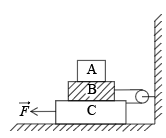
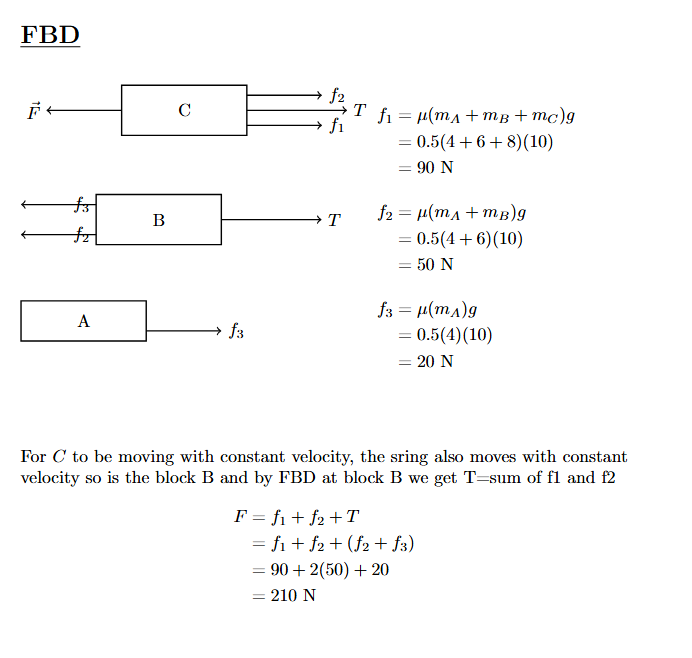
In the given figure, the blocks A, B and C weigh 4 kg, 6 kg and 8 kg, respectively. The coefficient of sliding friction between any two surfaces is 0.5. The force F required to slide the block C with constant speed is __ N. (Use $$g=10m/s^{2}$$) 

image
Question 18

Two masses of 3.4 kg and 2.5 kg are accelerated from an initial speed of 5 m/s and 12 m/s, respectively. The distances traversed by the masses in the 5$$^{\text{th}}$$ second are 104 m and 129 m, respectively. The ratio of their momenta after 10 s is $$\frac{x}{8}$$. The value of $$x$$ is __________.

Frequently Asked Questions