Join WhatsApp Icon JEE WhatsApp Group

JEE Kinetic Theory of Gases Questions

Kinetic Theory of Gases is a conceptually rich chapter in the Thermal Physics unit of JEE Physics that explains the macroscopic behaviour of gases from molecular motion. It connects pressure, temperature, and energy to the movement of countless molecules, bridging mechanics and thermodynamics. Because it offers both clean numerical questions and elegant conceptual ones, JEE Kinetic Theory of Gases questions appear reliably in JEE Main and feature in JEE Advanced. This chapter covers the ideal gas law, the kinetic interpretation of pressure and temperature, degrees of freedom, the law of equipartition of energy, mean free path, and molecular speeds. JEE Main tests RMS speed, energy, and gas-law applications, while JEE Advanced often links kinetic theory with thermodynamic processes. Practising topic-wise JEE Questions helps you master the relationships between speed, temperature, and energy that drive most questions.

A clear grasp of kinetic theory strengthens your thermodynamics preparation, since the two chapters frequently combine in higher-order problems.

Kinetic Theory of Gases Topic Overview

Parameter

Details

Topic Name

Kinetic Theory of Gases

Subject

Physics

JEE Main Weightage

~3–4% (1–2 questions on average)

JEE Advanced Weightage

~3–5% (often combined)

Difficulty Level

Moderate

Important Concepts

Ideal Gas Law, Kinetic Pressure, Molecular Speeds, Degrees of Freedom, Equipartition

Recommended Practice Level

High – attempt 50+ mixed problems

Why Practice JEE Kinetic Theory Questions?

  • Reliable weightage: Kinetic theory contributes 1–2 questions in JEE Main most years.
  • Bridges topics: It connects molecular mechanics to thermodynamics.
  • Clean numericals: RMS-speed and energy questions are quick once formulas are known.
  • Strong in Advanced: Combined kinetic-theory and thermodynamics problems are common.
  • Conceptual elegance: Equipartition and degrees of freedom build deep understanding.
  • Predictable patterns: Question types repeat across years, rewarding focused practice.
  • Efficient revision: A compact formula set makes review effective.

Important Concepts and Subtopics

Concept

Importance

Difficulty Level

Frequently Asked In

Ideal Gas Equation

Very High

Easy–Moderate

JEE Main

Kinetic Interpretation of Pressure

High

Moderate

JEE Main & Advanced

Molecular Speeds (RMS, Mean, Most Probable)

Very High

Moderate

JEE Main & Advanced

Degrees of Freedom

High

Moderate

JEE Main & Advanced

Law of Equipartition of Energy

Very High

Moderate

JEE Main & Advanced

Mean Free Path

Moderate

Moderate

JEE Main

Preparation Strategy for JEE Kinetic Theory

Concept learning: Understand how molecular motion gives rise to pressure and how temperature measures average kinetic energy. Learn degrees of freedom for mono-, di-, and polyatomic gases, since these determine energy and heat capacities.

Formula revision: Keep relations for RMS, mean, and most probable speeds, average kinetic energy, degrees of freedom, and heat-capacity ratios handy. Pairing this with structured JEE Online Coaching helps you reinforce the equipartition principle and clear doubts on combined problems.

Problem-solving techniques: Use the relationship between temperature and average kinetic energy to link speed and energy. Apply degrees of freedom to find internal energy and heat-capacity ratios for different gas types.

Common mistakes: Confusing the three molecular speeds, forgetting that average kinetic energy depends only on temperature, misusing degrees of freedom, and unit errors with the gas constant.

Exam strategy: Attempt direct gas-law and speed questions first, then tackle degrees-of-freedom and combined thermodynamic problems.

JEE Main & Advanced Weightage Analysis

Exam

Average Questions

Expected Marks

JEE Main

1–2

4–8

JEE Advanced

1–2

4–8

Kinetic Theory is a steady contributor in JEE Main through speed, energy, and gas-law questions. In JEE Advanced, it frequently combines with thermodynamic processes in multi-step problems.

Tips to Solve Kinetic Theory Questions Faster

  • Use the temperature–kinetic-energy relation to connect molecular speed and energy quickly.
  • Remember the ordering: most probable < mean < RMS speed.
  • Apply degrees of freedom directly to find internal energy and Cp/Cv ratios.
  • For speed comparisons between gases, use the inverse-square-root dependence on molar mass.
  • Keep average kinetic energy as depending only on temperature, not gas type.
  • Use SI units consistently, especially for the gas constant and molar mass.

Reinforcing these methods with a timed JEE Mock Test helps you link speed, temperature, and energy instantly under exam pressure.

JEE Kinetic Theory of Gases Questions

Question 1

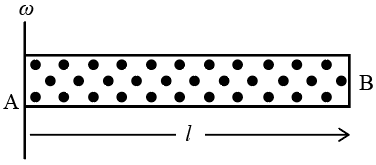
A cylindrical tube $$AB$$ of length $$l$$, closed at both ends contains an ideal gas of 1 mol having molecular weight $$M$$. The tube is rotated in a horizontal plane with constant angular velocity $$\omega$$ about an axis pe1pendicular to $$AB$$ and passing through the edge at end $$A$$ , as shown in the figure. If $$P_{A}$$ and $$P_{B}$$ are the pressures at $$A$$ and $$B$$ respectively, then
(Consider the temperature is same at all points in the tube)

Screenshot_33
Question 2

Consider two boxes containing ideal gases A and B such that their temperatures, pressures and number densities are same. The molecular size of A is half of that of B and mass of molecule A is four times that of B. If the collision frequency in gas B is $$32 \times 10^{18}/s$$ then collision frequency in gas A is _____________/s.

Question 3

Given below are two statements: one is labelled as Assertion A and the other is labelled as Reason R

Assertion A: If the average kinetic energy of H$$_2$$ and O$$_2$$ molecules, kept in two different sized containers are same, then their temperatures will be same.

Reason R: The r.m.s. speed of H$$_2$$ and O$$_2$$ molecules are same at same temperature.
Choose the correct answer from the options given below : 

Question 4

The internal energy of a monoatomic gas is 3nRT. One mole of helium is kept in a cylinder having internal cross section area of 17 $$cm^{2}$$ and fitted with a light movable frictionless piston. The gas is heated slowly by suppling 126 J heat. If the temperature rises by $$4^{o}C$$, then the piston will move ____ cm.
(atmospheric pressure= $$10^{5}$$ Pa)

Question 5

A mixture of carbon dioxide and oxygen has volume 8310 cm$$^3$$, temperature 300 K, pressure 100 kPa and mass 13.2 g. The number of moles of carbon dioxide and oxygen gases in the mixture respectively are _____.
(Assume both gases behave like ideal gases) [$$R = 8.31$$ J/mol.K]

Question 6

An ideal gas at pressure $$P$$ and temperature $$T$$ is expanding such that $$PT^3 = \text{constant}$$. The coefficient of volume expansion of the gas is :

Question 7

If 2 mole of an ideal monoatomic gas at temperature $$T$$, is mixed with 6 mole of another ideal monoatomic gas at temperature $$2T$$ then the temperature of mixture is :

Question 8

One gas of $$n_1$$ mole of molecules at temperature $$T_1$$, volume $$V_1$$, and pressure $$P_1$$, and another gas of $$n_2$$ mole of molecules at temperature $$T_2$$, volume $$V_2$$, and pressure $$P_2$$, are mixed resulting in pressure $$P$$ and volume $$V$$ of the mixture. The temperature of the mixture is :

Question 9

The r.m.s. speed of oxygen molecules at $$47^\circ$$ is equal to that of the hydrogen molecules kept at ________ $$C^\circ$$. (Mass of oxygen molecule/mass of hydrogen molecule = 32/2)

Question 10

Two closed vessels of same volume are joined through a narrow tube and both vessels are filled with air of pressure 90 kPa and temperature 400 K. Keeping the temperature of one vessel constant at 400 K the second vessel temperature is raised to 500 K. The final pressure in the vessels is _______ kPa.

Question 11

An ideal gas undergoes a process maintaining relation between pressure $$(P)$$ and volume $$(V)$$ as $$P = P_0\left(1 + \left(\frac{V_0}{V}\right)^2\right)^{-1}$$, where $$P_0$$ and $$V_0$$ are constants. If two samples A and B (two moles each) with initial volumes $$V_0$$ and $$3V_0$$ respectively undergo above mentioned process and attain same pressure, then the difference of the temperatures of these samples, $$T_B - T_A$$ is : 

(R = gas constant)

Question 12

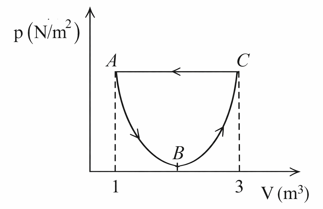
In the following p- V diagram the equation of state along the curved path is given by $$(V-2)^{2}=4ap$$ where a is a constant. The total work done in the closed path is

35-1
Question 13

Initial pressure and volume of a monoatomic ideal gas are $$P$$ and $$V$$. The change in internal energy of this gas in adiabatic expansion to volume $$V_{final} = 27V$$ is __________ J.

Question 14

The mean free path of a molecule of diameter $$5\times 10^{-10}m$$ at the temperature 41 °C and pressure $$1.38\times 10^{5} Pa$$, is given as ___ m (Given $$k_{B}=1.38\times 10^{-23}J/K$$.)

Question 15

When 300 J of heat given to an ideal gas with $$C_{p}= \frac{7}{2}R$$ its temperature raises from $$20^{\circ}C$$ to $$50^{\circ}C$$ keeping its volume constant. The mass of the gas is (approximately) __ g. (R = 8.314 J/mol.K)

Question 16

A gas of certain mass filled in a closed cylinder at a pressure of 3.23 kPa has temperature 50 °C. The gas is now heated to double its temperature. The modified pressure is __ Pa.

Question 17

An insulated cylinder of volume $$60cm^{3}$$ is filled with a gas at $$27 ^{\circ}C$$ and 2 atmospheric pressure. Then the gas is compressed making the final volume as $$20cm^{3}$$ while allowing the temperature to rise to $$77 ^{\circ}C$$. The final pressure is ___________ atmospheric pressure.

Frequently Asked Questions