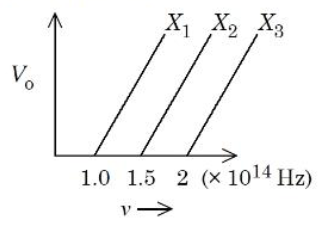
Join WhatsApp Icon JEE WhatsApp Group

JEE Dual Nature of Matter & Radiation Questions

Dual Nature of Matter and Radiation is one of the most scoring and predictable chapters in the Modern Physics section of JEE Physics. It introduces the revolutionary idea that light and matter both exhibit wave and particle behaviour, anchored by the photoelectric effect and the de Broglie hypothesis. Because most questions are direct and formula-based, JEE Dual Nature of Matter and Radiation questions are among the best returns on study time in the entire syllabus. This chapter covers the photoelectric effect and its laws, work function and threshold frequency, stopping potential, Einstein's photoelectric equation, the particle nature of light through photons, and the wave nature of matter through the de Broglie wavelength. JEE Main typically tests the photoelectric equation, stopping potential, and de Broglie relations, while JEE Advanced occasionally adds conceptual depth around photon momentum and energy. Practising topic-wise Cracku JEE Questions helps you lock in these direct relations and avoid careless unit errors.

Because the chapter has few derivations and many direct applications, disciplined practice converts quickly into accuracy. A focused effort here meaningfully lifts your Modern Physics score, which is why strong aspirants treat it as a guaranteed-marks chapter rather than an afterthought.

Dual Nature of Matter and Radiation Topic Overview

Parameter

Details

Topic Name

Dual Nature of Matter and Radiation

Subject

Physics

JEE Main Weightage

~3–5% (1–2 questions on average)

JEE Advanced Weightage

~3–5% (often conceptual)

Difficulty Level

Easy to Moderate

Important Concepts

Photoelectric Effect, Work Function, Stopping Potential, de Broglie Wavelength, Photons

Recommended Practice Level

High – attempt 60+ mixed problems

Why Practice JEE Dual Nature of Matter and Radiation Questions?

  • High scoring efficiency: Most questions are direct and formula-based, making them quick wins.
  • Reliable weightage: This chapter contributes 1–2 questions in JEE Main most years.
  • Predictable patterns: Photoelectric and de Broglie questions repeat in familiar formats.
  • Minimal derivations: Less time on proofs leaves more for practice and revision.
  • Boosts confidence: Quick marks here build momentum in the Physics section.
  • Conceptual clarity: It develops a clear picture of wave-particle duality.
  • Easy to revise: A compact formula set makes last-minute review highly effective.

Important Concepts and Subtopics

Concept

Importance

Difficulty Level

Frequently Asked In

Photoelectric Effect & Its Laws

Very High

Easy–Moderate

JEE Main & Advanced

Work Function & Threshold Frequency

Very High

Easy

JEE Main

Einstein's Photoelectric Equation

Very High

Moderate

JEE Main & Advanced

Stopping Potential

High

Moderate

JEE Main

Photon Energy & Momentum

High

Moderate

JEE Main & Advanced

de Broglie Wavelength

Very High

Easy–Moderate

JEE Main & Advanced

Intensity vs Frequency Effects

Moderate

Easy

JEE Main

Preparation Strategy for JEE Dual Nature of Matter and Radiation

Concept learning: Build a clear photon picture of light and understand the experimental laws of the photoelectric effect — how stopping potential depends on frequency but not intensity, and how photocurrent depends on intensity. Then learn the de Broglie hypothesis, connecting a particle's momentum to an associated wavelength.

Formula revision: Keep Einstein's photoelectric equation, work-function and threshold relations, stopping-potential expressions, and the de Broglie wavelength formula together for quick review. Structured JEE Online Coaching helps you reinforce these relations and clear conceptual doubts on duality efficiently.

Problem-solving techniques: Identify whether a problem needs energy conservation (photoelectric) or a wavelength relation (de Broglie). Keep energy in electron-volts for atomic-scale problems, and use the constant hc to shortcut wavelength-energy conversions.

Common mistakes: Confusing work function with threshold frequency, mixing electron-volts and joules, treating stopping potential as dependent on intensity, and misapplying the de Broglie relation.

Exam strategy: Treat this chapter as a quick-marks reservoir — attempt its questions early in the Physics section to bank score and build confidence before heavier chapters.

JEE Main & Advanced Weightage Analysis

Exam

Average Questions

Expected Marks

JEE Main

1–2

4–8

JEE Advanced

1–2

4–8

Dual Nature of Matter and Radiation is a consistently scoring chapter in JEE Main, with direct photoelectric and de Broglie questions. JEE Advanced maintains steady representation, usually with clean numerical or conceptual problems on photons and duality.

Tips to Solve Dual Nature Questions Faster

  • Use the constant hc (about 1240 eV·nm) to shortcut photon energy and wavelength calculations.
  • Remember stopping potential depends on frequency, while photocurrent depends on intensity.
  • Keep energy in electron-volts for atomic-scale problems to avoid unit errors.
  • Apply Einstein's equation directly: photon energy equals work function plus maximum kinetic energy.
  • Use the de Broglie relation to link momentum and wavelength in one step.
  • Recognise the standard photoelectric graph shapes to answer conceptual questions instantly.

Reinforcing these shortcuts with a timed JEE Mock Test ensures you capture every easy mark this chapter offers.

JEE Dual Nature of Matter & Radiation Questions

Question 1

When a light of a given wavelength falls on a metallic surface the stopping potential for photoelectrons is 3.2 V. If a second light having wavelength twice of first light is used, the stopping potential drops to 0. 7 V. The wavelength of first light is ___ m.
$$(h= 6.63\times10^{-34}J.s,e=1.6\times10^{-19}C,c=3\times10^{8}m/s)$$

Question 2

Number of photons of equal energy emitted per second by a 6 mW laser source operating at 663 nm is ____ . (Given: $$h=6.63\times 10^{-34}J.s\text{ and }c=3\times 10^{8} m/s$$)

Video Solution
Question 3

Light is incident on a metallic plate having work function $$110 \times 10^{-20}J$$. If the produced photoelectrons have zero kinetic energy then the angular frequency of the incident light is ___ rad/s. (h = $$6.63 \times 10^{-34}J.s.$$).

Video Solution
Question 4

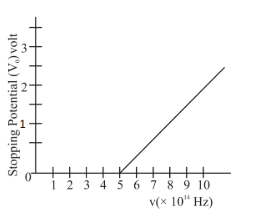
The graph shows variation of stopping potential $$V_0$$ with the frequency $$\nu$$ of the incident radiation for three photosensitive metals $$X_1$$, $$X_2$$ and $$X_3$$. Which metal will give out electrons with greater kinetic energy, for the same wavelength of incident radiation?

image
Video Solution
Question 5

An electron of mass $$m$$ is moving in an electric field $$\vec{E} = -2E_o \hat{i}$$ ($$E_o$$ = constant > 0), with an initial velocity $$\vec{V} = v_o \hat{i}$$ ($$v_o$$ = constant > 0). If $$\lambda_o = \frac{h}{4mv_o}$$, its de Broglie wavelength at time $$t$$ is _______. ($$e$$ = charge of electron)

Video Solution
Question 6

A light wave described by $$E=60[\sin(3\times10^{15})t+\sin(12\times10^{15})t]$$ (in SI units) falls on a metal surface of work function 2.8 eV. The maximum kinetic energy of ejected photoelectron is (approximately) ___ eV. $$(h=6.6\times10^{-34}J.s\text{ and }e=1.6\times10^{19}C)$$

Question 7

Light source having wavelength 331 nm is used to generate photo-electrons whose stopping potential is 0.2 V. The work function of the used metal in the experiment is $$\alpha \times 10^{-19}$$ J. The value of $$\alpha$$ is _______. (h = $$6.62 \times 10^{-34}$$ J s, e = $$1.6 \times 10^{-19}$$ C and c = $$3 \times 10^8$$ m/s)

Question 8

For a certain metal, when monochromatic light of wavelength $$\lambda$$ is incident, the stopping potential for photoelectrons is $$3V_0$$. When the same metal is illuminated by light of wavelength $$2\lambda$$, then the stopping potential becomes $$V_0$$. The threshold wavelength for photoelectric emission for the given metal is $$\alpha \lambda$$. The value of $$\alpha$$ is __________.

Question 9

An electron is travelling with a velocity $$v$$ in free space and when it enters a medium, its velocity is reduced by 20%. The de Broglie wavelength of electron in the medium is $$\alpha \lambda_0$$.where $$\lambda_0$$ is its de Broglie wavelength in free space. The value of $$\alpha$$ is :

Question 10

$$K_1$$ and $$K_2$$ be the maximum kinetic energies of photoelectrons emitted from a surface of a given material for the light of wavelength $$\lambda_1$$ and $$\lambda_2$$, respectively. If $$\lambda_1 = 2\lambda_2$$ then the work function of material is given by :

Question 11

If an alpha particle with energy 7.7 MeV is bombarded on a thin gold foil, the closest distance from nucleus it can reach is ___ m. (Atomic number of gold = 79 and $$\frac{1}{4\pi\epsilon _{0}}=9\times10^{9} \text{in SI units} )$$

Question 12

The de Broglie wavelength associated with an electron accelerated through a potential difference V is $$\lambda_e$$ and the de Broglie wavelength associated with a proton accelerated through the same potential difference is $$\lambda_p$$. If their corresponding masses are $$m_e$$ and $$m_p$$, respectively, then the ratio of their de Broglie wavelengths $$\left(\frac{\lambda_e}{\lambda_p}\right)$$ is ______.

Question 13

The de Broglie wavelength for an electron accelerated through the potential difference of $$V_1$$ volt is $$\lambda_1$$. When the potential difference is changed to $$V_2$$ volt, the associated de Broglie wavelength is increased by 50%. If $$(V_1 / V_2) = (9 / \alpha)$$, then the value of $$\alpha$$ is __________.

Frequently Asked Questions