
Join Our JEE Preparation Group
Prep with like-minded aspirants; Get access to free daily tests and study material.
Sign in
Please select an account to continue using cracku.in
↓ →
Join Our JEE Preparation Group
Prep with like-minded aspirants; Get access to free daily tests and study material.
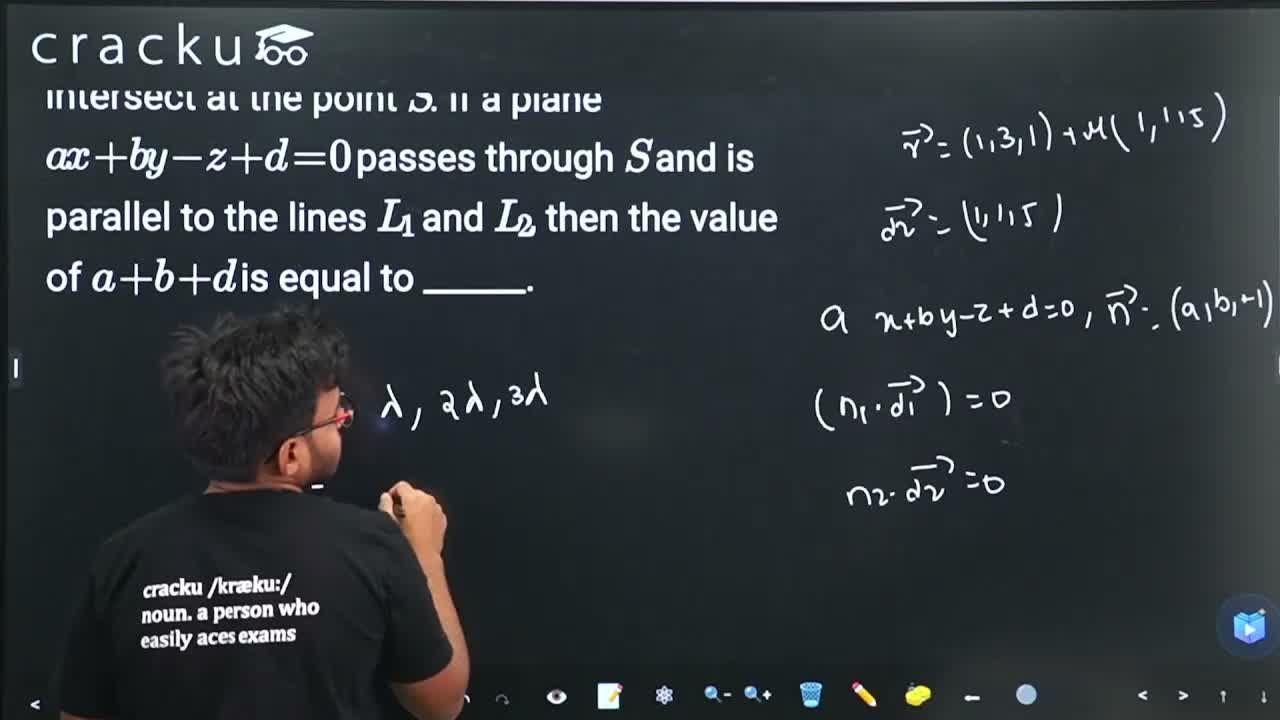
Let the lines $$L_1 : \vec{r} = \lambda(\hat{i} + 2\hat{j} + 3\hat{k}), \lambda \in R$$ and $$L_2 : \vec{r} = \hat{i} + 3\hat{j} + \hat{k} + \mu(\hat{i} + \hat{j} + 5\hat{k}); \mu \in R$$, intersect at the point $$S$$. If a plane $$ax + by - z + d = 0$$ passes through $$S$$ and is parallel to the lines $$L_1$$ and $$L_2$$, then the value of $$a + b + d$$ is equal to ______.
Correct Answer: 5
Given,
$$L_1:\vec r=\lambda(\hat i+2\hat j+3\hat k)$$
and
$$L_2:\vec r=\hat i+3\hat j+\hat k+\mu(\hat i+\hat j+5\hat k)$$
Direction vectors are
$$\vec d_1=(1,2,3),\qquad \vec d_2=(1,1,5)$$
A point on $$L_1$$ is
$$(\lambda,2\lambda,3\lambda)$$
and a point on $$L_2$$ is
$$(1+\mu,3+\mu,1+5\mu)$$
Since the lines intersect,
$$\lambda=1+\mu,\qquad 2\lambda=3+\mu,\qquad 3\lambda=1+5\mu$$
Using
$$\lambda=1+\mu$$
in
$$2\lambda=3+\mu$$
we get
$$2(1+\mu)=3+\mu$$
$$\mu=1$$
Hence,
$$\lambda=2$$
Thus, the point of intersection is
$$S=(2,4,6)$$
Now, the plane
$$ax+by-z+d=0$$
has normal vector
$$\vec n=(a,b,-1)$$
Since the plane is parallel to both lines,
$$\vec n\cdot\vec d_1=0$$
and
$$\vec n\cdot\vec d_2=0$$
Therefore,
$$a+2b-3=0$$
$$a+b-5=0$$
Subtracting,
$$b=-2$$
Hence,
$$a=7$$
So, the plane becomes
$$7x-2y-z+d=0$$
Since it passes through
$$S=(2,4,6)$$
$$7(2)-2(4)-6+d=0$$
$$14-8-6+d=0$$
$$d=0$$
Therefore,
$$a+b+d=7-2+0=5$$
Hence, $$\boxed{5}$$.
Was this solution helpful?
Click on the Email ☝️ to Watch the Video Solution
Create a FREE account and get:
_1.webp)

Educational materials for JEE preparation

Ask our AI anything

AI can make mistakes. Please verify important information.
AI can make mistakes. Please verify important information.
