
Join Our JEE Preparation Group
Prep with like-minded aspirants; Get access to free daily tests and study material.
Sign in
Please select an account to continue using cracku.in
↓ →
Join Our JEE Preparation Group
Prep with like-minded aspirants; Get access to free daily tests and study material.
Two infinite planes each with uniform surface charge density $$+\sigma$$ are kept in such a way that the angle between them is 30$$^\circ$$. The electric field in the region shown between them is given by:
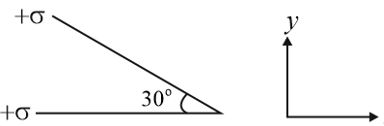
$$\text{The electric field in the region above it points straight up along the positive y-axis:}$$
$$\vec{E}_1 = \frac{\sigma}{2\varepsilon_0}\hat{y}$$
For the inclined sheet (inclined at $$30^\circ$$ to the horizontal with charge density $$+\sigma$$):
$$\text{The normal to this sheet points into the region between them, directed downwards and leftwards.}$$
$$\text{The angle of this electric field vector with the negative y-axis is } 30^\circ$$ making a $$60^\circ$$ angle with the negative $$x$$-axis:
$$\vec{E}_2 = E \cos(60^\circ)(-\hat{x}) + E \sin(60^\circ)(-\hat{y})$$
$$\vec{E}_2 = \frac{\sigma}{2\varepsilon_0}\left(-\frac{1}{2}\hat{x} - \frac{\sqrt{3}}{2}\hat{y}\right)$$
For the net electric field $$\vec{E}_{\text{net}}$$ in the region between them:
$$\vec{E}_{\text{net}} = \vec{E}_1 + \vec{E}_2$$
$$\vec{E}_{\text{net}} = \frac{\sigma}{2\varepsilon_0}\hat{y} + \frac{\sigma}{2\varepsilon_0}\left(-\frac{1}{2}\hat{x} - \frac{\sqrt{3}}{2}\hat{y}\right)$$
$$\vec{E}_{\text{net}} = \frac{\sigma}{2\varepsilon_0}\left[\left(1 - \frac{\sqrt{3}}{2}\right)\hat{y} - \frac{1}{2}\hat{x}\right]$$
Was this solution helpful?
Create a FREE account and get:
_1.webp)

Educational materials for JEE preparation

Ask our AI anything

AI can make mistakes. Please verify important information.
AI can make mistakes. Please verify important information.


