
Join Our JEE Preparation Group
Prep with like-minded aspirants; Get access to free daily tests and study material.
Sign in
Please select an account to continue using cracku.in
↓ →
Join Our JEE Preparation Group
Prep with like-minded aspirants; Get access to free daily tests and study material.
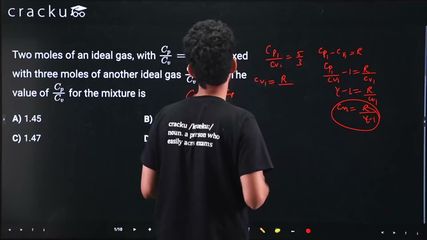
Two moles of an ideal gas, with $$\frac{C_p}{C_v} = \frac{5}{3}$$, are mixed with three moles of another ideal gas $$\frac{C_p}{C_v} = \frac{4}{3}$$. The value of $$\frac{C_p}{C_v}$$ for the mixture is
Let us denote the ratio $$\dfrac{C_p}{C_v}$$ of a gas by the symbol $$\gamma$$ (gamma).
For the first ideal gas we are given $$\gamma_1 = \dfrac{5}{3}$$ and the amount present is $$n_1 = 2$$ moles.
For the second ideal gas we are given $$\gamma_2 = \dfrac{4}{3}$$ and the amount present is $$n_2 = 3$$ moles.
For any ideal gas we have the universal relation $$C_p - C_v = R,$$ where $$R$$ is the universal gas constant per mole.
We begin with the first gas.
Using $$C_p - C_v = R$$ and $$\gamma_1 = \dfrac{C_{p1}}{C_{v1}},$$ we can write $$\gamma_1 = \dfrac{C_{p1}}{C_{v1}} = \dfrac{C_{v1} + R}{C_{v1}} = 1 + \dfrac{R}{C_{v1}}.$$ Solving for $$C_{v1}$$ we obtain $$\dfrac{R}{C_{v1}} = \gamma_1 - 1,$$ so $$C_{v1} = \dfrac{R}{\gamma_1 - 1}.$$
Substituting $$\gamma_1 = \dfrac{5}{3}$$ gives $$C_{v1} = \dfrac{R}{\dfrac{5}{3} - 1} = \dfrac{R}{\dfrac{2}{3}} = \dfrac{3R}{2}.$$
Now, $$C_{p1} = C_{v1} + R = \dfrac{3R}{2} + R = \dfrac{5R}{2}.$$
Next we turn to the second gas.
Exactly in the same way we have $$C_{v2} = \dfrac{R}{\gamma_2 - 1} = \dfrac{R}{\dfrac{4}{3} - 1} = \dfrac{R}{\dfrac{1}{3}} = 3R,$$ and $$C_{p2} = C_{v2} + R = 3R + R = 4R.$$
We now compute the total heat capacities of the mixture.
The total heat capacity at constant volume is $$C_{v,\text{mix}} = n_1 C_{v1} + n_2 C_{v2}.$$ Substituting the known numbers, $$C_{v,\text{mix}} = 2 \left(\dfrac{3R}{2}\right) + 3 (3R) = 3R + 9R = 12R.$$
The total heat capacity at constant pressure is $$C_{p,\text{mix}} = n_1 C_{p1} + n_2 C_{p2}.$$ Substituting the values, $$C_{p,\text{mix}} = 2 \left(\dfrac{5R}{2}\right) + 3 (4R) = 5R + 12R = 17R.$$
The total number of moles in the mixture is $$n_{\text{total}} = n_1 + n_2 = 2 + 3 = 5.$$
Hence the molar (per mole) heat capacities of the mixture are $$\overline{C_v} = \dfrac{C_{v,\text{mix}}}{n_{\text{total}}} = \dfrac{12R}{5} = 2.4\,R,$$ and $$\overline{C_p} = \dfrac{C_{p,\text{mix}}}{n_{\text{total}}} = \dfrac{17R}{5} = 3.4\,R.$$
The required ratio for the mixture is then $$\gamma_{\text{mix}} = \dfrac{\overline{C_p}}{\overline{C_v}} = \dfrac{3.4\,R}{2.4\,R} = \dfrac{34}{24} = \dfrac{17}{12} \approx 1.42.$$
Hence, the correct answer is Option D.
Was this solution helpful?
Click on the Email ☝️ to Watch the Video Solution
Create a FREE account and get:
_1.webp)

Educational materials for JEE preparation

Ask our AI anything

AI can make mistakes. Please verify important information.
AI can make mistakes. Please verify important information.


