
Join Our JEE Preparation Group
Prep with like-minded aspirants; Get access to free daily tests and study material.
Sign in
Please select an account to continue using cracku.in
↓ →
Join Our JEE Preparation Group
Prep with like-minded aspirants; Get access to free daily tests and study material.
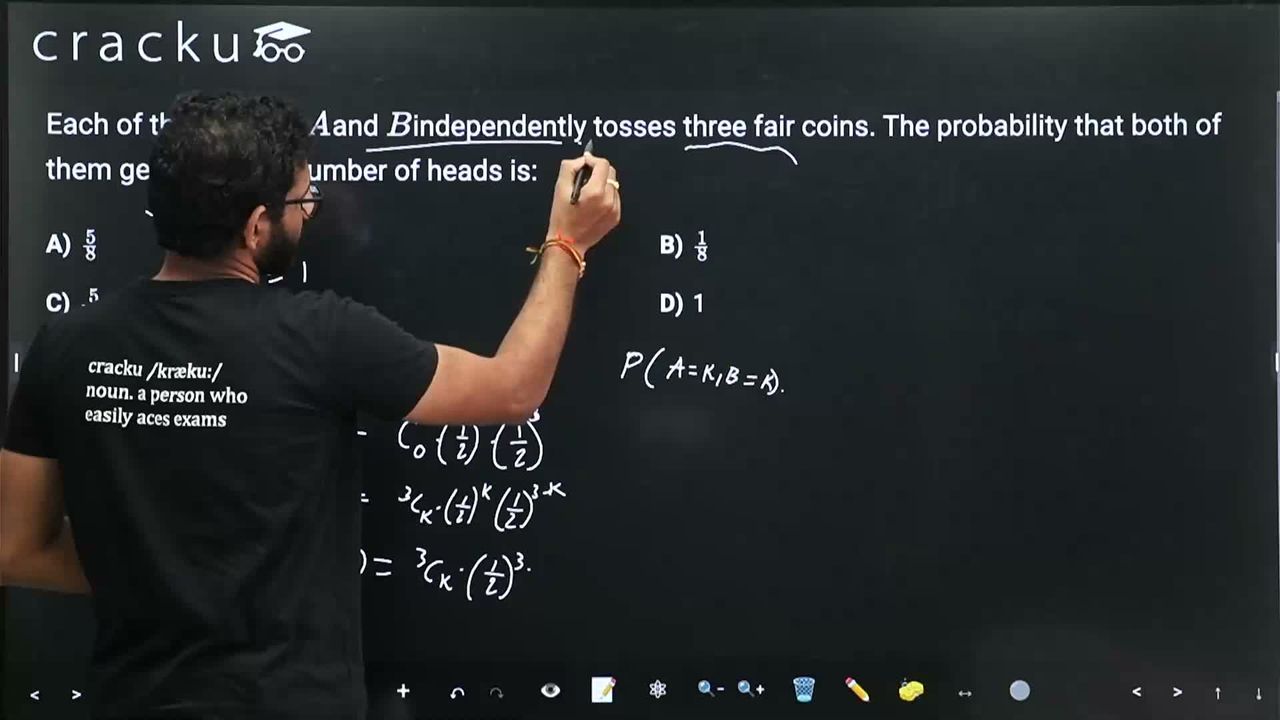
Each of the persons $$A$$ and $$B$$ independently tosses three fair coins. The probability that both of them get the same number of heads is:
We have two persons, $$A$$ and $$B$$. Each of them tosses three fair coins independently. For every single coin, the probability of getting a head is $$\tfrac12$$ and the probability of getting a tail is also $$\tfrac12$$.
Let the random variable $$X$$ denote “number of heads obtained by $$A$$ in the three tosses,” and let $$Y$$ denote “number of heads obtained by $$B$$ in the three tosses.” Both $$X$$ and $$Y$$ follow the same binomial distribution with parameters $$n = 3$$ and $$p = \tfrac12$$.
First we recall the binomial probability formula. For a binomially distributed random variable,
$$\Pr(X = k) \;=\; {^nC_k}\, p^{\,k}\, (1-p)^{\,n-k}.$$
Here $$n = 3$$ and $$p = \tfrac12$$, so for every admissible value $$k = 0,1,2,3$$ we have
$$\Pr(X = k) \;=\; {^3C_k}\,\Bigl(\tfrac12\Bigr)^{k}\,\Bigl(\tfrac12\Bigr)^{3-k} \;=\; {^3C_k}\,\Bigl(\tfrac12\Bigr)^{3} \;=\; {^3C_k}\,\frac{1}{8}.$$
We now list these four probabilities explicitly:
$$$ \begin{aligned} \Pr(X = 0) &= {^3C_0}\,\frac18 \;=\; 1 \times \frac18 \;=\; \frac18,\\[4pt] \Pr(X = 1) &= {^3C_1}\,\frac18 \;=\; 3 \times \frac18 \;=\; \frac38,\\[4pt] \Pr(X = 2) &= {^3C_2}\,\frac18 \;=\; 3 \times \frac18 \;=\; \frac38,\\[4pt] \Pr(X = 3) &= {^3C_3}\,\frac18 \;=\; 1 \times \frac18 \;=\; \frac18. \end{aligned} $$$
The same four numbers are also the probabilities for $$Y$$, because $$B$$ performs the same experiment independently.
The event of interest is “both obtain the same number of heads.” This equality can happen in four mutually exclusive ways:
$$$ (X=0,\,Y=0),\; (X=1,\,Y=1),\; (X=2,\,Y=2),\; (X=3,\,Y=3). $$$
Because the two persons toss their coins independently, the joint probability of any pair $$(X=k,\;Y=k)$$ is the product of the two individual probabilities:
$$$ \Pr(X=k \text{ and } Y=k) \;=\; \Pr(X=k)\,\Pr(Y=k). $$$
We compute these four products one by one:
$$$ \begin{aligned} \Pr(X=0,\,Y=0) &= \frac18 \times \frac18 \;=\; \frac{1}{64},\\[4pt] \Pr(X=1,\,Y=1) &= \frac38 \times \frac38 \;=\; \frac{9}{64},\\[4pt] \Pr(X=2,\,Y=2) &= \frac38 \times \frac38 \;=\; \frac{9}{64},\\[4pt] \Pr(X=3,\,Y=3) &= \frac18 \times \frac18 \;=\; \frac{1}{64}. \end{aligned} $$$
Now we add these four mutually exclusive probabilities to get the total probability that $$A$$ and $$B$$ have the same number of heads:
$$$ \begin{aligned} \Pr(\text{same number of heads}) &= \frac{1}{64} + \frac{9}{64} + \frac{9}{64} + \frac{1}{64}\\[4pt] &= \frac{1 + 9 + 9 + 1}{64}\\[4pt] &= \frac{20}{64}. \end{aligned} $$$
Next we simplify $$\frac{20}{64}$$ by dividing numerator and denominator by their greatest common divisor, $$4$$:
$$$ \frac{20}{64} \;=\; \frac{20 \div 4}{64 \div 4} \;=\; \frac{5}{16}. $$$
So, the probability that both persons get exactly the same number of heads is $$\dfrac{5}{16}$$.
Hence, the correct answer is Option C.
Click on the Email ☝️ to Watch the Video Solution
Create a FREE account and get:
_1.webp)

Educational materials for JEE preparation

Ask our AI anything

AI can make mistakes. Please verify important information.
AI can make mistakes. Please verify important information.


