
Join Our JEE Preparation Group
Prep with like-minded aspirants; Get access to free daily tests and study material.
Sign in
Please select an account to continue using cracku.in
↓ →
Join Our JEE Preparation Group
Prep with like-minded aspirants; Get access to free daily tests and study material.
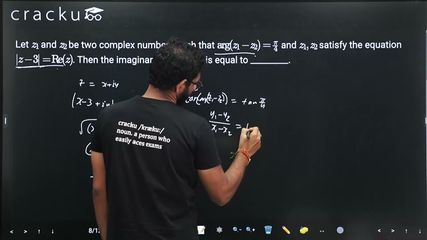
Let $$z_1$$ and $$z_2$$ be two complex numbers such that $$\arg(z_1 - z_2) = \frac{\pi}{4}$$ and $$z_1, z_2$$ satisfy the equation $$|z - 3| = \text{Re}(z)$$. Then the imaginary part $$z_1 + z_2$$ is equal to _________.
Correct Answer: 6
Let us denote a general complex number by $$z=x+iy$$ where $$x=\text{Re}(z)$$ and $$y=\text{Im}(z)$$.
Both $$z_1$$ and $$z_2$$ satisfy the given locus
$$|z-3|=\text{Re}(z).$$
First, we recall the modulus formula: for any $$z=x+iy,$$ we have $$|z|=\sqrt{x^{2}+y^{2}}.$$ Applying this to $$z-3=(x-3)+iy$$, we get
$$|(x-3)+iy|=\sqrt{(x-3)^2+y^2}.$$
The given equation therefore becomes
$$\sqrt{(x-3)^2+y^2}=x.$$
Squaring both sides (because both sides are non-negative) gives
$$(x-3)^2+y^2=x^2.$$
Expanding the left side and cancelling $$x^2$$ from both sides, we obtain
$$x^2-6x+9+y^2=x^2 \;\;\Longrightarrow\;\; -6x+9+y^2=0.$$
Rearranging,
$$y^2=6x-9.$$
Thus every point of the locus must satisfy
$$y^2=6x-9,\qquad x\ge \tfrac32.$$
Next we use the second condition. Because
$$\arg(z_1-z_2)=\frac{\pi}{4},$$
the vector $$z_1-z_2$$ makes an angle of $$45^{\circ}$$ with the positive real axis. Therefore its slope is
$$\tan\!\frac{\pi}{4}=1,$$
so we must have
$$\frac{y_1-y_2}{x_1-x_2}=1 \quad\Longrightarrow\quad y_1-y_2=x_1-x_2.$$
This equality tells us that both points lie on the same straight line of slope $$1$$. Writing the equation of that line as
$$y=x+c$$
for some real constant $$c,$$ we know that each of $$z_1$$ and $$z_2$$ satisfies this equation together with the parabola equation derived earlier.
We therefore substitute $$y=x+c$$ into $$y^2=6x-9$$:
$$(x+c)^2=6x-9.$$
Expanding and collecting like terms gives the quadratic in $$x$$
$$x^2+2cx+c^2-6x+9=0,$$
or
$$x^2+(2c-6)x+(c^2+9)=0.$$
Let $$x_1$$ and $$x_2$$ be the roots of this quadratic; they are precisely the real parts of $$z_1$$ and $$z_2$$. By Vieta’s formulas, for a quadratic $$x^2+px+q=0,$$ the sum of the roots is $$-p$$ and the product is $$q$$. Hence here
$$x_1+x_2=-(2c-6)=6-2c.$$
Because $$y=x+c,$$ the corresponding imaginary parts are
$$y_1=x_1+c,\qquad y_2=x_2+c.$$
Adding these two imaginary parts, we get
$$y_1+y_2=(x_1+x_2)+2c=(6-2c)+2c=6.$$
The quantity asked for in the question is the imaginary part of $$z_1+z_2$$, and that is exactly $$y_1+y_2$$. We therefore have
$$\text{Im}(z_1+z_2)=6.$$
So, the answer is $$6$$.
Was this solution helpful?
Click on the Email ☝️ to Watch the Video Solution
Create a FREE account and get:
_1.webp)

Educational materials for JEE preparation

Ask our AI anything

AI can make mistakes. Please verify important information.
AI can make mistakes. Please verify important information.
