
Join Our JEE Preparation Group
Prep with like-minded aspirants; Get access to free daily tests and study material.
Sign in
Please select an account to continue using cracku.in
↓ →
Join Our JEE Preparation Group
Prep with like-minded aspirants; Get access to free daily tests and study material.
The angle between the straight lines, whose direction cosines $$l, m, n$$ are given by the equations $$2l + 2m - n = 0$$ and $$mn + nl + lm = 0$$, is:
To obtain the angle between the required straight lines we begin with the two relations satisfied by their direction cosines $$l,\;m,\;n$$:
$$2l + 2m - n = 0 \qquad\text{and}\qquad mn + nl + lm = 0.$$
From the first equation we can express $$n$$ in terms of $$l$$ and $$m$$:
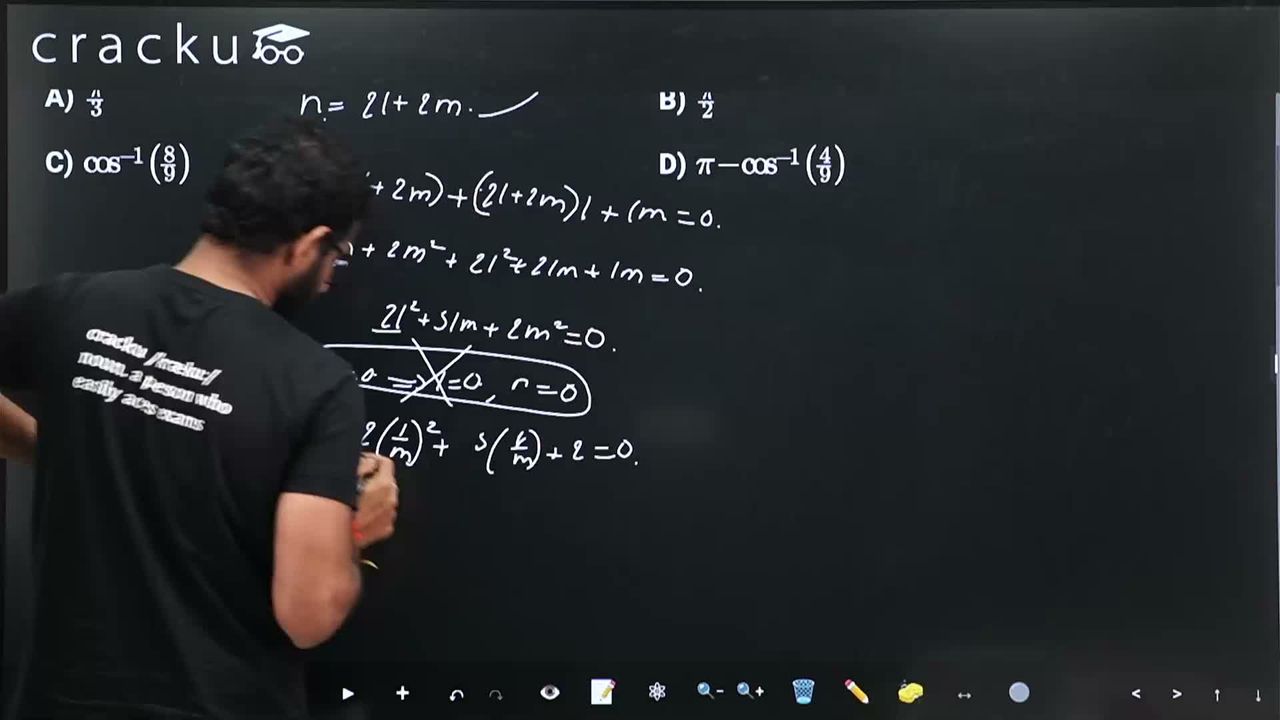
$$2l + 2m - n = 0 \;\Longrightarrow\; n = 2l + 2m.$$
Substituting this value of $$n$$ into the second equation gives
$$mn + nl + lm = 0$$
$$\;\Longrightarrow\; m(2l + 2m) + (2l + 2m)l + lm = 0.$$
Multiplying out every term:
$$2ml + 2m^{2} + 2l^{2} + 2lm + lm = 0.$$
Collecting like terms (note that $$ml = lm$$):
$$2l^{2} + 2m^{2} + 5lm = 0.$$
To solve this homogeneous equation we divide throughout by $$l^{2}$$ (assuming $$l\neq0$$) and write $$m = kl,$$ where $$k$$ is the required ratio $$\dfrac{m}{l}$$. Thus,
$$2 + 2k^{2} + 5k = 0.$$
This quadratic simplifies to
$$2k^{2} + 5k + 2 = 0.$$
Using the quadratic-formula $$k = \dfrac{-b \pm \sqrt{b^{2}-4ac}}{2a}$$ with $$a = 2,\, b = 5,\, c = 2,$$ we get
$$k = \dfrac{-5 \pm \sqrt{25-16}}{4} = \dfrac{-5 \pm 3}{4}.$$
Hence
$$k_{1} = -\dfrac{1}{2}, \qquad k_{2} = -2.$$
For each value of $$k$$ we find the corresponding triple $$(l,m,n):$$
First set (with $$k = -\dfrac12$$):
$$m = -\dfrac12\,l, \quad n = 2l + 2m = 2l - l = l.$$
Thus $$\bigl(l,m,n\bigr) \propto \bigl(l,\;-\tfrac12l,\;l\bigr) = (2,\;-1,\;2).$$
Second set (with $$k = -2$$):
$$m = -2l, \quad n = 2l + 2m = 2l - 4l = -2l.$$
Thus $$\bigl(l,m,n\bigr) \propto \bigl(l,\;-2l,\;-2l\bigr) = (1,\;-2,\;-2).$$
Each proportional vector must be converted into unit direction cosines by dividing by its magnitude. The magnitudes are
$$|(2,-1,2)| = \sqrt{2^{2}+(-1)^{2}+2^{2}} = \sqrt{9} = 3,$$ $$|(1,-2,-2)| = \sqrt{1^{2}+(-2)^{2}+(-2)^{2}} = \sqrt{9} = 3.$$
Therefore the two sets of direction cosines are
$$\left(\dfrac23,\;-\dfrac13,\;\dfrac23\right) \quad\text{and}\quad \left(\dfrac13,\;-\dfrac23,\;-\dfrac23\right).$$
The angle $$\theta$$ between the two lines is found from the dot-product formula
$$\cos\theta = l_{1}l_{2} + m_{1}m_{2} + n_{1}n_{2}.$$
Substituting the above values gives
$$\cos\theta = \dfrac23\cdot\dfrac13 + \left(-\dfrac13\right)\!\left(-\dfrac23\right) + \dfrac23\!\left(-\dfrac23\right) = \dfrac{2}{9} + \dfrac{2}{9} - \dfrac{4}{9} = 0.$$
Since $$\cos\theta = 0,$$ we have
$$\theta = \dfrac{\pi}{2}.$$
Hence, the correct answer is Option 2.
Was this solution helpful?
Click on the Email ☝️ to Watch the Video Solution
Create a FREE account and get:
_1.webp)

Educational materials for JEE preparation

Ask our AI anything

AI can make mistakes. Please verify important information.
AI can make mistakes. Please verify important information.
