
Join Our JEE Preparation Group
Prep with like-minded aspirants; Get access to free daily tests and study material.
Sign in
Please select an account to continue using cracku.in
↓ →
Join Our JEE Preparation Group
Prep with like-minded aspirants; Get access to free daily tests and study material.
The equation of the plane passing through the line of intersection of the planes $$\vec{r} \cdot (2\hat{i} + 3\hat{j} - \hat{k}) + 4 = 0$$ and $$\vec{r} \cdot (\hat{i} + \hat{j} + \hat{k}) = 1$$ and parallel to the x-axis, is
We have two given planes
$$\vec r\cdot(2\hat i+3\hat j-\hat k)+4=0$$
and
$$\vec r\cdot(\hat i+\hat j+\hat k)=1.$$
First, we rewrite the second plane in the standard “equal-to-zero” form by taking the term on the right to the left:
$$\vec r\cdot(\hat i+\hat j+\hat k)-1=0.$$
The line of intersection of two planes can generate an entire family (or pencil) of planes. The general equation of that family is obtained by adding the two left-hand sides with a real parameter λ:
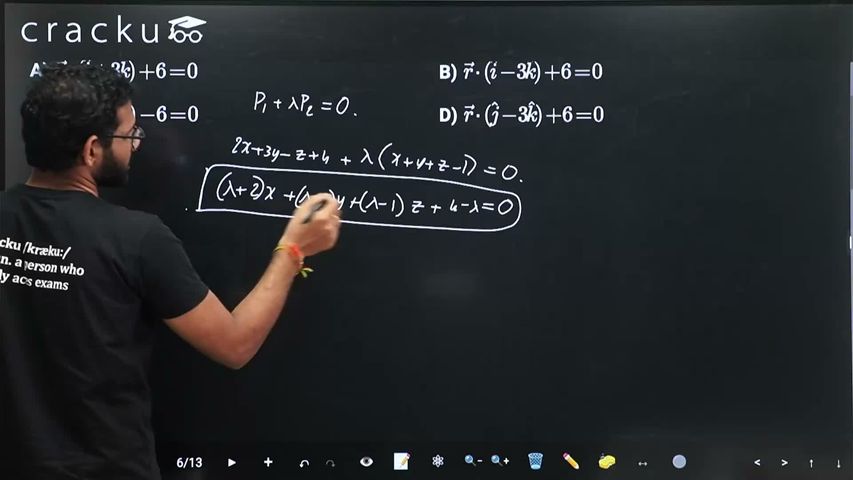
$$\bigl[\vec r\cdot(2\hat i+3\hat j-\hat k)+4\bigr]+\lambda\bigl[\vec r\cdot(\hat i+\hat j+\hat k)-1\bigr]=0.$$
Simplifying the bracketed expressions, we get
$$\vec r\cdot\bigl[(2+\lambda)\hat i+(3+\lambda)\hat j+(-1+\lambda)\hat k\bigr]+4-\lambda=0.$$
So the normal vector of any plane in this family is
$$\vec n=(2+\lambda)\hat i+(3+\lambda)\hat j+(-1+\lambda)\hat k.$$
The required plane is said to be parallel to the x-axis. A plane is parallel to a given direction if that direction is perpendicular to the plane’s normal vector. The x-axis has direction vector $$\hat i,$$ hence we must have
$$\vec n\cdot\hat i=0.$$
Since $$\vec n=(2+\lambda)\hat i+(3+\lambda)\hat j+(-1+\lambda)\hat k,$$ its dot-product with $$\hat i$$ is simply the coefficient of $$\hat i,$$ namely $$2+\lambda.$$ Therefore the condition becomes
$$2+\lambda=0\quad\Longrightarrow\quad\lambda=-2.$$
Now we substitute $$\lambda=-2$$ back into the family equation:
$$\bigl[\vec r\cdot(2\hat i+3\hat j-\hat k)+4\bigr]-2\bigl[\vec r\cdot(\hat i+\hat j+\hat k)-1\bigr]=0.$$
Expanding step by step, we have
$$\vec r\cdot(2\hat i+3\hat j-\hat k)+4-2\,\vec r\cdot(\hat i+\hat j+\hat k)+2=0.$$
Collecting the dot-product terms together:
$$\vec r\cdot\bigl[(2\hat i+3\hat j-\hat k)-2(\hat i+\hat j+\hat k)\bigr]+6=0.$$
Distributing the -2 inside the bracket:
$$\vec r\cdot\bigl[(2-2)\hat i+(3-2)\hat j+(-1-2)\hat k\bigr]+6=0.$$
Simplifying each component:
$$\vec r\cdot\bigl[0\hat i+1\hat j-3\hat k\bigr]+6=0.$$
Removing the zero term gives the final equation of the plane:
$$\vec r\cdot(\hat j-3\hat k)+6=0.$$
This matches Option D in the list. Hence, the correct answer is Option D.
Was this solution helpful?
Click on the Email ☝️ to Watch the Video Solution
Create a FREE account and get:
_1.webp)

Educational materials for JEE preparation

Ask our AI anything

AI can make mistakes. Please verify important information.
AI can make mistakes. Please verify important information.
