
Join Our JEE Preparation Group
Prep with like-minded aspirants; Get access to free daily tests and study material.
Sign in
Please select an account to continue using cracku.in
↓ →
Join Our JEE Preparation Group
Prep with like-minded aspirants; Get access to free daily tests and study material.
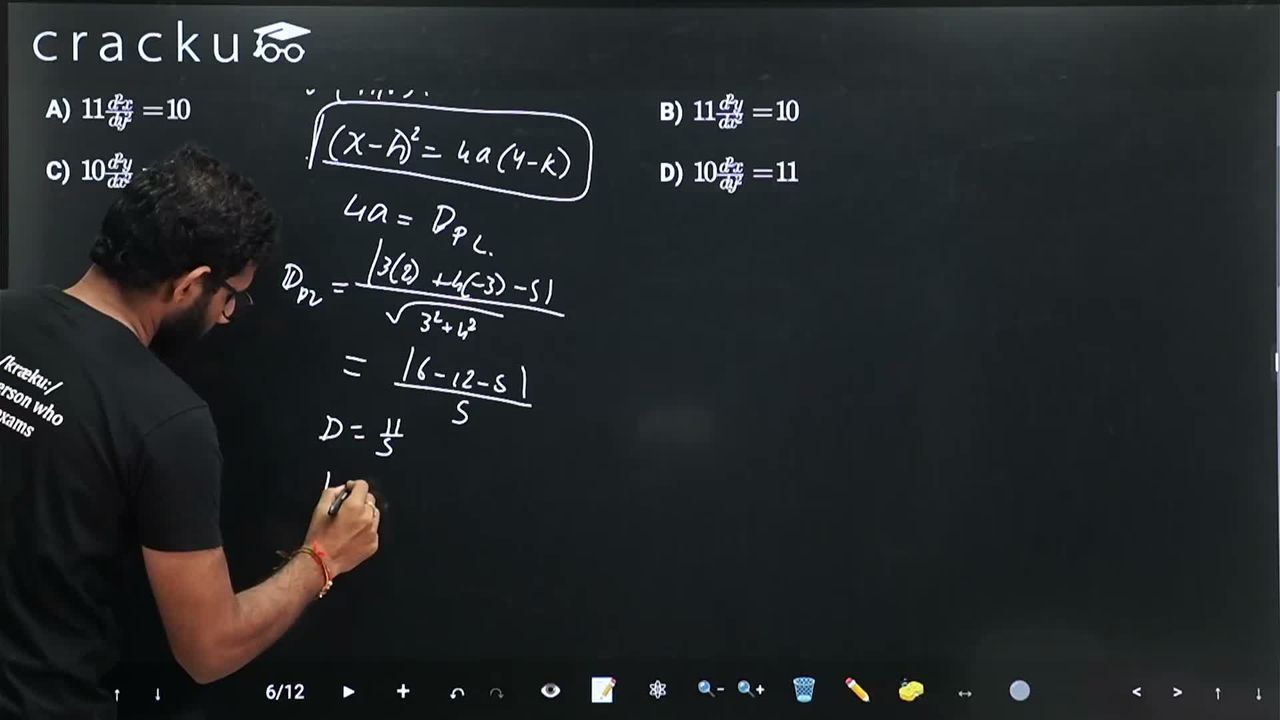
A differential equation representing the family of parabolas with axis parallel to y-axis and whose length of latus rectum is the distance of the point $$(2, -3)$$ from the line $$3x + 4y = 5$$, is given by:
First we have to find the numerical value of the length of the latus-rectum that is to be allotted to every member of the required family. The statement says that this length equals the distance of the fixed point $$(2,-3)$$ from the straight line $$3x+4y=5$$.
We recall the distance formula. For a point $$(x_1,y_1)$$ and a line $$ax+by+c=0$$ the perpendicular distance is given by
$$D=\frac{\lvert\,ax_1+by_1+c\,\rvert}{\sqrt{a^2+b^2}}.$$
Writing the given line in the form $$3x+4y-5=0$$, we have $$a=3,\;b=4,\;c=-5.$$ Now substituting the coordinates $$(x_1,y_1)=(2,-3)$$ we get
$$\begin{aligned} D&=\frac{\lvert\,3(2)+4(-3)-5\,\rvert}{\sqrt{3^2+4^2}} =\frac{\lvert\,6-12-5\,\rvert}{\sqrt{9+16}} =\frac{\lvert\,-11\,\rvert}{5} =\frac{11}{5}. \end{aligned}$$
So the required length of the latus-rectum is fixed at $$\dfrac{11}{5}.$$ For a parabola whose axis is parallel to the $$y$$-axis (that is, vertical) the standard form is
$$ (x-h)^2 = 4a\,(y-k), $$
where $$(h,k)$$ is the vertex and the axis is the line $$x=h.$$ In this form the length of the latus-rectum is $$\lvert 4a\rvert.$$ Equating this to $$\dfrac{11}{5}$$ we obtain
$$\lvert 4a\rvert=\frac{11}{5}\;\Longrightarrow\;4a=\pm\frac{11}{5}.$$
For convenience write the numerical constant as
$$L=\frac{11}{5} \qquad\text{(we shall keep the sign }\pm$$ separate).
Thus every member of the family can be expressed as
$$ (x-h)^2 = \pm L\,(y-k). \quad -(1)$$
To obtain the differential equation we must eliminate the two arbitrary constants $$h$$ and $$k.$$ We treat $$y$$ as the dependent variable $$y=y(x)$$ and differentiate with respect to $$x.$$
Differentiating equation (1) once, remembering that $$h,k$$ and $$L$$ are constants, gives
$$ 2(x-h)\cdot\frac{d}{dx}(x-h)=\pm L\,\frac{dy}{dx}. $$
Since $$\dfrac{d}{dx}(x-h)=1,$$ this simplifies to
$$ 2(x-h)=\pm L\,y'. \quad -(2)$$
(Here $$y'$$ denotes $$\dfrac{dy}{dx}.$$)
We now differentiate equation (2) a second time with respect to $$x.$$ The left side $$2(x-h)$$ differentiates to $$2,$$ while the right side differentiates to $$\pm L\,y''.$$ Thus we obtain
$$ 2 = \pm L\,y''. \quad -(3)$$
Solving (3) for $$y''$$ gives
$$ y'' = \frac{2}{\pm L}. $$
Substituting $$L=\dfrac{11}{5}$$ we find
$$ y'' = \frac{2}{\pm\frac{11}{5}}=\pm\frac{10}{11}. $$
If the positive sign is taken (parabola opening upward) we have
$$ y'' = \frac{10}{11}\;\Longrightarrow\;11\,y'' = 10. $$
(With the negative sign the right side would be $$-10,$$ which merely corresponds to the downward-opening members of the family; the required differential equation is therefore $$11\,y''=10$$ because that single equation already embraces both orientations through the possibility of $$y''$$ changing sign in different solutions.)
Writing explicitly,
$$ 11\frac{d^2y}{dx^2}=10. $$
This matches Option B in the list provided.
Hence, the correct answer is Option B.
Was this solution helpful?
Click on the Email ☝️ to Watch the Video Solution
Create a FREE account and get:
_1.webp)

Educational materials for JEE preparation

Ask our AI anything

AI can make mistakes. Please verify important information.
AI can make mistakes. Please verify important information.
