
Join Our JEE Preparation Group
Prep with like-minded aspirants; Get access to free daily tests and study material.
Sign in
Please select an account to continue using cracku.in
↓ →
Join Our JEE Preparation Group
Prep with like-minded aspirants; Get access to free daily tests and study material.
If the solution curve of the differential equation $$(2x - 10y^3)dy + ydx = 0$$, passes through the points $$(0, 1)$$ and $$(2, \beta)$$, then $$\beta$$ is a root of the equation?
We begin with the differential equation
$$\bigl(2x-10y^{3}\bigr)\,dy + y\,dx = 0.$$
For convenience we regard $$x$$ as a function of $$y$$ (that is, we shall write $$x=x(y)$$ and differentiate with respect to $$y$$). Writing the differentials explicitly we have
$$y\,dx + \bigl(2x-10y^{3}\bigr)\,dy = 0.$$
Dividing by $$dy$$ gives a first-order linear ordinary differential equation in $$x$$:
$$y\,\dfrac{dx}{dy} + 2x - 10y^{3} = 0.$$
Re-arranging,
$$y\,\dfrac{dx}{dy} = 10y^{3} - 2x,$$
and hence
$$\dfrac{dx}{dy} + \dfrac{2}{y}\,x = 10y^{2}.$$
This is of the standard linear form
$$\dfrac{dx}{dy} + P(y)\,x = Q(y),\qquad\text{with }P(y)=\dfrac{2}{y},\;Q(y)=10y^{2}.$$
For such an equation the integrating factor is obtained from
$$\mu(y)=e^{\int P(y)\,dy}.$$
Computing the integral,
$$\int P(y)\,dy = \int\dfrac{2}{y}\,dy = 2\ln y,$$
so
$$\mu(y)=e^{2\ln y}=y^{2}.$$
Multiplying the differential equation by this integrating factor we get
$$y^{2}\dfrac{dx}{dy}+y^{2}\left(\dfrac{2}{y}\right)x = y^{2}\cdot10y^{2}.$$
Simplifying each term,
$$y^{2}\dfrac{dx}{dy}+2yx = 10y^{4}.$$
Notice that the left-hand side is exactly the derivative of the product $$y^{2}x$$ with respect to $$y$$, because
$$\dfrac{d}{dy}\bigl(y^{2}x\bigr)=y^{2}\dfrac{dx}{dy}+2yx.$$
Hence we can write
$$\dfrac{d}{dy}\bigl(y^{2}x\bigr)=10y^{4}.$$
Integrating both sides with respect to $$y$$,
$$\int\dfrac{d}{dy}\bigl(y^{2}x\bigr)\,dy=\int10y^{4}\,dy,$$
which yields
$$y^{2}x = 10\cdot\dfrac{y^{5}}{5} + C = 2y^{5}+C,$$
where $$C$$ is the constant of integration. Solving for $$x$$ gives
$$x = \dfrac{2y^{5}+C}{y^{2}} = 2y^{3} + \dfrac{C}{y^{2}}.$$
To determine $$C$$ we apply the first point through which the curve passes, namely $$(0,1)$$. Substituting $$x=0$$ and $$y=1$$ we have
$$0 = 2\cdot1^{3} + \dfrac{C}{1^{2}} \quad\Longrightarrow\quad C = -2.$$
Thus the particular solution is
$$x = 2y^{3} - \dfrac{2}{y^{2}}.$$
Now we use the second point $$(2,\beta)$$. Substituting $$x=2$$ and $$y=\beta$$ in the above relation yields
$$2 = 2\beta^{3} - \dfrac{2}{\beta^{2}}.$$
Multiplying both sides by $$\beta^{2}$$ to clear the denominator,
$$2\beta^{2} = 2\beta^{5} - 2.$$
Bringing all terms to one side,
$$2\beta^{5} - 2\beta^{2} - 2 = 0.$$
Factoring out the common factor $$2$$,
$$2\bigl(\beta^{5} - \beta^{2} - 1\bigr) = 0.$$
Since $$2\neq0$$, we must have
$$\beta^{5} - \beta^{2} - 1 = 0.$$
This is exactly the polynomial equation listed as Option B.
Hence, the correct answer is Option B.
Was this solution helpful?
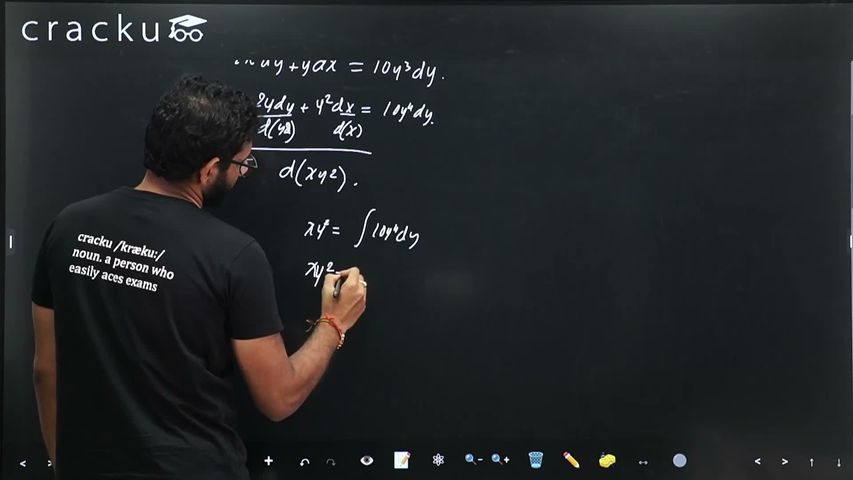
Click on the Email ☝️ to Watch the Video Solution
Create a FREE account and get:
_1.webp)

Educational materials for JEE preparation

Ask our AI anything

AI can make mistakes. Please verify important information.
AI can make mistakes. Please verify important information.
