
Join Our JEE Preparation Group
Prep with like-minded aspirants; Get access to free daily tests and study material.
Sign in
Please select an account to continue using cracku.in
↓ →
Join Our JEE Preparation Group
Prep with like-minded aspirants; Get access to free daily tests and study material.
Seven identical circular planar disks, each of mass M and radius R are welded symmetrically as shown. The moment of inertia of the arrangement about the axis normal to the plane and passing through the point P is:
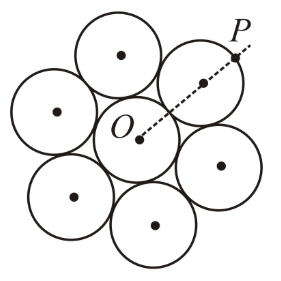
The total moment of inertia of a symmetric multi-body system about a given axis is found by first computing the total moment of inertia about the center of mass using the parallel axis theorem, and then shifting the entire system's inertia to the parallel axis passing through point $$P$$.
Moment of inertia of the central disk about center $$O$$:
$$I_{\text{center}} = \frac{1}{2}MR^2$$
Moment of inertia of one surrounding disk about $$O$$ (using parallel axis theorem with $$d=2R$$):
$$I_{\text{outer}} = \frac{1}{2}MR^2 + M(2R)^2 = \frac{9}{2}MR^2$$
Total moment of inertia of the 7-disk arrangement about $$O$$:
$$I_O = I_{\text{center}} + 6I_{\text{outer}} = \frac{1}{2}MR^2 + 6\left(\frac{9}{2}MR^2\right) = \frac{55}{2}MR^2$$
Total mass of the arrangement: $$M_{\text{total}} = 7M$$
Given distance from $$O$$ to point $$P$$ on the periphery of an outer disk: $$d_{OP} = 2R + R = 3R$$
Shifting the total moment of inertia to axis through $$P$$ via parallel axis theorem:
$$I_P = I_O + M_{\text{total}}d_{OP}^2$$
$$I_P = \frac{55}{2}MR^2 + (7M)(3R)^2 = \frac{55}{2}MR^2 + 63MR^2 = \frac{181}{2}MR^2$$
Was this solution helpful?
Create a FREE account and get:
_1.webp)

Educational materials for JEE preparation

Ask our AI anything

AI can make mistakes. Please verify important information.
AI can make mistakes. Please verify important information.
