For the following questions answer them individually
The density of a material, in the shape of a cube, is determined by measuring three sides of the cube and its mass. If the relative errors in measuring the mass and length are 1.5% and 1%, respectively, the maximum error in determining the density is:
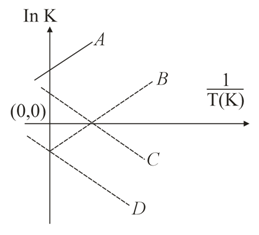
All the graphs below are intended to represent the same motion. One of them does it incorrectly. Pick it up.
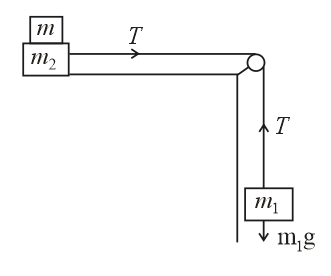
Two masses $$m_1 = 5$$ kg and $$m_2 = 10$$ kg, connected by an inextensible string over a frictionless pulley, are moving as shown in the figure. The coefficient of friction of horizontal surface is 0.15. The minimum weight m that should be put on top of $$m_2$$ to stop the motion is:
A particle is moving in a circular path of radius a under the action of an attractive potential $$U = -\frac{k}{2r^2}$$. Its total energy is:
In a collinear collision, a particle with an initial speed $$v_0$$ strikes a stationary particle of the same mass. If the final total kinetic energy is 50% greater than the original kinetic energy, the magnitude of the relative velocity between the two particles, after the collision, is:
It is found that if a neutron suffers an elastic collinear collision with a deuterium at rest, the fractional loss of its energy is $$P_d$$, while for its similar collision with a carbon nucleus at rest, the fractional loss of energy is $$P_c$$. The values of $$P_d$$ and $$P_c$$ are respectively:
The mass of a hydrogen molecule is $$3.32 \times 10^{-27}$$ kg. If $$10^{23}$$ hydrogen molecules strike, per second, a fixed wall of the area 2 cm$$^2$$ at an angle of 45$$^\circ$$ to the normal, and rebound elastically with a speed of $$10^3$$ m s$$^{-1}$$, then the pressure on the wall is nearly:
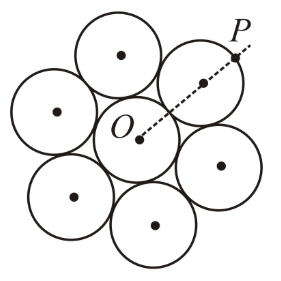
Seven identical circular planar disks, each of mass M and radius R are welded symmetrically as shown. The moment of inertia of the arrangement about the axis normal to the plane and passing through the point P is:
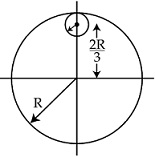
From a uniform circular disc of radius R and mass 9 M, a small disc of radius $$\frac{R}{3}$$ is removed as shown in the figure. The moment of inertia of the remaining disc about an axis perpendicular to the plane of the disc and passing through centre of disc is:
A particle is moving with a uniform speed in a circular orbit of radius R in a central force inversely proportional to the $$n^{th}$$ power of R. If the period of rotation of the particle is T, then: