
Join Our JEE Preparation Group
Prep with like-minded aspirants; Get access to free daily tests and study material.
Sign in
Please select an account to continue using cracku.in
↓ →
Join Our JEE Preparation Group
Prep with like-minded aspirants; Get access to free daily tests and study material.
The number of distinct real roots of the equation, $$\begin{vmatrix} \cos x & \sin x & \sin x \\ \sin x & \cos x & \sin x \\ \sin x & \sin x & \cos x \end{vmatrix} = 0$$ in the interval $$\left[-\frac{\pi}{4}, \frac{\pi}{4}\right]$$ is:
We need to find the number of distinct real roots of the equation $$\begin{vmatrix} \cos x & \sin x & \sin x \\ \sin x & \cos x & \sin x \\ \sin x & \sin x & \cos x \end{vmatrix} = 0$$ in the interval $$\left[-\dfrac{\pi}{4},\, \dfrac{\pi}{4}\right]$$.
Apply the column operation $$C_1 \to C_1 + C_2 + C_3$$. Every entry in the first column becomes $$\cos x + 2\sin x$$. Factoring this out gives $$(\cos x + 2\sin x) \begin{vmatrix} 1 & \sin x & \sin x \\ 1 & \cos x & \sin x \\ 1 & \sin x & \cos x \end{vmatrix} = 0$$.
Now apply $$R_2 \to R_2 - R_1$$ and $$R_3 \to R_3 - R_1$$ to the remaining determinant: $$\begin{vmatrix} 1 & \sin x & \sin x \\ 0 & \cos x - \sin x & 0 \\ 0 & 0 & \cos x - \sin x \end{vmatrix} = (\cos x - \sin x)^2$$.
So the original determinant equals $$(\cos x + 2\sin x)(\cos x - \sin x)^2 = 0$$.
Setting the first factor to zero: $$\cos x + 2\sin x = 0$$, which gives $$\tan x = -\dfrac{1}{2}$$. Since $$\tan\!\left(-\dfrac{\pi}{4}\right) = -1 < -\dfrac{1}{2} < 0 = \tan 0$$, there is exactly one root $$x = -\arctan\!\left(\dfrac{1}{2}\right)$$ in the interval $$\left[-\dfrac{\pi}{4},\, \dfrac{\pi}{4}\right]$$.
Setting the second factor to zero: $$\cos x - \sin x = 0$$, which gives $$\tan x = 1$$, so $$x = \dfrac{\pi}{4}$$. This lies at the right endpoint of the closed interval, so it is a valid root.
Therefore there are $$2$$ distinct real roots in the given interval.
Was this solution helpful?
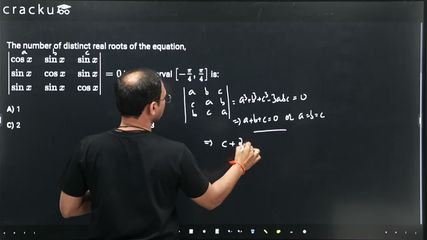
Click on the Email ☝️ to Watch the Video Solution
Create a FREE account and get:
_1.webp)

Educational materials for JEE preparation

Ask our AI anything

AI can make mistakes. Please verify important information.
AI can make mistakes. Please verify important information.
