
Join Our JEE Preparation Group
Prep with like-minded aspirants; Get access to free daily tests and study material.
Sign in
Please select an account to continue using cracku.in
↓ →
Join Our JEE Preparation Group
Prep with like-minded aspirants; Get access to free daily tests and study material.
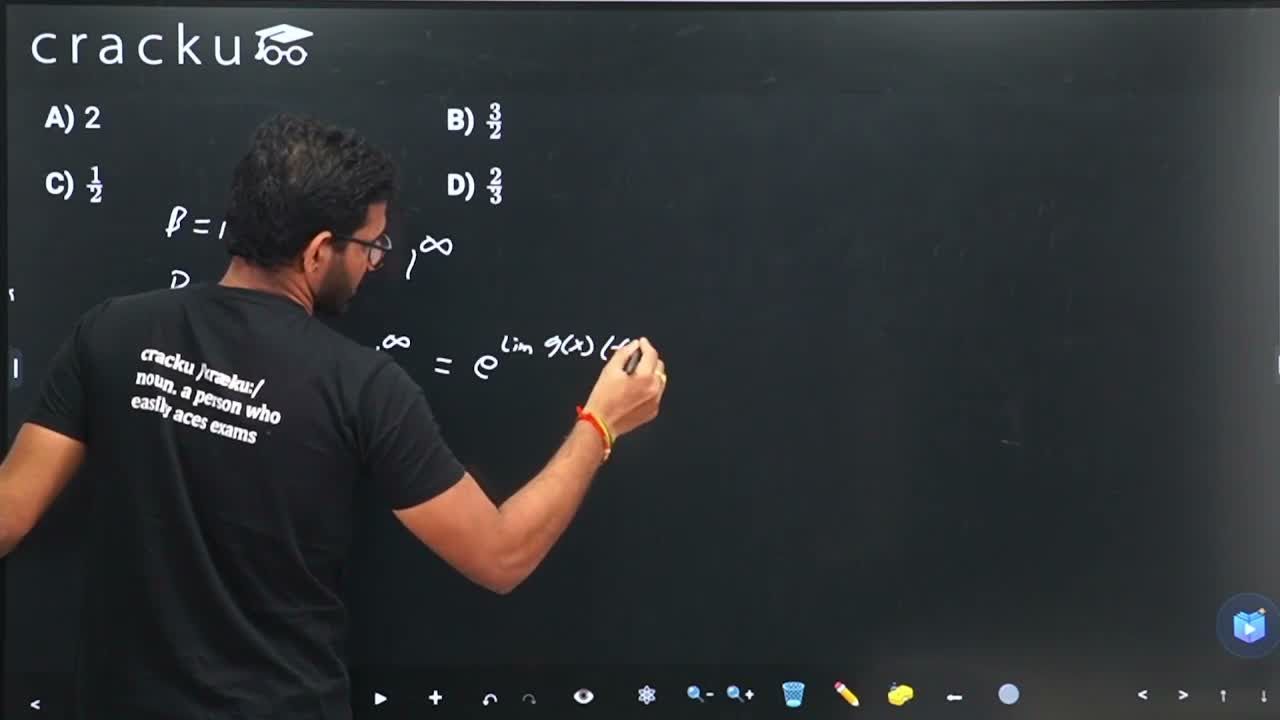
If $$\lim_{x \to \infty} \left(1 + \frac{a}{x} - \frac{4}{x^2}\right)^{2x} = e^3$$, then $$a$$ is equal to
We have to evaluate the limit
$$\displaystyle \lim_{x \to \infty}\bigl(1+\frac{a}{x}-\frac{4}{x^{2}}\bigr)^{2x}$$
and compare the answer with the number $$e^{3}$$ that is given in the question. A very convenient way of dealing with limits of the form $$\bigl(1+\text{(something that goes to }0)\bigr)^{\text{(something large)}}$$ is to take natural logarithms first. So, let us denote the required limit by $$L$$:
$$L=\lim_{x\to\infty}\Bigl(1+\frac{a}{x}-\frac{4}{x^{2}}\Bigr)^{2x}.$$
Taking natural logarithm on both sides, we obtain
$$\ln L=\lim_{x\to\infty} 2x\;\ln\!\Bigl(1+\frac{a}{x}-\frac{4}{x^{2}}\Bigr).$$
Now, for any small real number $$y$$, the Taylor series of the natural logarithm starts as
$$\ln(1+y)=y-\frac{y^{2}}{2}+\frac{y^{3}}{3}-\dots$$
In our case the quantity inside the logarithm is
$$1+y\quad\text{with}\quad y=\frac{a}{x}-\frac{4}{x^{2}}.$$
Because $$y\to 0$$ as $$x\to\infty$$, it is perfectly valid to keep only the first two terms of the above expansion; any higher-order term would give a contribution that vanishes when multiplied by $$2x$$ and then letting $$x\to\infty$$. Hence
$$\ln\!\Bigl(1+\frac{a}{x}-\frac{4}{x^{2}}\Bigr)=\Bigl(\frac{a}{x}-\frac{4}{x^{2}}\Bigr)\;-\;\frac{1}{2}\Bigl(\frac{a}{x}-\frac{4}{x^{2}}\Bigr)^{2}+O\!\Bigl(\frac{1}{x^{3}}\Bigr).$$
Let us simplify the square that appears in the second term:
$$\Bigl(\frac{a}{x}-\frac{4}{x^{2}}\Bigr)^{2}=\frac{a^{2}}{x^{2}}-\frac{8a}{x^{3}}+\frac{16}{x^{4}}.$$ Consequently,
$$-\frac{1}{2}\Bigl(\frac{a}{x}-\frac{4}{x^{2}}\Bigr)^{2}=-\frac{a^{2}}{2x^{2}}+O\!\Bigl(\frac{1}{x^{3}}\Bigr).$$
Putting everything together, the logarithm is
$$\ln\!\Bigl(1+\frac{a}{x}-\frac{4}{x^{2}}\Bigr)=\frac{a}{x}-\frac{4}{x^{2}}-\frac{a^{2}}{2x^{2}}+O\!\Bigl(\frac{1}{x^{3}}\Bigr).$$
Now multiply by the outer factor $$2x$$ that we still have in $$\ln L$$:
$$2x\;\ln\!\Bigl(1+\frac{a}{x}-\frac{4}{x^{2}}\Bigr)=2x\Bigl(\frac{a}{x}-\frac{4}{x^{2}}-\frac{a^{2}}{2x^{2}}+O\!\bigl(\frac{1}{x^{3}}\bigr)\Bigr).$$
Distributing the $$2x$$ term by term yields
$$2x\;\ln(\dots)=2a+\frac{-8-a^{2}}{x}+O\!\Bigl(\frac{1}{x^{2}}\Bigr).$$
Finally, let $$x\to\infty$$. All the terms containing $$1/x$$ or higher powers of $$1/x$$ vanish, and we obtain the very simple limit
$$\ln L = 2a.$$
But by the statement of the problem the original limit is equal to $$e^{3}$$, so $$\ln L=3$$. Equating the two values of $$\ln L$$, we have
$$2a = 3 \quad\Longrightarrow\quad a = \frac{3}{2}.$$
Therefore the required value of $$a$$ is $$\displaystyle\frac{3}{2}$$. This matches option B in the given list.
Hence, the correct answer is Option B.
Was this solution helpful?
Click on the Email ☝️ to Watch the Video Solution
Create a FREE account and get:
_1.webp)

Educational materials for JEE preparation

Ask our AI anything

AI can make mistakes. Please verify important information.
AI can make mistakes. Please verify important information.
