
Join Our JEE Preparation Group
Prep with like-minded aspirants; Get access to free daily tests and study material.
Sign in
Please select an account to continue using cracku.in
↓ →
Join Our JEE Preparation Group
Prep with like-minded aspirants; Get access to free daily tests and study material.
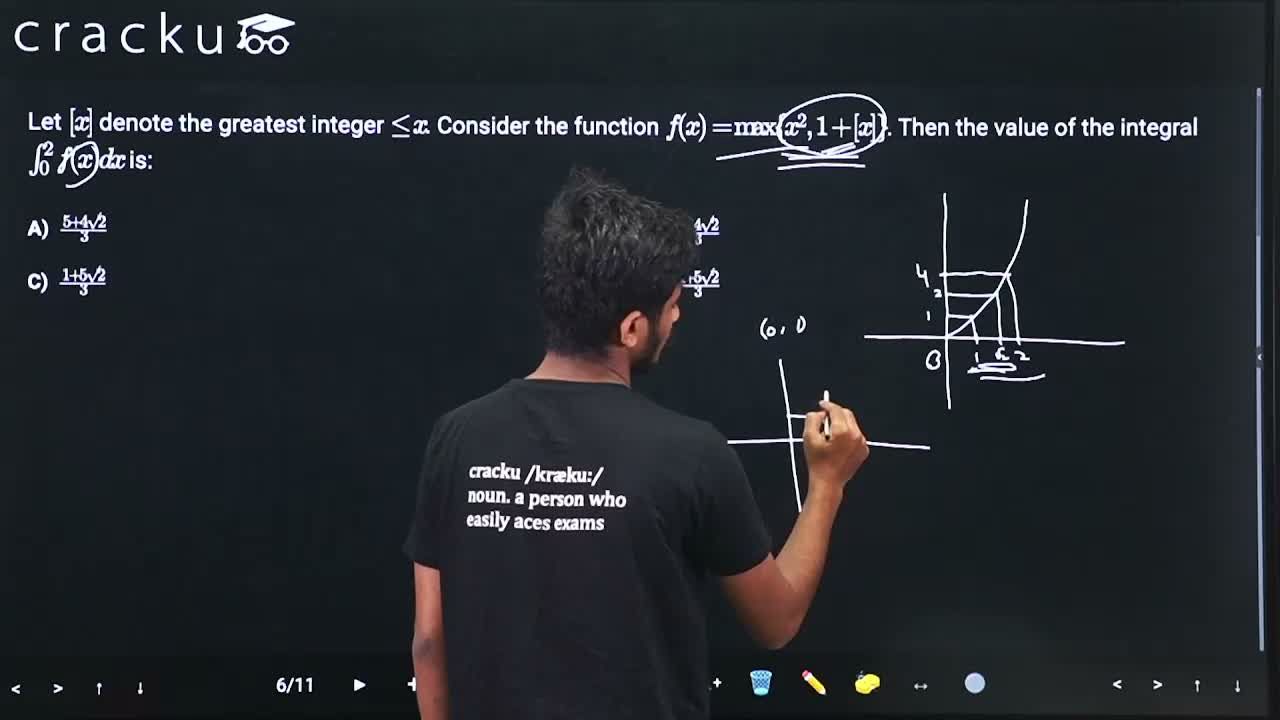
Let $$[x]$$ denote the greatest integer $$\leq x$$. Consider the function $$f(x) = \max\{x^2, 1 + [x]\}$$. Then the value of the integral $$\int_0^2 f(x) dx$$ is:
To evaluate the integral of the function $$f(x) = \max\{x^2, 1 + [x]\}$$ from $$0$$ to $$2$$, we must break the interval $$[0, 2]$$ into subintervals based on the behavior of the greatest integer function,$$[x]$$, and the intersection of the two functions inside the maximum.
Step 1: Analyze the function on subintervals
The value of $$[x]$$ changes at integer values. We analyze $$1 + [x]$$ and compare it to $$x^2$$ over the interval$$[0, 2]$$.
For $$0 \leq x < 1$$:
$$[x] = 0 \implies 1 + [x] = 1$$
We need to find $$\max\{x^2, 1\}$$.
Since $$x^2 < 1$$ for all $$x$$ in this interval, the maximum is $$1$$.
Therefore, $$f(x) = 1$$.
For $$1 \leq x < 2$$:
$$[x] = 1 \implies 1 + [x] = 2$$
We need to find $$\max\{x^2, 2\}$$.
We must determine where $$x^2 = 2$$. Taking the square root gives $$x = \sqrt{2}$$, which falls inside our interval.
Subinterval $$1 \leq x < \sqrt{2}$$: Here, $$x^2 < 2$$, so the maximum is $$2$$. Thus, $$f(x) = 2$$.
Subinterval $$\sqrt{2} \leq x < 2$$: Here, $$x^2 \geq 2$$, so the maximum is $$x^2$$. Thus, $$f(x) = x^2$$.
Step 2: Set up the piecewise integrals
Now we can express the original integral as the sum of three separate definite integrals based on the subintervals we found:
$$\int_0^2 f(x) dx = \int_0^1 1 \, dx + \int_1^{\sqrt{2}} 2 \, dx + \int_{\sqrt{2}}^2 x^2 \, dx$$
Step 3: Evaluate each integral
Calculate the definite integral for each part separately:
1. First part:
$$\int_0^1 1 \, dx = [x]_0^1 = 1 - 0 = 1$$
2. Second part:
$$\int_1^{\sqrt{2}} 2 \, dx = [2x]_1^{\sqrt{2}} = 2\sqrt{2} - 2(1) = 2\sqrt{2} - 2$$
3. Third part:
$$\int_{\sqrt{2}}^2 x^2 \, dx = \left[\frac{x^3}{3}\right]_{\sqrt{2}}^2 = \frac{2^3}{3} - \frac{(\sqrt{2})^3}{3} = \frac{8}{3} - \frac{2\sqrt{2}}{3}$$
Step 4: Sum the results
Add the evaluated parts together to find the total area:
$$\text{Total Area} = 1 + (2\sqrt{2} - 2) + \left(\frac{8}{3} - \frac{2\sqrt{2}}{3}\right)$$
$$\text{Total Area} = \frac{5 + 4\sqrt{2}}{3}$$
Final Answer
The value of the integral is: $$\frac{5 + 4\sqrt{2}}{3}$$
Was this solution helpful?
Click on the Email ☝️ to Watch the Video Solution
Create a FREE account and get:
_1.webp)

Educational materials for JEE preparation

Ask our AI anything

AI can make mistakes. Please verify important information.
AI can make mistakes. Please verify important information.
