
Join Our JEE Preparation Group
Prep with like-minded aspirants; Get access to free daily tests and study material.
Sign in
Please select an account to continue using cracku.in
↓ →
Join Our JEE Preparation Group
Prep with like-minded aspirants; Get access to free daily tests and study material.
The number of points on the curve $$y = 54x^5 - 135x^4 - 70x^3 + 180x^2 + 210x$$ at which the normal lines are parallel to $$x + 90y + 2 = 0$$ is:
Step 1: Find the slope of the given line
The equation of the given line is:
$$x + 90y + 2 = 0$$
Rewriting it in slope-intercept form ($$y = mx + c$$):
$$90y = -x - 2 \implies y = -\frac{1}{90}x - \frac{2}{90}$$
Thus, the slope of this line is $$m = -\frac{1}{90}$$.
Step 2: Formulate the condition for parallel normal lines
Since the normal lines to the curve are parallel to the given line, their slope must be equal to the slope of the line:
$$m_{\text{normal}} = -\frac{1}{90}$$
The relationship between the slope of the tangent ($$\frac{dy}{dx}$$) and the slope of the normal is given by:
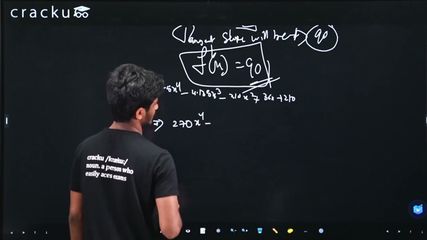
$$m_{\text{normal}} = -\frac{1}{\frac{dy}{dx}} = -\frac{1}{90} \implies \frac{dy}{dx} = 90$$
Step 3: Differentiate the given curve equation
The equation of the curve is:
$$y = 54x^5 - 135x^4 - 70x^3 + 180x^2 + 210x$$
Differentiating $$y$$ with respect to $$x$$ gives:
$$\frac{dy}{dx} = 54(5x^4) - 135(4x^3) - 70(3x^2) + 180(2x) + 210$$
$$\frac{dy}{dx} = 270x^4 - 540x^3 - 210x^2 + 360x + 210$$
Step 4: Set the derivative equal to 90 and solve the polynomial equation
Substituting $$\frac{dy}{dx} = 90$$ into the derivative equation:
$$270x^4 - 540x^3 - 210x^2 + 360x + 210 = 90$$
Subtracting 90 from both sides:
$$270x^4 - 540x^3 - 210x^2 + 360x + 120 = 0$$
Dividing the entire equation by 30 to simplify:
$$9x^4 - 18x^3 - 7x^2 + 12x + 4 = 0$$
By inspection, we test integer roots:
- For $$x = 1$$: $$9(1)^4 - 18(1)^3 - 7(1)^2 + 12(1) + 4 = 9 - 18 - 7 + 12 + 4 = 0$$ (So, $$x = 1$$ is a root)
- For $$x = 2$$: $$9(2)^4 - 18(2)^3 - 7(2)^2 + 12(2) + 4 = 144 - 144 - 28 + 24 + 4 = 0$$ (So, $$x = 2$$ is a root)
Since $$x = 1$$ and $$x = 2$$ are roots, $$(x-1)(x-2) = x^2 - 3x + 2$$ is a factor. Dividing the polynomial by this factor yields the remaining quadratic equation:
$$9x^2 + 9x + 2 = 0$$
Factoring the quadratic equation:
$$(3x + 1)(3x + 2) = 0 \implies x = -\frac{1}{3} \quad \text{or} \quad x = -\frac{2}{3}$$
The four distinct real roots for the x-coordinates are $$x = 1, 2, -\frac{1}{3}, -\frac{2}{3}$$. Since all four values are real and distinct, they correspond to four unique points on the curve.
Conclusion:
The number of points on the curve at which the normal lines are parallel to the given line is 4.
Was this solution helpful?
Click on the Email ☝️ to Watch the Video Solution
Create a FREE account and get:
_1.webp)

Educational materials for JEE preparation

Ask our AI anything

AI can make mistakes. Please verify important information.
AI can make mistakes. Please verify important information.


