
Join Our JEE Preparation Group
Prep with like-minded aspirants; Get access to free daily tests and study material.
Sign in
Please select an account to continue using cracku.in
↓ →
Join Our JEE Preparation Group
Prep with like-minded aspirants; Get access to free daily tests and study material.
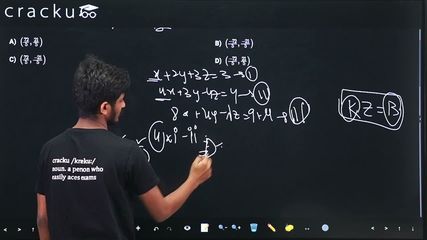
If the system of equations $$x + 2y + 3z = 3$$, $$4x + 3y - 4z = 4$$ and $$8x + 4y - \lambda z = 9 + \mu$$ has infinitely many solutions, then the ordered pair $$(\lambda, \mu)$$ is equal to
$$\Delta = \Delta_x = \Delta_y = \Delta_z = 0$$
$$x + 2y + 3z = 3$$, $$4x + 3y - 4z = 4$$, $$8x + 4y - \lambda z = 9 + \mu$$
$$\Delta = \text{det} \begin{bmatrix} 1 & 2 & 3 \\ 4 & 3 & -4 \\ 8 & 4 & -\lambda \end{bmatrix} = 0$$
$$1[3(-\lambda) - (-4)(4)] - 2[4(-\lambda) - (-4)(8)] + 3[4(4) - 3(8)] = 0$$
$$1(-3\lambda + 16) - 2(-4\lambda + 32) + 3(16 - 24) = 0$$
$$5\lambda - 72 = 0 \implies \lambda = \frac{72}{5}$$
$$\Delta_z = \text{det} \begin{bmatrix} 1 & 2 & 3 \\ 4 & 3 & 4 \\ 8 & 4 & 9+\mu \end{bmatrix} = 0$$
$$1[3(9+\mu) - 4(4)] - 2[4(9+\mu) - 4(8)] + 3[4(4) - 3(8)] = 0$$
$$1(27 + 3\mu - 16) - 2(36 + 4\mu - 32) + 3(16 - 24) = 0$$
$$-5\mu - 21 = 0 \implies -5\mu = 21 \implies \mu = -\frac{21}{5}$$
$$(\lambda, \mu) = \left(\frac{72}{5}, -\frac{21}{5}\right)$$
Click on the Email ☝️ to Watch the Video Solution
Create a FREE account and get:
_1.webp)

Educational materials for JEE preparation

Ask our AI anything

AI can make mistakes. Please verify important information.
AI can make mistakes. Please verify important information.


