
Join Our JEE Preparation Group
Prep with like-minded aspirants; Get access to free daily tests and study material.
Sign in
Please select an account to continue using cracku.in
↓ →
Join Our JEE Preparation Group
Prep with like-minded aspirants; Get access to free daily tests and study material.
If $$f(x) = \frac{2^{2x}}{2^{2x}+2}$$, $$x \in \mathbb{R}$$, then $$f\left(\frac{1}{2023}\right) + f\left(\frac{2}{2023}\right) + f\left(\frac{3}{2023}\right) + \ldots + f\left(\frac{2022}{2023}\right)$$ is equal to
We need to evaluate $$f\left(\frac{1}{2023}\right) + f\left(\frac{2}{2023}\right) + \cdots + f\left(\frac{2022}{2023}\right)$$ where $$f(x) = \dfrac{2^{2x}}{2^{2x} + 2} = \dfrac{4^x}{4^x + 2}$$.
First, observe that for any $$x$$ we have
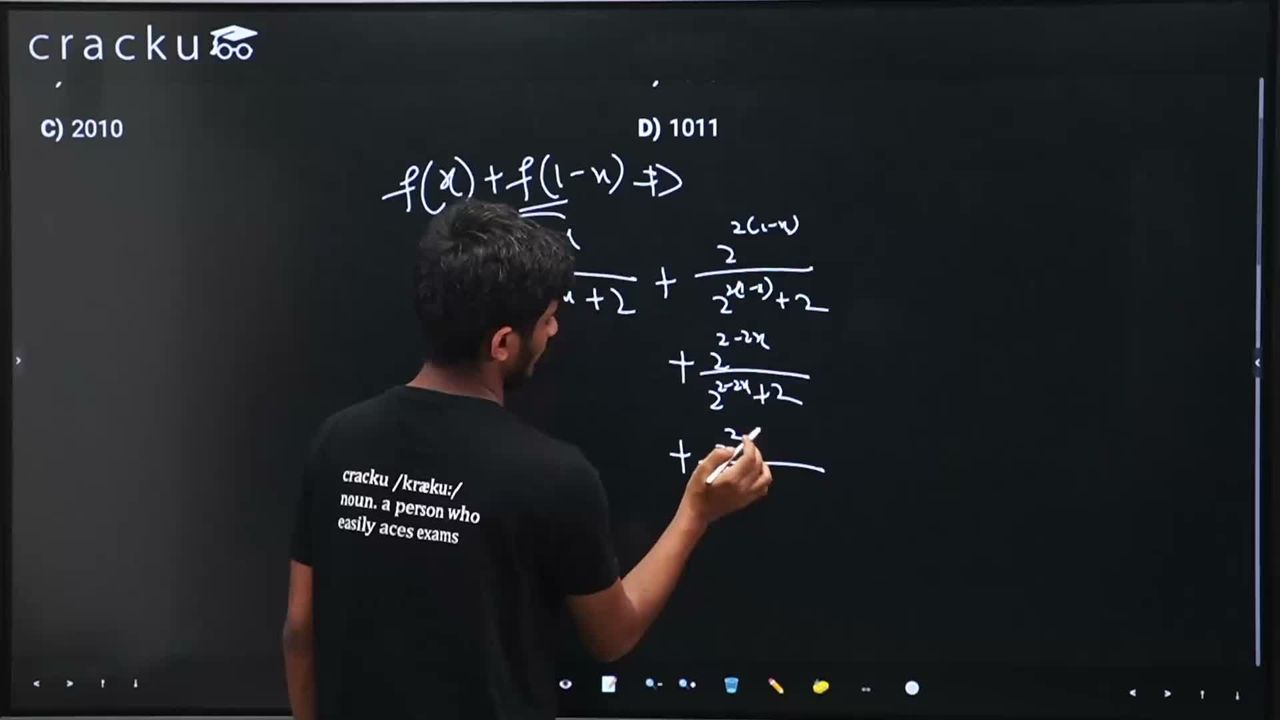
$$f(1 - x) = \dfrac{4^{1 - x}}{4^{1 - x} + 2} = \dfrac{\frac{4}{4^x}}{\frac{4}{4^x} + 2} = \dfrac{4}{4 + 2 \cdot 4^x} = \dfrac{2}{2 + 4^x}$$
and therefore
$$f(x) + f(1 - x) = \dfrac{4^x}{4^x + 2} + \dfrac{2}{4^x + 2} = \dfrac{4^x + 2}{4^x + 2} = 1.$$
Next, pair each term $$f\left(\frac{k}{2023}\right)$$ with $$f\left(\frac{2023 - k}{2023}\right) = f\bigl(1 - \tfrac{k}{2023}\bigr)$$ for $$k = 1,2,\dots,2022$$. Each pair sums to 1:
$$f\left(\frac{k}{2023}\right) + f\left(\frac{2023 - k}{2023}\right) = 1.$$
Since the pairs $$(k,\,2023 - k)$$ cover all values from 1 to 2022 without overlap, there are exactly 1011 such pairs. Hence the total sum is
$$1011 \times 1 = 1011.$$
The correct answer is Option D: 1011.
Click on the Email ☝️ to Watch the Video Solution
Create a FREE account and get:
_1.webp)

Educational materials for JEE preparation

Ask our AI anything

AI can make mistakes. Please verify important information.
AI can make mistakes. Please verify important information.


