
Join Our JEE Preparation Group
Prep with like-minded aspirants; Get access to free daily tests and study material.
Sign in
Please select an account to continue using cracku.in
↓ →
Join Our JEE Preparation Group
Prep with like-minded aspirants; Get access to free daily tests and study material.
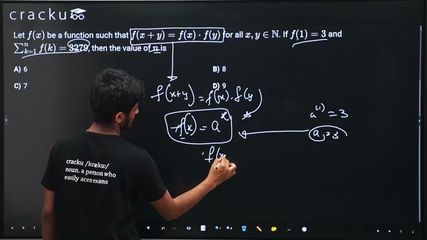
Let $$f(x)$$ be a function such that $$f(x + y) = f(x) \cdot f(y)$$ for all $$x, y \in \mathbb{N}$$. If $$f(1) = 3$$ and $$\sum_{k=1}^{n} f(k) = 3279$$, then the value of $$n$$ is
We are given the functional equation $$f(x + y) = f(x) \cdot f(y)$$ for all $$x, y \in \mathbb{N}$$, along with $$f(1) = 3$$ and the condition $$\sum_{k=1}^{n} f(k) = 3279\;.$$
By setting $$y = 1$$ in the functional equation, we obtain $$f(x + 1) = f(x)\cdot f(1) = 3f(x)\;. $$ An inductive argument then shows that $$f(n) = 3^n$$ for every natural number $$n\;.$$
Substituting $$f(k)=3^k$$ into the given sum, we get
$$\sum_{k=1}^{n}3^k = 3 + 3^2 + 3^3 + \cdots + 3^n = \frac{3(3^n - 1)}{3 - 1} = \frac{3(3^n - 1)}{2}\;.$$
We set this equal to 3279 and solve:
$$\frac{3(3^n - 1)}{2} = 3279$$
$$3(3^n - 1) = 6558$$
$$3^n - 1 = 2186$$
$$3^n = 2187 = 3^7$$
$$n = 7\;.$$
Therefore, the value of $$n$$ is 7.
Was this solution helpful?
Click on the Email ☝️ to Watch the Video Solution
Create a FREE account and get:
_1.webp)

Educational materials for JEE preparation

Ask our AI anything

AI can make mistakes. Please verify important information.
AI can make mistakes. Please verify important information.
