
Join Our JEE Preparation Group
Prep with like-minded aspirants; Get access to free daily tests and study material.
Sign in
Please select an account to continue using cracku.in
↓ →
Join Our JEE Preparation Group
Prep with like-minded aspirants; Get access to free daily tests and study material.
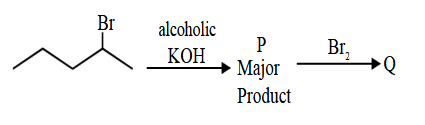
Consider the above sequence of reactions. 151 g of 2-bromopentane is made to react. Yield of major product P is 80% whereas Q is 100%.
Mass of product Q obtained is _________ g.
(Given molar mass in g mol$$^{-1}$$ H: 1, C: 12, O: 16, Br: 80)
Correct Answer: 184
The problem can be solved by first identifying the products formed in each reaction step and then carrying out the required stoichiometric calculations.
In the first step, the starting compound is 2-bromopentane. When treated with alcoholic KOH, it undergoes a $\beta$-elimination reaction.
According to Zaitsev's rule, the more substituted alkene is formed as the major product.
The reaction is
$$\text{2-Bromopentane}+\text{alc. KOH}\longrightarrow\text{Pent-2-ene}+KBr+H_2O.$$
Hence, product P is
$$\boxed{\text{Pent-2-ene }(\mathrm{CH_3-CH=CH-CH_2-CH_3}).}$$
In the second step, pent-2-ene reacts with bromine through electrophilic addition across the double bond.
The reaction is
$$\text{Pent-2-ene}+Br_2\longrightarrow\text{2,3-Dibromopentane}.$$
Therefore, product Q is
$$\boxed{\mathrm{CH_3-CH(Br)-CH(Br)-CH_2-CH_3}.}$$
Next, calculate the molar masses.
For 2-bromopentane,
$$\mathrm{C_5H_{11}Br},$$
the molar mass is
$$M=(5\times12)+(11\times1)+80$$
$$=60+11+80$$
$$=151\ \text{g mol}^{-1}.$$
For 2,3-dibromopentane,
$$\mathrm{C_5H_{10}Br_2},$$
the molar mass is
$$M=(5\times12)+(10\times1)+(2\times80)$$
$$=60+10+160$$
$$=230\ \text{g mol}^{-1}.$$
Initially,
$$151\ \text{g}$$
of 2-bromopentane is taken.
Hence,
$$\text{Number of moles}=\frac{151}{151}=1\ \text{mol}.$$
The first reaction proceeds with an
$$80%$$
yield.
Therefore, the actual amount of product P formed is
$$1\times0.80=0.8\ \text{mol}.$$
The second reaction has
$$100%$$
yield and follows a
$$1:1$$
stoichiometric ratio.
Hence,
$$\text{Moles of Q}=0.8\ \text{mol}.$$
Finally, the mass of product Q is
$$\text{Mass}=0.8\times230$$
$$=184\ \text{g}.$$
Therefore, the required mass of product Q is
$$\boxed{184\ \text{g}}.$$
Was this solution helpful?
Click on the Email ☝️ to Watch the Video Solution
Create a FREE account and get:
_1.webp)

Educational materials for JEE preparation

Ask our AI anything

AI can make mistakes. Please verify important information.
AI can make mistakes. Please verify important information.


