Join WhatsApp Icon JEE WhatsApp Group
Question 72

'$$x$$' is the product which is obtained from benzene by reacting it with carbon monoxide and hydrogen chloride in the presence of cuprous chloride. '$$y$$' is the major product obtained from the benzene by reacting it with ethanoyl chloride in the presence of anhydrous AlCl$$_3$$. Product (major) obtained by heating $$x$$ and $$y$$ in the presence of alkali is $$z$$. Total number of $$\pi$$ (pi) electrons in $$z$$ is __________.


Correct Answer: 16

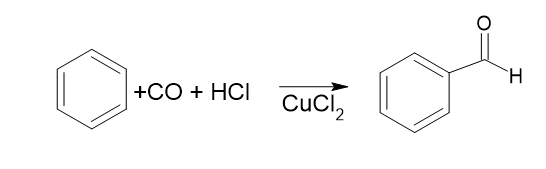
Benzene reacts with carbon monoxide and hydrogen chloride in the presence of cuprous chloride to give benzaldehyde by the Gattermann-Koch reaction.
Screenshot 2026-05-25 142301

$$x=C_6H_5OH$$

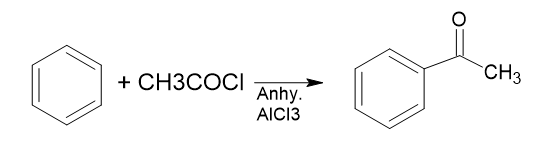
Benzene reacts with ethanoyl chloride $$(\mathrm{CH_3COCl})$$ in presence of anhydrous $$\mathrm{AlCl_3}$$​ to give acetophenone by Friedel-Crafts acylation.
Screenshot 2026-05-25 142730

$$y=C_{6}H_{5}COCH_3$$

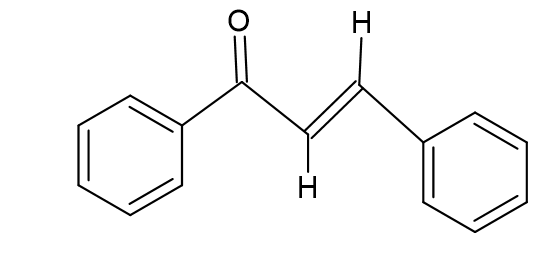
On heating benzaldehyde and acetophenone in presence of alkali, Claisen-Schmidt condensation occurs to form chalcone:
Screenshot 2026-05-25 143134

Now count total $$\pi$$-electrons in Chalcone:

  • Two benzene rings: 6+6=12
  • One $$C=C$$ bond: 2
  • One $$C=O$$ bond: 2

Total $$\pi$$ bonds is 16.

Get AI Help

Video Solution

video

Create a FREE account and get:

  • Free JEE Mains Previous Papers PDF
  • Take JEE Mains paper tests

JEE Quant Questions | JEE Quantitative Ability

JEE DILR Questions | LRDI Questions For JEE

JEE Verbal Ability Questions | VARC Questions For JEE

Free JEE Topicwise Questions

JEE Dual Nature of Matter & RadiationJEE Simple Harmonic MotionJEE Sequences & SeriesJEE Redox ReactionsJEE Complex NumbersJEE Basic Principles of Organic ChemistryJEE Organic Compounds with HalogensJEE d and f-Block ElementsJEE EquilibriumJEE Practical Organic ChemistryJEE Aldehydes & KetonesJEE Atoms & NucleiJEE Conic SectionsJEE Electric Potential & CapacitanceJEE Magnetic Effects of CurrentJEE Laws of ThermodynamicsJEE Basic Concepts in ChemistryJEE ElectrochemistryJEE CirclesJEE Units & MeasurementsJEE Chemical ThermodynamicsJEE Trigonometric FunctionsJEE Coordination CompoundsJEE Wave OpticsJEE Electronic DevicesJEE SolutionsJEE Work, Energy & PowerJEE Kinematics - 1D MotionJEE MatricesJEE Hydrocarbons - AlkanesJEE Indefinite IntegrationJEE Inverse Trigonometric FunctionsJEE StatisticsJEE Laboratory Experiments - XIJEE Continuity & DifferentiabilityJEE Differential EquationsJEE BiomoleculesJEE Fluid MechanicsJEE Ray OpticsJEE Straight LinesJEE DeterminantsJEE DifferentiationJEE Chemical Bonding & Molecular StructureJEE Magnetism & Magnetic MaterialsJEE Three Dimensional GeometryJEE Alcohols, Phenols & EthersJEE Sets, Relations & FunctionsJEE Heat TransferJEE Vector AlgebraJEE Nitrogen-Containing CompoundsJEE Kinetic Theory of GasesJEE Number SystemJEE Current & ResistanceJEE ElasticityJEE ProbabilityJEE Electric Charges & FieldsJEE Purification & CharacterisationJEE GravitationJEE LimitsJEE Electromagnetic InductionJEE Chemical KineticsJEE Applications of DerivativesJEE WavesJEE EMF & Circuit AnalysisJEE Definite IntegrationJEE Carboxylic AcidsJEE Binomial TheoremJEE Hydrocarbons - AlkynesJEE Alternating CurrentsJEE Electromagnetic WavesJEE Quadratic EquationsJEE Permutations & CombinationsJEE Laws of MotionJEE Hydrocarbons - AlkenesJEE Kinematics - 2D MotionJEE Atomic StructureJEE Periodic Table & PeriodicityJEE JEE 2D GeometryJEE Hydrocarbons - AromaticJEE p-Block Elements (Groups 13-18)JEE Rotational MotionJEE Surface Tension
Ask AI