
Join Our JEE Preparation Group
Prep with like-minded aspirants; Get access to free daily tests and study material.
Sign in
Please select an account to continue using cracku.in
↓ →
Join Our JEE Preparation Group
Prep with like-minded aspirants; Get access to free daily tests and study material.
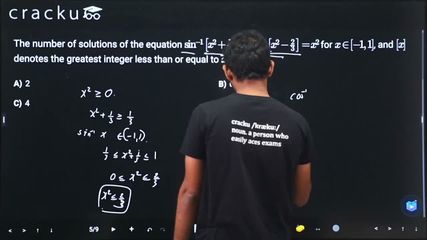
The number of solutions of the equation $$\sin^{-1}\left[x^2 + \frac{1}{3}\right] + \cos^{-1}\left[x^2 - \frac{2}{3}\right] = x^2$$ for $$x \in [-1, 1]$$, and $$[x]$$ denotes the greatest integer less than or equal to $$x$$, is:
Given equation,
$$\sin^{-1}\left[x^2+\frac13\right]+\cos^{-1}\left[x^2-\frac23\right]=x^2$$
for
$$x\in[-1,1]$$
First apply domain conditions.
For
$$\sin^{-1}\left[x^2+\frac13\right]$$
we need
$$-1\le x^2+\frac13\le1$$
Since
$$x^2\ge0,$$
only upper bound matters:
$$x^2+\frac13\le1$$
$$x^2\le\frac23$$
Similarly, for
$$\cos^{-1}\left[x^2-\frac23\right],$$
we need
$$-1\le x^2-\frac23\le1$$
This is automatically satisfied for
$$x^2\in\left[0,\frac23\right]$$
Hence valid domain is
$$x^2\le\frac23$$
Now use identity
$$\sin^{-1}t+\cos^{-1}t=\frac\pi2$$
Write
$$x^2-\frac23=\left(x^2+\frac13\right)-1$$
Put
$$u=x^2+\frac13$$
Then equation becomes
$$\sin^{-1}u+\cos^{-1}(u-1)=x^2$$
Now observe that
$$u\in\left[\frac13,1\right]$$
Checking possible values:
If
$$u=1,$$
then
$$x^2=\frac23$$
LHS becomes
$$\sin^{-1}(1)+\cos^{-1}(0)$$
$$=\frac\pi2+\frac\pi2=\pi$$
which is not equal to
$$\frac23$$
For all valid
$$x,$$
LHS lies in
$$\left[\frac\pi2,\pi\right]$$
while RHS satisfies
$$x^2\le\frac23$$
Since
$$\frac\pi2>\frac23,$$
equation cannot hold.
Hence there are no real solutions.
Therefore, the required number of solutions is
$$\boxed{0}$$
Was this solution helpful?
Click on the Email ☝️ to Watch the Video Solution
Create a FREE account and get:
_1.webp)

Educational materials for JEE preparation

Ask our AI anything

AI can make mistakes. Please verify important information.
AI can make mistakes. Please verify important information.


