
Join Our JEE Preparation Group
Prep with like-minded aspirants; Get access to free daily tests and study material.
Sign in
Please select an account to continue using cracku.in
↓ →
Join Our JEE Preparation Group
Prep with like-minded aspirants; Get access to free daily tests and study material.
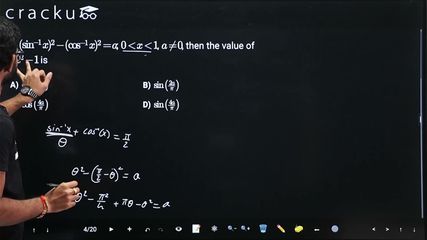
If $$(\sin^{-1} x)^2 - (\cos^{-1} x)^2 = a$$; $$0 < x < 1$$, $$a \neq 0$$, then the value of $$2x^2 - 1$$ is
We are given the relation $$\left(\sin^{-1}x\right)^2-\left(\cos^{-1}x\right)^2=a$$ with $$0<x<1$$ and $$a\neq0$$.
For angles in the interval $$(0,\tfrac{\pi}{2})$$ we always have the elementary identity $$\cos^{-1}x=\frac{\pi}{2}-\sin^{-1}x.$$ Using this fact lets us re-express the second square in terms of the first.
Put $$\theta=\sin^{-1}x.$$ Then $$\cos^{-1}x=\frac{\pi}{2}-\theta.$$ Substituting these into the given equation yields
$$\theta^{2}-\left(\frac{\pi}{2}-\theta\right)^{2}=a.$$
Now we expand the square on the right side. First write the binomial square formula $$\left(A-B\right)^{2}=A^{2}-2AB+B^{2}.$$ Applying it here with $$A=\frac{\pi}{2}$$ and $$B=\theta,$$ we find
$$\left(\frac{\pi}{2}-\theta\right)^{2}=\left(\frac{\pi}{2}\right)^{2}-2\left(\frac{\pi}{2}\right)\theta+\theta^{2}=\frac{\pi^{2}}{4}-\pi\theta+\theta^{2}.$$
Substituting this explicit expansion back gives
$$\theta^{2}-\left[\frac{\pi^{2}}{4}-\pi\theta+\theta^{2}\right]=a.$$
The two $$\theta^{2}$$ terms cancel because one is positive and the other is negative:
$$\theta^{2}-\frac{\pi^{2}}{4}+\pi\theta-\theta^{2}=a.$$
Simplifying, we keep only the remaining terms:
$$\pi\theta-\frac{\pi^{2}}{4}=a.$$
Now solve for $$\theta$$. First add $$\dfrac{\pi^{2}}{4}$$ to both sides:
$$\pi\theta=a+\frac{\pi^{2}}{4}.$$
Next divide by $$\pi$$:
$$\theta=\frac{a}{\pi}+\frac{\pi}{4}.$$
But recall that $$\theta=\sin^{-1}x,$$ so
$$x=\sin\theta=\sin\!\left(\frac{a}{\pi}+\frac{\pi}{4}\right).$$
The quantity we must evaluate is $$2x^{2}-1.$$ Because $$x=\sin\alpha$$ where $$\alpha=\dfrac{a}{\pi}+\dfrac{\pi}{4},$$ it is convenient to rewrite $$2\sin^{2}\alpha-1$$ using the standard double-angle identity for cosine. First state the identity:
$$\cos2\alpha=1-2\sin^{2}\alpha \quad\Longrightarrow\quad 2\sin^{2}\alpha-1=-\cos2\alpha.$$
We substitute $$\alpha=\dfrac{a}{\pi}+\dfrac{\pi}{4}:$$
$$2x^{2}-1=2\sin^{2}\alpha-1=-\cos\!\bigl(2\alpha\bigr)=-\cos\!\left(2\left(\frac{a}{\pi}+\frac{\pi}{4}\right)\right).$$
Compute the argument of the cosine explicitly:
$$2\left(\frac{a}{\pi}+\frac{\pi}{4}\right)=\frac{2a}{\pi}+\frac{\pi}{2}.$$
Hence
$$2x^{2}-1=-\cos\!\left(\frac{2a}{\pi}+\frac{\pi}{2}\right).$$
Now use the phase-shift identity $$\cos\left(\theta+\frac{\pi}{2}\right)=-\sin\theta.$$ Setting $$\theta=\dfrac{2a}{\pi},$$ we obtain
$$\cos\!\left(\frac{2a}{\pi}+\frac{\pi}{2}\right)=-\sin\!\left(\frac{2a}{\pi}\right).$$
Therefore
$$-\cos\!\left(\frac{2a}{\pi}+\frac{\pi}{2}\right)=\sin\!\left(\frac{2a}{\pi}\right).$$
Substituting this result back, we finally get
$$2x^{2}-1=\sin\!\left(\frac{2a}{\pi}\right).$$
Among the given options, this matches Option B: $$\sin\!\left(\dfrac{2a}{\pi}\right).$$
Hence, the correct answer is Option B.
Click on the Email ☝️ to Watch the Video Solution
Create a FREE account and get:
_1.webp)

Educational materials for JEE preparation

Ask our AI anything

AI can make mistakes. Please verify important information.
AI can make mistakes. Please verify important information.


