
Join Our JEE Preparation Group
Prep with like-minded aspirants; Get access to free daily tests and study material.
Sign in
Please select an account to continue using cracku.in
↓ →
Join Our JEE Preparation Group
Prep with like-minded aspirants; Get access to free daily tests and study material.
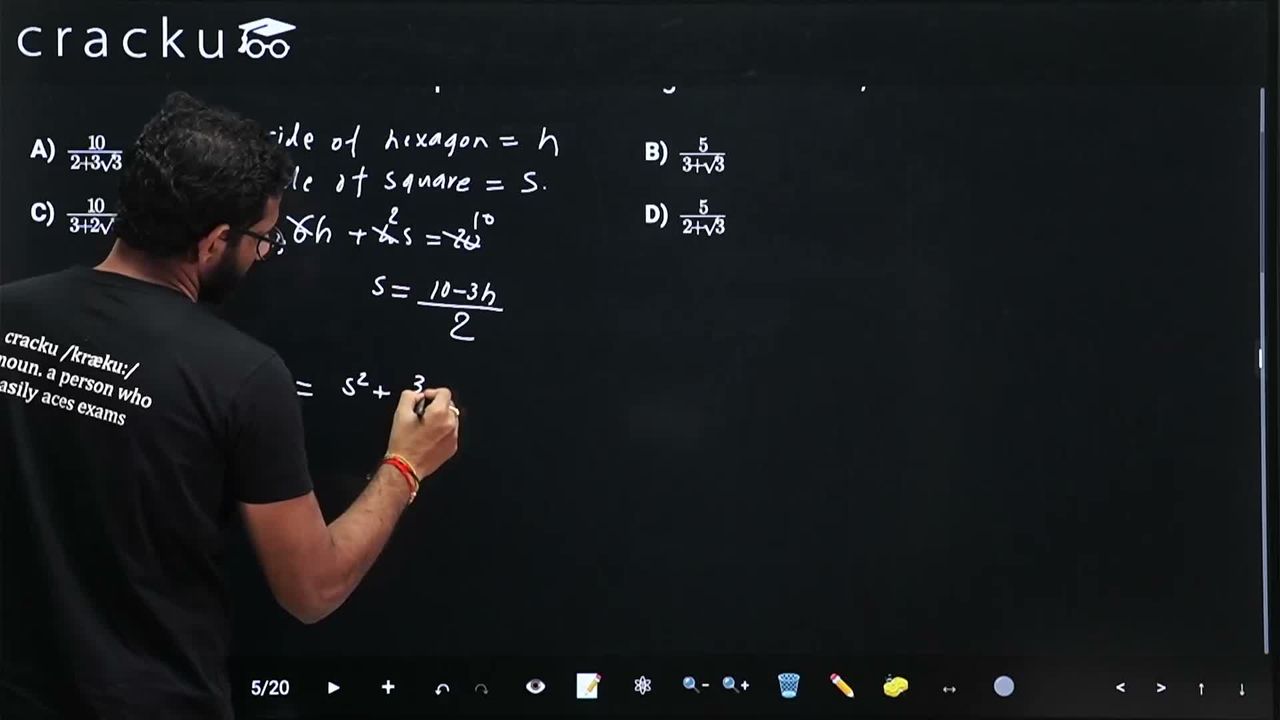
A wire of length 20 m is to be cut into two pieces. One of the pieces is to be made into a square and the other into a regular hexagon. Then the length of the side (in meters) of the hexagon, so that the combined area of the square and the hexagon is minimum, is
Let the wire be cut in such a way that the regular hexagon obtained has side $$x\ \text{m}$$ and the square obtained has side $$y\ \text{m}$$.
The whole wire is used, so the sum of the perimeters equals the original length.
For a regular hexagon the perimeter is $$6x$$, and for a square the perimeter is $$4y$$. Hence
$$6x+4y = 20.$$
Solving for $$y$$ we get
$$4y = 20-6x$$
$$y = \frac{20-6x}{4}$$
$$y = 5 - 1.5x.$$
Next we write the expressions for the areas.
The area of a square is $$y^{2}$$.
The area of a regular hexagon of side $$x$$ is given by the standard formula
$$\text{Area}_{\text{hexagon}} = \frac{3\sqrt{3}}{2}\,x^{2}.$$
So the total area $$A(x)$$, as a function of $$x$$ alone, is
$$A(x) = y^{2} + \frac{3\sqrt{3}}{2}\,x^{2}.$$
Substituting $$y = 5-1.5x$$ we have
$$A(x) = (5-1.5x)^{2} + \frac{3\sqrt{3}}{2}\,x^{2}.$$
To minimise this area, we differentiate with respect to $$x$$ and set the derivative equal to zero.
First expand the square term:
$$(5-1.5x)^{2} = 25 - 2(5)(1.5)x + (1.5)^{2}x^{2}$$
$$ = 25 - 15x + 2.25x^{2}.$$
Therefore
$$A(x) = 25 - 15x + 2.25x^{2} + \frac{3\sqrt{3}}{2}x^{2}.$$
Combining the quadratic terms:
$$A(x) = 25 - 15x + \left(2.25 + \frac{3\sqrt{3}}{2}\right)x^{2}.$$
Differentiate:
$$\frac{dA}{dx} = -15 + 2\left(2.25 + \frac{3\sqrt{3}}{2}\right)x.$$
Simplify the coefficient of $$x$$ inside the derivative:
$$2\left(2.25 + \frac{3\sqrt{3}}{2}\right) = 4.5 + 3\sqrt{3}.$$
So
$$\frac{dA}{dx} = -15 + (4.5 + 3\sqrt{3})x.$$
Set $$\dfrac{dA}{dx}=0$$ for the extremum:
$$-15 + (4.5 + 3\sqrt{3})x = 0.$$
Hence
$$(4.5 + 3\sqrt{3})x = 15$$
$$x = \frac{15}{4.5 + 3\sqrt{3}}.$$
Write $$4.5$$ as $$\dfrac{9}{2}$$ to combine denominators:
$$4.5 + 3\sqrt{3} = \frac{9}{2} + 3\sqrt{3} = \frac{9 + 6\sqrt{3}}{2}.$$
Therefore
$$x = \frac{15}{\dfrac{9 + 6\sqrt{3}}{2}} = 15 \cdot \frac{2}{9 + 6\sqrt{3}} = \frac{30}{9 + 6\sqrt{3}}.$$
Factor out a $$3$$ from the denominator:
$$x = \frac{30}{3(3 + 2\sqrt{3})} = \frac{10}{3 + 2\sqrt{3}}.$$
Since the second derivative is positive (the coefficient of $$x^{2}$$ in $$A(x)$$ is positive), this value of $$x$$ indeed gives the minimum combined area.
Thus the side of the hexagon that minimises the total area is
$$x = \frac{10}{3 + 2\sqrt{3}}\ \text{metres}.$$
Hence, the correct answer is Option C.
Click on the Email ☝️ to Watch the Video Solution
Create a FREE account and get:
_1.webp)

Educational materials for JEE preparation

Ask our AI anything

AI can make mistakes. Please verify important information.
AI can make mistakes. Please verify important information.


