
Join Our JEE Preparation Group
Prep with like-minded aspirants; Get access to free daily tests and study material.
Sign in
Please select an account to continue using cracku.in
↓ →
Join Our JEE Preparation Group
Prep with like-minded aspirants; Get access to free daily tests and study material.
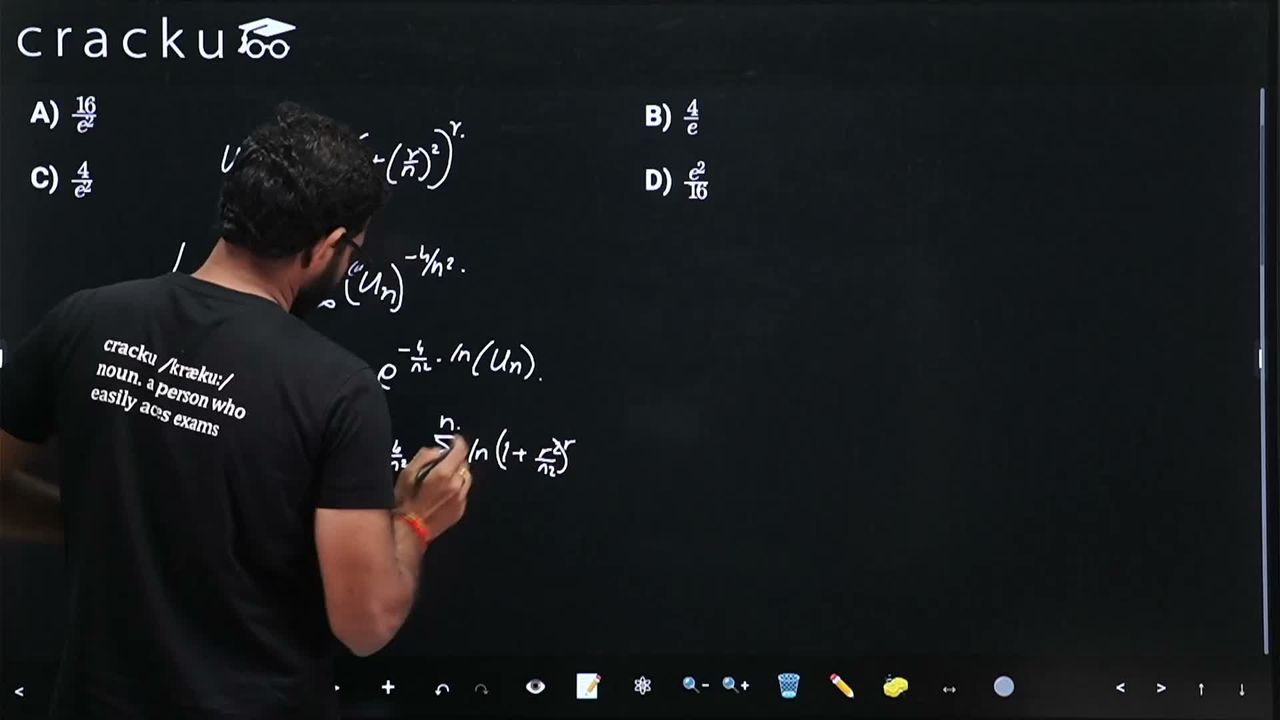
If $$U_n = \left(1 + \frac{1}{n^2}\right)\left(1 + \frac{2^2}{n^2}\right)^2 \cdots \left(1 + \frac{n^2}{n^2}\right)^n$$, then $$\lim_{n \to \infty} (U_n)^{\frac{-4}{n^2}}$$ is equal to
We have the product $$U_n=\left(1+\frac{1}{n^{2}}\right)^{1}\!\left(1+\frac{2^{2}}{n^{2}}\right)^{2}\!\cdots\!\left(1+\frac{n^{2}}{n^{2}}\right)^{n}=\prod_{k=1}^{n}\left(1+\frac{k^{2}}{n^{2}}\right)^{k}.$$
To find $$\displaystyle\lim_{n\to\infty}\bigl(U_n\bigr)^{\frac{-4}{n^{2}}},$$ it is natural to take natural logarithms. Using the law $$\ln\!\bigl(a^{b}\bigr)=b\ln a,$$ we first write
$$\ln U_n=\sum_{k=1}^{n}k\,\ln\!\left(1+\frac{k^{2}}{n^{2}}\right).$$
Our ultimate expression then becomes
$$\bigl(U_n\bigr)^{\!-4/n^{2}}=\exp\!\left(\!-\frac{4}{n^{2}}\ln U_n\!\right).$$
So we need the limit of $$-\dfrac{4}{n^{2}}\ln U_n$$ as $$n\to\infty.$$ If that limit tends to some number $$L,$$ then the required limit will be $$e^{L}.$$
Now we analyse $$\ln U_n.$$ Put $$k=nt$$ so that $$t=\dfrac{k}{n},$$ and note that as $$k$$ runs from $$1$$ to $$n,$$ the variable $$t$$ runs through the values $$\dfrac{1}{n},\dfrac{2}{n},\dots ,1.$$ Re-writing each summand,
$$k\,\ln\!\left(1+\frac{k^{2}}{n^{2}}\right)=nt\,\ln\!\bigl(1+t^{2}\bigr).$$
The sum thus becomes
$$\ln U_n=\sum_{k=1}^{n}nt\,\ln\!\bigl(1+t^{2}\bigr)=n\sum_{k=1}^{n}t\,\ln\!\bigl(1+t^{2}\bigr).$$
Between successive terms, $$t$$ increases by $$\dfrac{1}{n},$$ so the Riemann-sum form of an integral appears. Using the well-known fact that
$$\sum_{k=1}^{n}f\!\left(\frac{k}{n}\right)\frac{1}{n}\;\xrightarrow[n\to\infty]{}\;\int_{0}^{1}f(t)\,dt,$$
we see that
$$\frac{\ln U_n}{n^{2}}=\frac{1}{n^{2}}\,n\sum_{k=1}^{n}t\,\ln\!\bigl(1+t^{2}\bigr) =\frac{1}{n}\sum_{k=1}^{n}t\,\ln\!\bigl(1+t^{2}\bigr) \xrightarrow[n\to\infty]{}\int_{0}^{1}t\,\ln\!\bigl(1+t^{2}\bigr)\,dt.$$ Denote this integral by $$I,$$ so that $$\lim_{n\to\infty}\frac{\ln U_n}{n^{2}}=I.$$
We next compute $$I=\displaystyle\int_{0}^{1}t\,\ln(1+t^{2})\,dt.$$ Put the substitution $$u=1+t^{2},$$ whence $$du=2t\,dt\; \Longrightarrow\; t\,dt=\frac{du}{2}.$$ When $$t=0,$$ we have $$u=1,$$ and when $$t=1,$$ we have $$u=2.$$ Therefore,
$$I=\int_{t=0}^{1}t\,\ln(1+t^{2})\,dt =\frac{1}{2}\int_{u=1}^{2}\ln u\;du.$$
We recall the antiderivative formula $$\displaystyle\int\ln u\,du=u\ln u-u.$$ Using this,
$$\frac{1}{2}\int_{1}^{2}\ln u\;du =\frac{1}{2}\Bigl[u\ln u-u\Bigr]_{1}^{2} =\frac{1}{2}\Bigl[(2\ln 2-2)-(1\cdot 0-1)\Bigr] =\frac{1}{2}\bigl(2\ln 2-1\bigr) =\ln 2-\frac{1}{2}.$$
Thus $$I=\ln 2-\dfrac{1}{2}.$$
Consequently,
$$\lim_{n\to\infty}\frac{\ln U_n}{n^{2}}=I=\ln 2-\frac{1}{2}.$$
We now return to the exponent we need:
$$\lim_{n\to\infty}\left(-\frac{4}{n^{2}}\ln U_n\right) =-4\left(\ln 2-\frac{1}{2}\right) =-4\ln 2+2.$$
Exponentiating gives
$$\lim_{n\to\infty}\bigl(U_n\bigr)^{-4/n^{2}} =\exp\!\bigl(-4\ln 2+2\bigr) =e^{2}\,e^{-4\ln 2} =e^{2}\,\left(e^{\ln 2}\right)^{-4} =\frac{e^{2}}{2^{4}} =\frac{e^{2}}{16}.$$
Hence, the correct answer is Option D.
Was this solution helpful?
Click on the Email ☝️ to Watch the Video Solution
Create a FREE account and get:
_1.webp)

Educational materials for JEE preparation

Ask our AI anything

AI can make mistakes. Please verify important information.
AI can make mistakes. Please verify important information.
