
Join Our JEE Preparation Group
Prep with like-minded aspirants; Get access to free daily tests and study material.
Sign in
Please select an account to continue using cracku.in
↓ →
Join Our JEE Preparation Group
Prep with like-minded aspirants; Get access to free daily tests and study material.
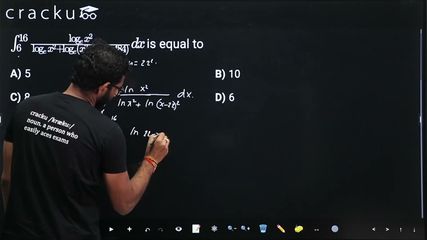
$$\int_6^{16} \frac{\log_e x^2}{\log_e x^2 + \log_e(x^2 - 44x + 484)} dx$$ is equal to
We have to evaluate the definite integral
$$I=\int_{6}^{16}\dfrac{\log_e x^{2}}{\log_e x^{2}+\log_e\!\left(x^{2}-44x+484\right)}\,dx.$$
First we try to simplify the algebraic expressions which appear inside the logarithms. Observe that
$$x^{2}-44x+484=(x-22)^{2},$$
because expanding $$(x-22)^{2}$$ gives $$x^{2}-2\!\cdot\!22x+22^{2}=x^{2}-44x+484$$. Substituting this in the integral, we get
$$I=\int_{6}^{16}\dfrac{\log_e x^{2}}{\log_e x^{2}+\log_e (x-22)^{2}}\,dx.$$
Using the logarithmic identity $$\log a+\log b=\log(ab)$$, the denominator can be combined:
$$\log_e x^{2}+\log_e (x-22)^{2}=\log_e\!\bigl(x^{2}(x-22)^{2}\bigr)=\log_e\!\bigl[(x(x-22))^{2}\bigr].$$
For our strategy it is not necessary to simplify further; what matters is that both terms in the denominator are symmetric in $$x$$ and $$(22-x)$$. To exploit this symmetry we recall the standard property of definite integrals:
$$\int_{a}^{b}f(x)\,dx=\int_{a}^{b}f(a+b-x)\,dx.$$
Here the limits are $$a=6$$ and $$b=16$$, so $$a+b=22$$. We therefore define a new function
$$f(x)=\dfrac{\log_e x^{2}}{\log_e x^{2}+\log_e (x-22)^{2}}.$$
Using the integral property, we also have
$$I=\int_{6}^{16}f(22-x)\,dx.$$
Let us now compute $$f(22-x)$$ explicitly. Replace $$x$$ by $$(22-x)$$ in the definition of $$f(x)$$:
$$f(22-x)=\dfrac{\log_e(22-x)^{2}}{\log_e(22-x)^{2}+\log_e\bigl((22-x)-22\bigr)^{2}}.$$
Simplify the last term in the denominator: $$(22-x)-22 = -x,$$ so
$$(22-x)-22=-x \quad\Longrightarrow\quad ((22-x)-22)^{2}=(-x)^{2}=x^{2}.$$
Thus the denominator of $$f(22-x)$$ becomes
$$\log_e(22-x)^{2}+\log_e x^{2},$$
which is exactly the same as the denominator of $$f(x)$$. Therefore
$$f(22-x)=\dfrac{\log_e(22-x)^{2}}{\log_e x^{2}+\log_e(22-x)^{2}}.$$
Now add $$f(x)$$ and $$f(22-x)$$:
$$$ \begin{aligned} f(x)+f(22-x)&=\dfrac{\log_e x^{2}}{\log_e x^{2}+\log_e(22-x)^{2}} +\dfrac{\log_e(22-x)^{2}}{\log_e x^{2}+\log_e(22-x)^{2}}\\[6pt] &=\dfrac{\log_e x^{2}+\log_e(22-x)^{2}}{\log_e x^{2}+\log_e(22-x)^{2}}\\[6pt] &=1. \end{aligned} $$$
Therefore for every $$x$$ in the interval $$[6,16]$$ we have
$$f(x)+f(22-x)=1.$$
Next, integrate the above identity from $$x=6$$ to $$x=16$$:
$$$ \int_{6}^{16}\bigl[f(x)+f(22-x)\bigr]\,dx =\int_{6}^{16}1\,dx. $$$
The left‐hand side splits into two separate integrals:
$$\int_{6}^{16}f(x)\,dx+\int_{6}^{16}f(22-x)\,dx.$$
Using the substitution $$u=22-x$$ (which merely reverses the limits), the second integral is equal to the first; that is,
$$\int_{6}^{16}f(22-x)\,dx=\int_{6}^{16}f(x)\,dx=I.$$
Hence the left‐hand side becomes $$I+I=2I$$. The right‐hand side is simply the length of the interval times $$1$$:
$$\int_{6}^{16}1\,dx=16-6=10.$$
Equating both sides, we obtain
$$2I=10.$$
Dividing by $$2$$,
$$I=5.$$
Hence, the correct answer is Option A.
Click on the Email ☝️ to Watch the Video Solution
Create a FREE account and get:
_1.webp)

Educational materials for JEE preparation

Ask our AI anything

AI can make mistakes. Please verify important information.
AI can make mistakes. Please verify important information.


