
Join Our JEE Preparation Group
Prep with like-minded aspirants; Get access to free daily tests and study material.
Sign in
Please select an account to continue using cracku.in
↓ →
Join Our JEE Preparation Group
Prep with like-minded aspirants; Get access to free daily tests and study material.
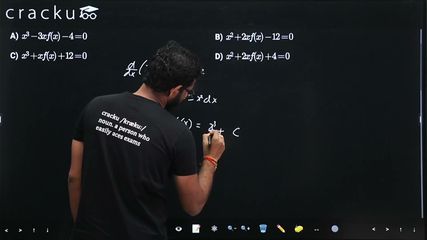
Let us consider a curve, $$y = f(x)$$ passing through the point $$(-2, 2)$$ and the slope of the tangent to the curve at any point $$(x, f(x))$$ is given by $$f(x) + xf'(x) = x^2$$. Then
We are told that the curve satisfies the differential relation $$f(x)+x\,f'(x)=x^{2}.$$
First, we rewrite it so that the coefficient of $$f'(x)$$ is 1. Dividing every term by $$x$$ (we assume $$x\neq 0$$ while differentiating), we obtain
$$f'(x)+\frac{1}{x}\,f(x)=x.$$
This is a linear first-order differential equation of the standard form
$$y'+P(x)\,y=Q(x),$$
where here $$y=f(x),\; P(x)=\dfrac{1}{x},\; Q(x)=x.$$
For such an equation, the integrating factor is defined by
$$\mu(x)=e^{\int P(x)\,dx}.$$
We calculate the integral of $$P(x):$$
$$\int \frac{1}{x}\,dx=\ln|x|.$$
Hence
$$\mu(x)=e^{\ln|x|}=|x|.$$
For simplicity we take $$\mu(x)=x$$ (the sign has no effect on the integration that follows). Multiplying the entire differential equation by this integrating factor, we get
$$x\,f'(x)+f(x)=x^{2}.$$
Now observe that the left‐hand side is precisely the derivative of the product $$x\,f(x)$$ with respect to $$x$$, since
$$\frac{d}{dx}\bigl[x\,f(x)\bigr]=x\,f'(x)+f(x).$$
Therefore the differential equation reduces to the very simple form
$$\frac{d}{dx}\,[x\,f(x)]=x^{2}.$$
We integrate both sides with respect to $$x$$:
$$x\,f(x)=\int x^{2}\,dx=\frac{x^{3}}{3}+C,$$
where $$C$$ is the constant of integration. Solving for $$f(x)$$ gives
$$f(x)=\frac{x^{2}}{3}+\frac{C}{x}.$$
The curve passes through the point $$(-2,\,2)$$, so we substitute $$x=-2$$ and $$f(x)=2$$ to find $$C$$:
$$2=\frac{(-2)^{2}}{3}+\frac{C}{-2}=\frac{4}{3}-\frac{C}{2}.$$
Clearing denominators by multiplying every term by $$6$$:
$$12=8-3C.$$
Thus
$$3C=-4\;\Longrightarrow\;C=-\frac{4}{3}.$$
We now insert this value back into the expression for $$f(x)$$:
$$f(x)=\frac{x^{2}}{3}-\frac{4}{3x}.$$
To eliminate the denominators, multiply both sides by $$3$$:
$$3\,f(x)=x^{2}-\frac{4}{x}.$$
Next multiply every term by $$x$$ to remove the remaining fraction:
$$3x\,f(x)=x^{3}-4.$$
Finally, bring all terms to one side to obtain a purely algebraic relation between $$x$$ and $$f(x)$$:
$$x^{3}-3x\,f(x)-4=0.$$
This matches the expression given in Option A. None of the other options coincide with the derived relation.
Hence, the correct answer is Option A.
Was this solution helpful?
Click on the Email ☝️ to Watch the Video Solution
Create a FREE account and get:
_1.webp)

Educational materials for JEE preparation

Ask our AI anything

AI can make mistakes. Please verify important information.
AI can make mistakes. Please verify important information.
